

| Major U.S. network owners | 3 (AT&T, T-Mobile, Verizon) (All other carriers lease from these three) |
| 5G band types | 3 (low-band, mid-band, mmWave) (Each has different speed and range trade-offs) |
| Typical soft data cap before deprioritization | 50-100 GB on most unlimited plans (Varies by plan tier and carrier) |
| eSIM adoption | Standard on most flagship phones since 2022 (Physical SIM trays removed from some models) |
| Autopay discount range | $5-$10 per line per month (Common across major U.S. carriers) |
Why Carrier Language Feels Confusing (and Isn't Accidental)
Wireless carriers communicate through a dense mix of technical abbreviations, trademark terms, and marketing-speak that often blurs important distinctions. Words like "unlimited," "5G," and "nationwide" carry legal definitions that differ from their everyday meanings - and carriers know that ambiguity works in their favor.
This glossary cuts through that language. Whether you're comparing plans, disputing a charge, or trying to understand your phone's status bar, the terms below are the ones that directly affect your experience and your bill. For context on how the same kind of jargon appears with home internet, see our ISP jargon glossary.
Throttling
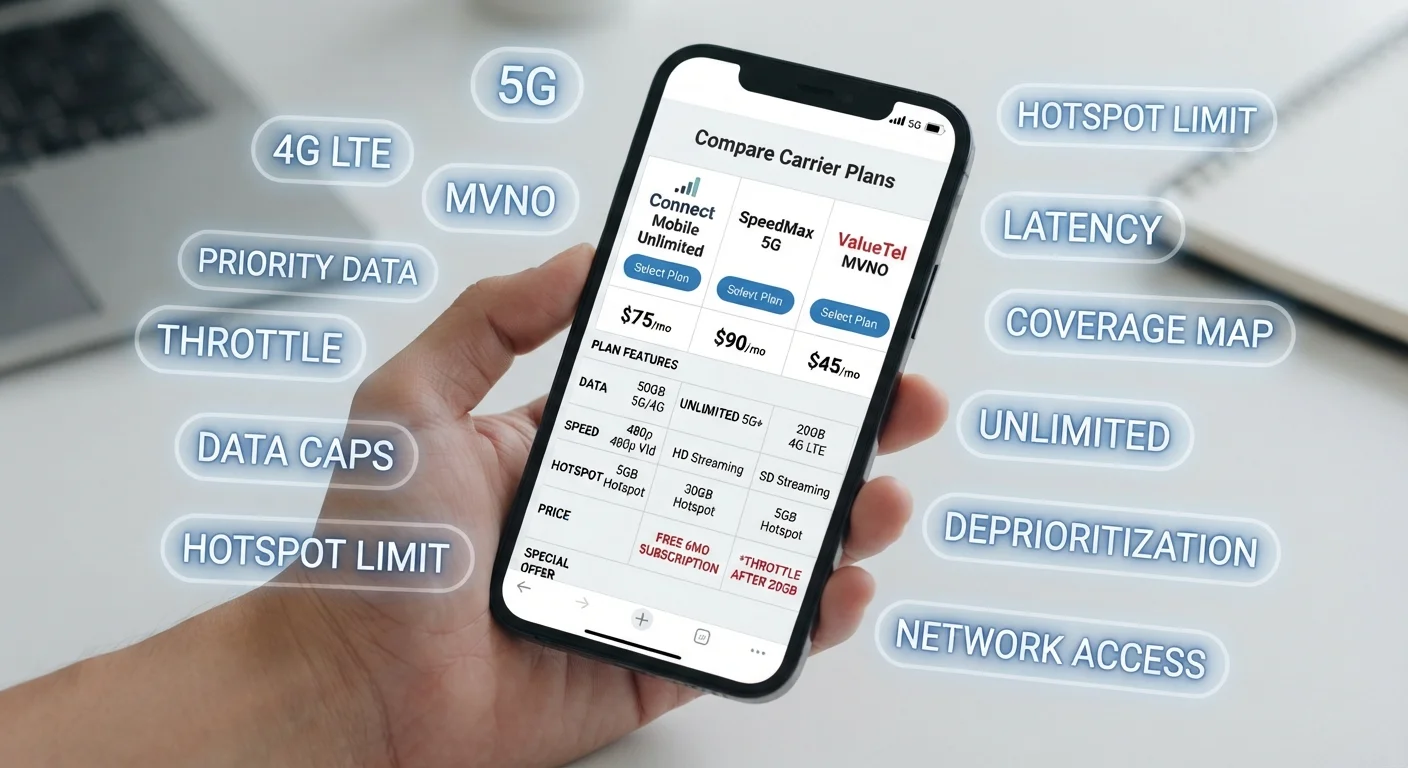
A deliberate slowdown of your data speeds by the carrier, typically triggered after you exceed a set data threshold or during network congestion. Throttled speeds can drop significantly - sometimes to 2G-era rates - making video streaming or navigation sluggish.
MVNO
Mobile Virtual Network Operator. A carrier that resells wireless service by leasing network access from a major carrier rather than owning its own towers. MVNOs often offer lower prices but may receive lower data priority during congestion.
Deprioritization
A network management practice where, during congestion, subscribers on certain plans are temporarily given slower speeds to make room for higher-priority customers. Unlike hard throttling, deprioritization only slows you down when the network is busy.
Hotspot
A feature that lets you share your phone's cellular data connection with other devices - laptops, tablets, or other phones - via Wi-Fi. Plans often specify a separate, lower data cap for hotspot usage.
SIM Card
A small chip - or now an embedded software profile called an eSIM - that identifies your device and account on the carrier's network. Swapping SIM cards is how many people switch carriers without buying a new phone.
Carrier Lock
A software restriction that prevents a phone from working on another carrier's network. Carriers typically unlock phones after account requirements (like paying off the device) are met.
5G UC / 5G UW / 5G+
Carrier-specific branding for mmWave or mid-band 5G - the faster but shorter-range flavor of 5G connectivity. These labels appear in your status bar but their meaning varies by carrier and location.
Autopay Discount
A monthly bill reduction offered when you enroll in automatic payments, usually via bank account or debit card. The discount typically does not apply if you pay by credit card.
Roaming
Using your carrier's service while connected to a partner network outside your carrier's coverage area - often internationally, but sometimes domestically in rural areas. Roaming can trigger extra charges depending on your plan.
Line Access Fee
A per-device charge added to your monthly bill in addition to the plan's base price. Multi-line family plans often reduce this fee per line, which is a major driver of bundled plan marketing.
eSIM
An embedded SIM built directly into the phone's hardware. Instead of inserting a physical card, you download a carrier profile digitally - making it easier to switch carriers or hold two numbers on one device.
Premium Data
A data tier on some plans that receives highest network priority and is not subject to deprioritization. Once premium data is exhausted, your remaining data may still work but at lower priority.
The Terms That Show Up on Your Bill
Several charges on a typical wireless bill have names that obscure what they actually represent. Understanding them helps you spot errors, identify negotiable fees, and compare plan costs accurately.
| Major U.S. network owners | 3 (AT&T, T-Mobile, Verizon) (All other carriers lease from these three) |
| 5G band types | 3 (low-band, mid-band, mmWave) (Each has different speed and range trade-offs) |
| Typical soft data cap before deprioritization | 50-100 GB on most unlimited plans (Varies by plan tier and carrier) |
| eSIM adoption | Standard on most flagship phones since 2022 (Physical SIM trays removed from some models) |
| Autopay discount range | $5-$10 per line per month (Common across major U.S. carriers) |
Line access fees are separate from the plan's advertised price and can add $20-$40 per device. Multi-line discounts reduce this, which is why carriers push family bundles heavily. Autopay discounts are real savings, but read the fine print - many apply only to bank account or debit payments, not credit cards.
Device installment plans are loans, not leases. The phone's cost is divided across 24 or 36 months and added to your bill as a separate line item. Paying off the device early typically allows you to request an unlock. For more on how locking and unlocking works, see our explainer on carrier-locked phones.
If you want to understand which of these charges are actually negotiable, our guide to climbing phone bills walks through the specifics.
Network Terms That Affect Your Speeds
"Unlimited" data plans almost universally include speed limits - they just go by different names. Throttling is a hard speed cap applied after a data threshold. Deprioritization is softer: your connection slows only when the tower you're connected to is congested, then returns to normal when traffic clears.
Coverage Maps Aren't the Whole Story
Terms like '5G nationwide' or 'extended coverage' on a carrier's map often blend multiple network types - including slower low-band 5G - into a single color. A shaded area doesn't guarantee fast speeds. For a deeper look at how to read these maps critically, see our guide to carrier coverage maps.
Premium data is the tier that skips deprioritization entirely. Higher-tier unlimited plans often include 50-100 GB of premium data before any slowdown kicks in. Once that allotment is used, your remaining data is still available but may slow during busy periods.
The label in your phone's status bar - "5G UC," "5G UW," or "5G+" - tells you which flavor of 5G you're connected to. These proprietary badges indicate mid-band or mmWave connections, which offer faster speeds but limited range. Low-band 5G, which covers most of the "5G nationwide" footprint on coverage maps, is often only marginally faster than 4G LTE. Our 5G explainer breaks down exactly what each band delivers in practice.
Hotspot data is another term worth watching. Even on plans with large premium data buckets, hotspot usage is often capped separately at a lower amount - and may be throttled to very slow speeds once that cap is reached.
SIMs, MVNOs, and Switching Without the Confusion
A SIM card - physical or embedded (eSIM) - is your identity on the network. Most modern smartphones support eSIM, which lets you switch carriers by downloading a new profile rather than swapping hardware. Some phones support dual SIM, allowing you to maintain two numbers or two carrier connections simultaneously.
MVNOs (Mobile Virtual Network Operators) lease capacity from the three major U.S. network owners - AT&T, T-Mobile, and Verizon - and resell it under their own brand, often at lower prices. The trade-off is typically lower data priority during congestion. Since MVNOs don't own infrastructure, they can't influence how the host carrier manages its network during busy periods. Learn more about how MVNOs work before deciding if one fits your needs.
Number portability is your legal right to keep your phone number when switching carriers. Initiating a port-out from your new carrier - rather than canceling with the old one first - is the standard process. Canceling first can sometimes forfeit the number.
Understanding these terms won't just help you read a plan page - it gives you the vocabulary to ask the right questions before signing any agreement.