

Key Takeaways
Our Verdict
Cabin and engine air filters are both essential, but they guard completely separate systems. Neglecting either one creates different problems - reduced air quality inside the cabin or degraded engine performance. Checking both on a regular schedule is one of the simplest ways to maintain a healthy, efficient vehicle.
| Best for | Recommended |
|---|---|
| Drivers concerned about air quality and allergens inside the car | Prioritize cabin air filter replacement |
| Drivers noticing reduced fuel economy or sluggish acceleration | Inspect the engine air filter first |
| Anyone wanting a simple, affordable maintenance win | Replace both filters on schedule |
What Each Filter Actually Does
Both filters clean air, but they serve entirely separate purposes in your vehicle's operation.
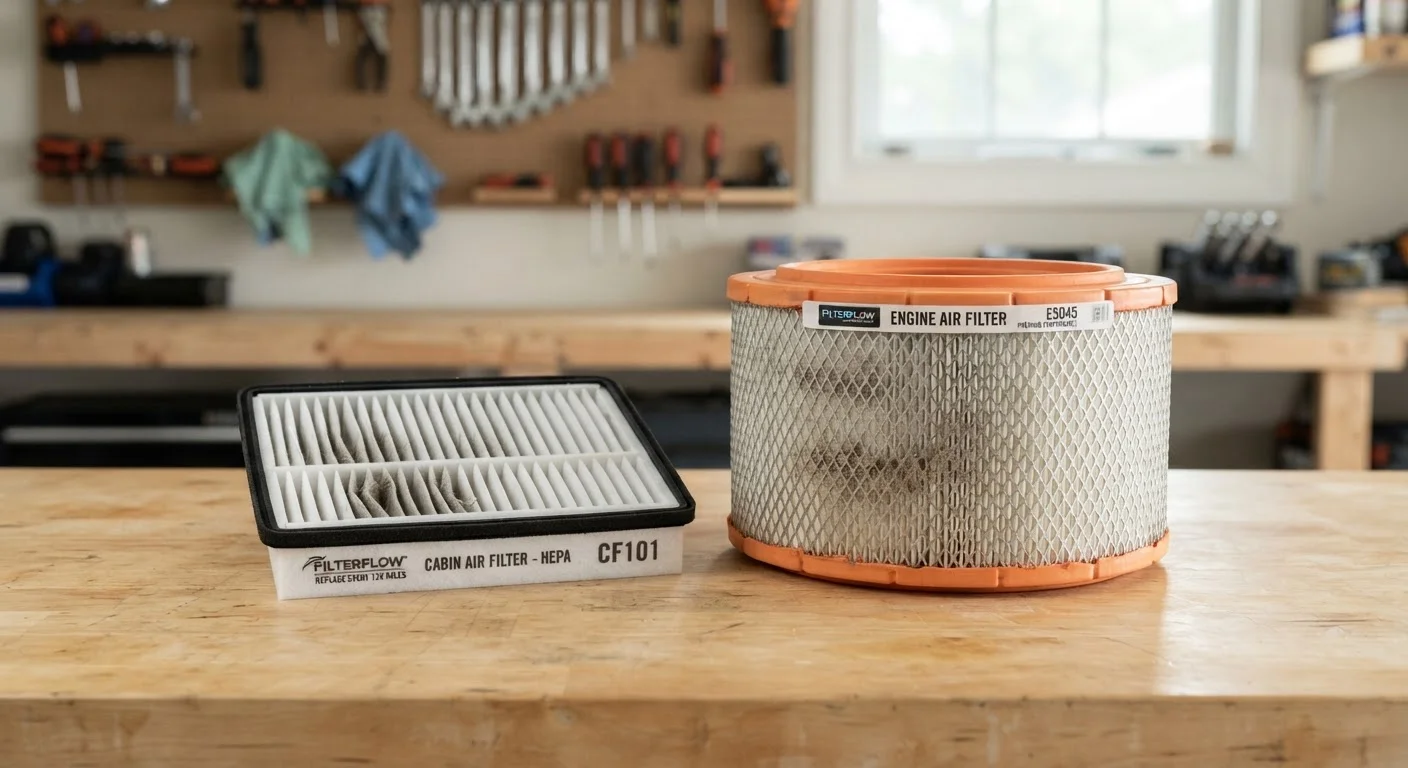
The cabin air filter sits inside the HVAC (heating, ventilation, and air conditioning) system. Its job is to trap dust, pollen, mold spores, exhaust particles, and other airborne contaminants before they enter the passenger compartment through your vents. Think of it as the filter protecting the air your lungs encounter while driving.
The engine air filter, by contrast, is positioned at the entry point of the engine's air intake system. Combustion engines need a precise mix of air and fuel to run. The engine air filter removes dirt, debris, and fine particles from the incoming air before it reaches the engine, preventing abrasive material from grinding away internal engine components.
In short: one protects people, the other protects the powertrain. Both matter, but for very different reasons.
Signs Each Filter Needs Attention
Because these filters work in different systems, they show wear in different ways.
Cabin Air Filter Warning Signs
- Weak or reduced airflow from dashboard vents even at high fan settings
- Musty or unpleasant odors when the heat or A/C is running
- Increased dust accumulation on interior surfaces
- Allergy symptoms worsening during drives
Engine Air Filter Warning Signs
- Noticeably reduced fuel efficiency (miles per gallon dropping)
- Sluggish throttle response or hesitation when accelerating
- The check engine light appearing in some vehicles when airflow is severely restricted
- Visibly dark, dirty, or clogged filter material on inspection
| Cabin Air Filter | Engine Air Filter | |
|---|---|---|
| What it protects | Passenger compartment air quality | Engine combustion and internals |
| Location | Behind glove box or under dash | Engine air box near intake |
| Typical replacement interval | 12,000-15,000 miles | 15,000-30,000 miles |
| Key warning signs | Weak airflow, musty odors, more dust | Lower MPG, sluggish acceleration |
| DIY accessibility | Usually tool-free on most models | Simple, often just clips or screws |
| Impact of neglect | Poor cabin air, allergy aggravation | Reduced engine efficiency and performance |
It's worth noting that neither filter announces itself clearly - many drivers go well past the recommended interval simply because the symptoms are gradual. That's why scheduled inspections matter more than waiting for something obvious to go wrong. See commonly overlooked maintenance tasks for more items that quietly cause problems.
Replacement Intervals: What the General Guidance Says
Replacement intervals vary by vehicle, driving conditions, and environment - always check your owner's manual for the manufacturer's recommendation. That said, general industry guidance provides a useful starting point.
Cabin air filters are commonly replaced every 12,000 to 15,000 miles, or roughly once a year for average drivers. Drivers in high-pollen areas, near heavy construction, or in cities with significant air pollution may need to replace them more frequently.
Engine air filters are typically replaced every 15,000 to 30,000 miles under normal driving conditions. Vehicles driven frequently on unpaved or dusty roads may require shorter intervals because the filter loads up with particles more quickly.
Make Filter Checks Part of Your Oil Change Routine
Many drivers tie filter inspections to oil changes - a practical habit since the hood is already open and a technician is already under the dash area. Even if you don't replace both filters every visit, a visual check costs nothing and can catch a filter that's due. Ask your service advisor to show you the current condition of each filter so you can make an informed decision.
One easy habit: inspect both filters at every oil change. Many service centers will check them automatically, but it's smart to ask and to look yourself - a visual check takes seconds and can prevent a neglected filter from becoming a real problem.
DIY or Professional Replacement?
Both filters are among the more accessible maintenance items on most modern vehicles, though ease of access varies by make and model.
Cabin air filters are usually located behind the glove box or under the dashboard on the passenger side. On many vehicles, replacement involves releasing a few clips and sliding the filter out - no tools required. Some models route the filter through the engine compartment instead, which can be slightly less convenient.
Engine air filters are housed in a plastic air box near the top of the engine and are generally straightforward to access. In most cases, a screwdriver or simple clip release is all that's needed.
That said, if you're unsure about any step, or if your vehicle's layout makes access difficult, having a qualified mechanic handle the replacement is always a sound choice. Incorrectly seated filters - particularly on the engine side - can allow unfiltered air into sensitive components, which defeats the purpose entirely.
Keeping both filters fresh is a low-cost habit that pays off in comfort and performance. If you're building out a broader maintenance routine, other commonly skipped maintenance items are worth reviewing as well.