

Key Takeaways
Start here
Why a Monthly Budget Matters
Next
Step 1: Calculate Your Real Take-Home Income
Then
Step 2: List and Categorize Your Expenses
Choose your method
Step 3: Choose a Budgeting Framework
Put it together
Step 4: Assign Every Dollar a Job
Stay on track
Keeping Your Budget on Track
Why a Monthly Budget Matters
A budget is not a restriction on your freedom - it is a description of your priorities. Without one, money tends to disappear in ways that are difficult to explain at the end of the month. With one, every dollar has a destination, and trade-offs become visible and deliberate.
The month is the natural unit for personal finances because most bills, rent or mortgage payments, and paychecks run on a monthly cycle. Starting with a monthly framework makes it easy to compare what came in against what went out. If you have ever reached mid-month and wondered where your paycheck went, a monthly budget is exactly the tool that answers that question - before it becomes a problem.
This guide walks through the process from the ground up, with no assumed experience and no need for expensive software.
Step 1: Calculate Your Real Take-Home Income
Your budget must be built on net income - the amount that actually arrives in your bank account after taxes, Social Security contributions, health insurance premiums, and any other automatic deductions. Using your gross (pre-tax) salary will cause you to plan for money you never actually receive.
Add up all reliable monthly income sources: wages from employment, freelance income, side work, rental income, and any regular government benefits. If your income varies, use a conservative estimate - the average of your three lowest recent months is a reasonable starting point. Variable-income earners especially benefit from building a small buffer into their estimates.
Net income
The amount of money you actually receive after all taxes and deductions have been taken out - what lands in your bank account.
Fixed expense
A bill or payment that is the same amount every month, such as rent or a car loan, making it predictable and easier to plan around.
Variable expense
A spending category where the amount changes from month to month, such as groceries, gas, or dining out.
Zero-based budgeting
A method where you assign a specific purpose to every dollar of income so that your total income minus total planned spending equals zero.
50/30/20 rule
A budgeting guideline that splits net income into three groups: 50% for needs, 30% for wants, and 20% for savings and debt payoff.
Irregular expense
A cost that does not occur every month - such as an annual insurance premium or holiday gifts - that still needs to be planned for in a monthly budget.
Step 2: List and Categorize Your Expenses
Pull up two or three months of bank and credit card statements. Go through each transaction and sort expenses into two buckets:
- Fixed expenses - amounts that stay the same each month, such as rent, car payments, loan minimums, and insurance premiums.
- Variable expenses - amounts that fluctuate, such as groceries, dining out, utilities, gas, and entertainment.
Do not guess. Actual transaction data will almost always reveal spending in categories you had not consciously tracked - subscriptions, convenience fees, and impulse purchases are common surprises. Also account for irregular expenses: annual fees, car registration, holiday gifts, and seasonal bills. Divide their annual total by 12 so they appear as a monthly line item rather than an occasional shock.
For households also thinking about larger purchases - such as a vehicle - see our car-buying guidance for how to factor those costs into a long-term plan.
Step 3: Choose a Budgeting Framework
A framework gives your budget structure without requiring you to invent rules from scratch. Two approaches suit most beginners:
- The 50/30/20 Rule
- Allocate roughly 50% of net income to needs (housing, utilities, groceries, minimum debt payments), 30% to wants (dining out, entertainment, hobbies), and 20% to savings and debt repayment above minimums. These are guidelines, not rigid law - your ratios will shift based on your cost of living and goals.
- Zero-Based Budgeting
- Assign a purpose to every single dollar so that income minus expenses equals zero. Nothing is left unaccounted for. This method demands more tracking effort but gives very precise control.
Our comparison article Zero-Based vs. 50/30/20 walks through each approach in depth to help you decide which fits your situation.
Start Simple, Then Refine
If choosing a framework feels overwhelming, start with the 50/30/20 rule for your first month. It requires far less tracking than zero-based budgeting and gives you a working plan quickly. After a month or two of real data, you can shift to a more detailed method if you want greater precision.
Step 4: Assign Every Dollar a Job
With your income total and expense list in hand, write out your budget allocations. Start with non-negotiable fixed expenses, then minimum debt payments, then a savings contribution - even a small one. Treat saving as a bill that must be paid, not a remainder. The pay-yourself-first approach formalizes this idea by automating savings before discretionary spending begins.
Once essentials and savings are covered, distribute what remains across variable categories. If the numbers do not balance - expenses exceed income - look first at variable categories for reductions. Cutting a fixed expense usually requires a longer-term change (moving, refinancing), while variable spending can often be adjusted immediately.
For more on connecting your budget to saving and debt goals, the Saving & Debt hub offers practical guidance across both areas.
Keeping Your Budget on Track
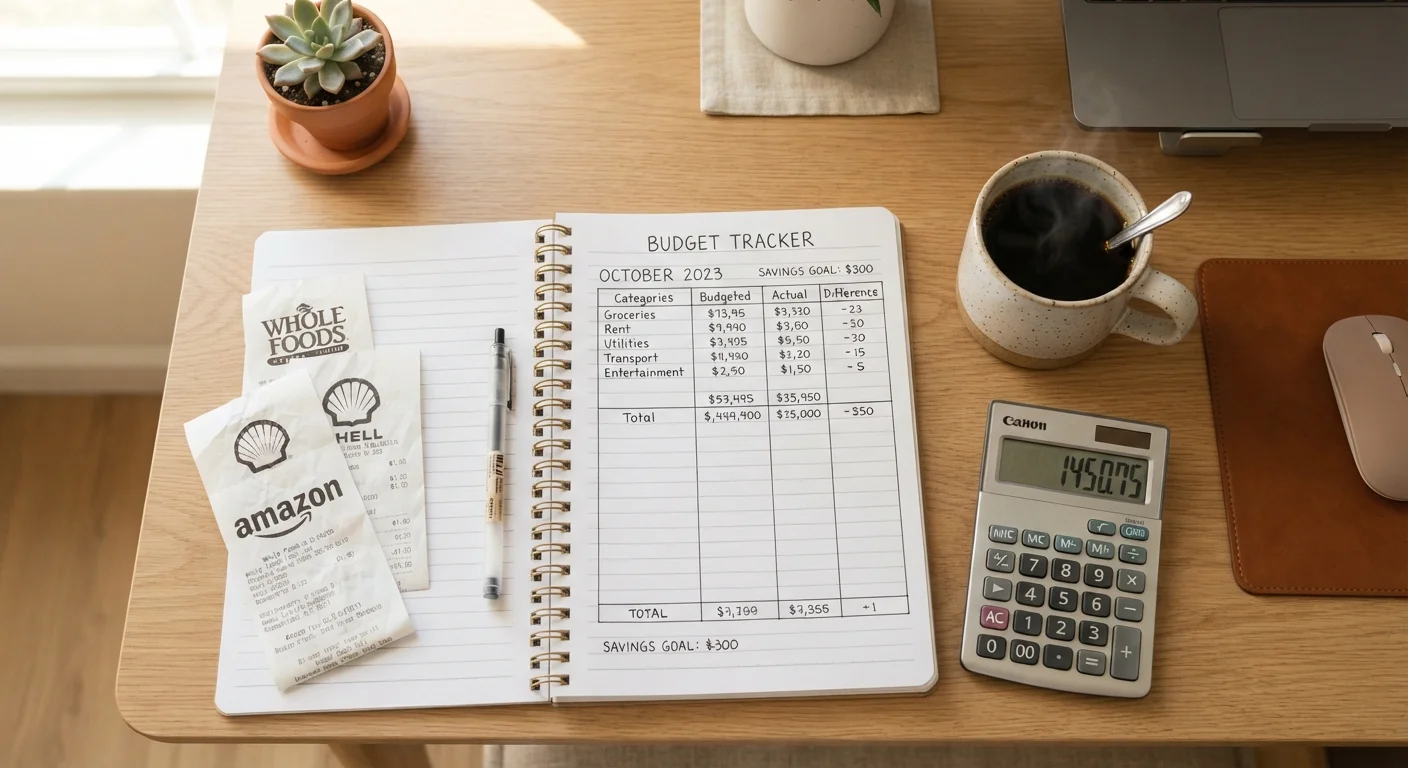
A budget written once and never reviewed has limited value. At the end of each month, compare your planned spending to your actual spending in every category. This single habit - called a budget review - is what separates people who improve over time from those who keep starting over.
Our Monthly Budget Reset Checklist provides a structured end-of-month routine to reconcile numbers and set up the following month cleanly. If you find your plan breaking down partway through the month, Why Your Budget Falls Apart by Week Two identifies the most common early failure patterns and how to address them.
Once your first budget feels stable, Building a Budget That Actually Holds Over Time covers how to adapt your plan as income, goals, and life circumstances change.
This article is for general informational and educational purposes only and does not constitute personalized financial advice. For guidance specific to your financial situation, consider consulting a qualified financial professional.