

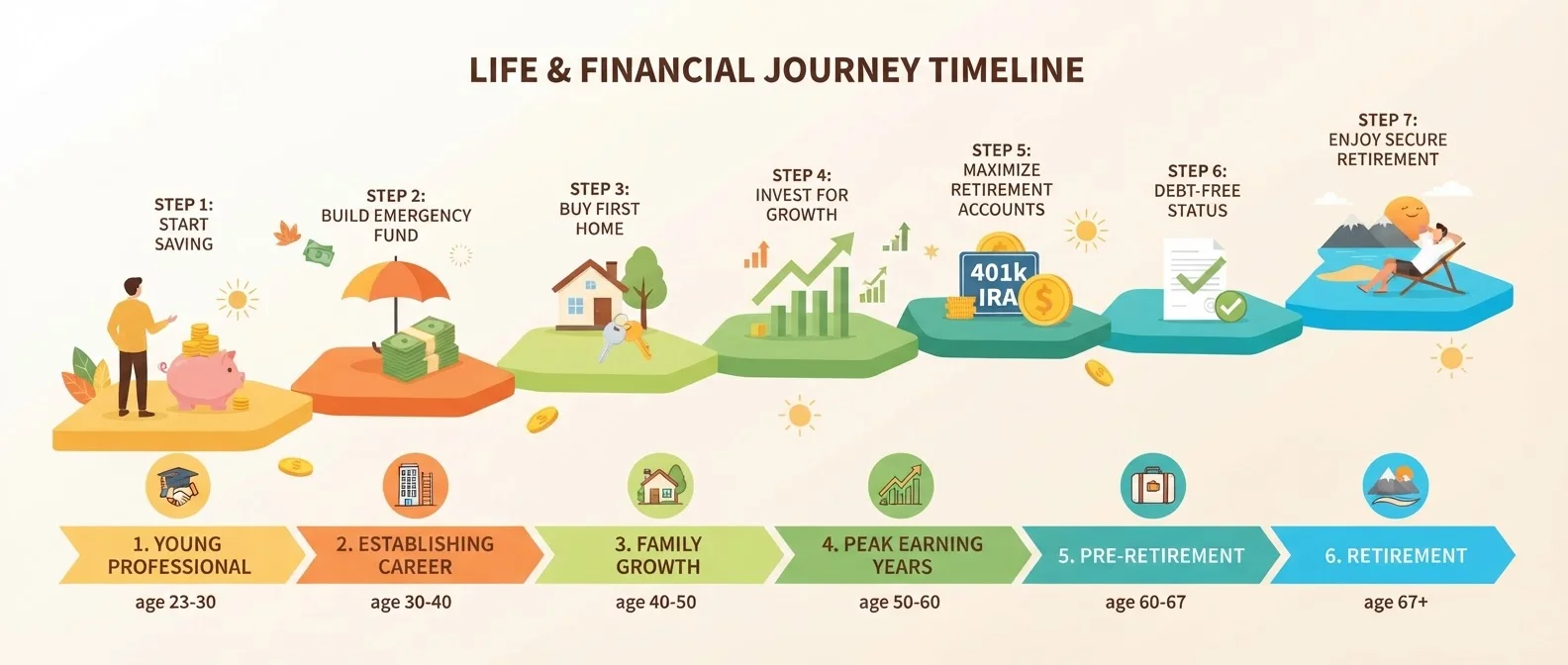
Key Takeaways
Why the Full Arc Matters
Most Americans think about retirement in fragments - a 401(k) enrollment form here, a Social Security statement there. But retirement planning is a continuous, interconnected process that spans an entire working life and extends well into your later years. Viewing it as a single arc, rather than a series of isolated decisions, changes how you prioritize every financial choice along the way.
Decisions made at 25 directly shape options available at 65. The account types you open, the contributions you make (or skip), and the debts you carry all compound - for better or worse - over time. This guide walks through each major life stage, the key financial tools available at each point, and how the phases connect. It is general financial education, not personalized advice; consult a licensed financial professional for guidance tailored to your situation.
For a broader look at how to plan around life's unexpected turns, see our guide to financial planning around life's unpredictability.
Early Career: Building the Foundation (Ages 22-35)
The most valuable asset in early career isn't income - it's time. Compound growth, the process by which investment returns generate their own returns, is most powerful over the longest time horizons. Even modest contributions made in your twenties can outpace much larger contributions started a decade later.
Core Account Types to Know
- 401(k) or 403(b): Employer-sponsored plans that allow pre-tax contributions, reducing taxable income today. Many employers match a portion of contributions - that match is effectively part of your compensation.
- Traditional IRA: An individual retirement account funded with pre-tax dollars (subject to income and eligibility rules), with taxes paid upon withdrawal in retirement.
- Roth IRA: Funded with after-tax dollars; qualified withdrawals in retirement are tax-free. Often advantageous when current tax rates are lower than expected future rates.
If your employer offers a match on your 401(k), contributing at least enough to capture the full match is a widely cited priority among financial planners - passing it up is leaving compensation on the table. After that, many people weigh whether to prioritize a Roth IRA for tax diversification.
Even if you can only contribute 1-2% of your salary initially, set up automatic annual increases of 1%. Most people don't notice the incremental reduction in take-home pay, but the compounding effect over 30+ years is substantial.
Behavioral finance research consistently shows that automatic escalation dramatically improves long-term savings rates because it removes the friction of repeated active decisions.
Open a Roth IRA early in your career even if you're also contributing to a 401(k). Tax diversification - having both pre-tax and after-tax retirement assets - gives you more flexibility to manage taxes in retirement.
Tax rates and rules change over time. Having withdrawal options across different tax treatments reduces your exposure to any single future tax scenario.
If you're also carrying high-interest debt, that balance is worth understanding before allocating every spare dollar to retirement. Our framework on debt payoff versus retirement contributions can help you think through the trade-offs.
Mid-Career: Accelerating and Adjusting (Ages 35-50)
By mid-career, income typically rises, and many people have more room to increase contributions. This is also when life complexity peaks: mortgages, children, career changes, and sometimes eldercare responsibilities all compete for cash flow.
Key Priorities in This Stage
- Increase contribution rates whenever income rises - automate increases to remove the decision from each paycheck.
- Review asset allocation periodically. A portfolio that made sense at 30 may carry too much or too little risk at 45. Most target-date funds adjust automatically, but individually managed portfolios require deliberate review.
- Account for life changes. Job changes, marriage, divorce, or a child's birth all warrant updating beneficiary designations on retirement accounts - an easy step that is frequently overlooked.
Mid-career is also a common point at which people revisit their retirement vision: What age do they realistically want to retire? What lifestyle do they anticipate? These questions shape how aggressively savings must grow. The Saving & Debt hub offers practical guidance on building savings momentum during demanding financial years.
Pre-Retirement: Fine-Tuning the Plan (Ages 50-65)
The decade or two before retirement is when planning shifts from accumulation to preparation. The IRS allows catch-up contributions for those 50 and older - in 2024, this means an additional $7,500 above the standard $23,000 limit for 401(k) plans, and an additional $1,000 above the standard $7,000 IRA limit. These figures are subject to periodic IRS adjustment, so verify current limits at IRS.gov.
Pre-Retirement Checklist
- Estimate projected retirement income from all sources: accounts, Social Security, any pension.
- Assess healthcare coverage gaps between retirement and Medicare eligibility at 65.
- Begin shifting asset allocation gradually toward lower-volatility holdings, though not so conservatively that growth stops entirely.
- Understand required minimum distributions (RMDs) - the IRS mandates withdrawals from most tax-deferred accounts starting at age 73 (as of current law).
This is also the time to stress-test your plan against scenarios like early retirement due to health, or a market downturn in the first years after leaving work. Sequence-of-returns risk - the danger of large early losses just before or after retirement - is one of the most underappreciated threats to a retirement portfolio's longevity.
Understanding Social Security
Social Security is a foundational piece of most Americans' retirement income, but it functions differently than many assume. Benefits are calculated based on your 35 highest-earning years, adjusted for wage inflation. The age at which you claim matters significantly.
- Claiming at 62 (the earliest option) permanently reduces your monthly benefit - by as much as 30% compared to your full retirement age (FRA) benefit.
- Claiming at full retirement age (66-67 for most people born after 1943) delivers your standard calculated benefit.
- Delaying past FRA, up to age 70, increases your benefit by roughly 8% per year - a guaranteed, inflation-adjusted return that is difficult to replicate elsewhere.
The optimal claiming age depends on health, other income sources, and whether a spouse's benefit is involved. There is no universal right answer. The Social Security Administration's online tools at ssa.gov allow you to model different scenarios using your own earnings record.
Many people also carry misconceptions about what Social Security will and won't cover. Our article on retirement planning myths addresses common misunderstandings that can quietly undermine long-term security.
The Drawdown Phase: Making Your Money Last
Accumulating retirement savings is only half the challenge. Turning a portfolio into reliable, lasting income - without depleting it too quickly - requires a deliberate drawdown strategy.
Common Withdrawal Frameworks
- The 4% guideline: A widely discussed starting point suggesting that withdrawing roughly 4% of a portfolio in the first year of retirement, then adjusting for inflation annually, has historically sustained portfolios for 30 years. This is a general heuristic, not a guarantee, and the appropriate rate varies by individual circumstances.
- Bucket strategy: Dividing assets into short-term (cash/bonds), medium-term, and long-term (equities) buckets based on when you'll need the funds - reducing the need to sell growth assets during downturns.
- Account sequencing: The order in which you draw from taxable, tax-deferred, and tax-free accounts affects your lifetime tax bill. Many financial planners suggest drawing from taxable accounts first, then tax-deferred, then Roth - but the optimal sequence depends on your specific tax situation.
Healthcare costs, longevity risk, and inflation are the three variables most likely to stress a drawdown plan. Planning for a 25-30 year retirement is increasingly common as life expectancy rises. A qualified financial adviser can help model these variables against your actual numbers.
This article is for general informational and educational purposes only and does not constitute personalized financial, tax, investment, or legal advice. Consult a licensed financial professional before making decisions about your retirement savings or income strategy.