

Key Takeaways
Our Verdict
Savings accounts and investment accounts are not rivals - they serve fundamentally different roles in a personal financial plan. A well-structured approach uses both: liquid savings for near-term needs and emergencies, and invested assets for goals that are years away. The right balance depends on your timeline, income stability, and existing debt obligations.
| Best for | Recommended |
|---|---|
| Those building an emergency fund or saving for a near-term goal | Short-term savings account |
| Those with a stable income, emergency fund in place, and goals 5+ years out | Long-term investment account |
| Those managing both current expenses and future financial security simultaneously | A deliberate split between savings and investing |
Two Tools, Two Jobs
Most people treat savings and investing as interchangeable terms for putting money aside. In practice, they operate very differently - and confusing the two can mean either taking on unnecessary risk or leaving long-term growth on the table.
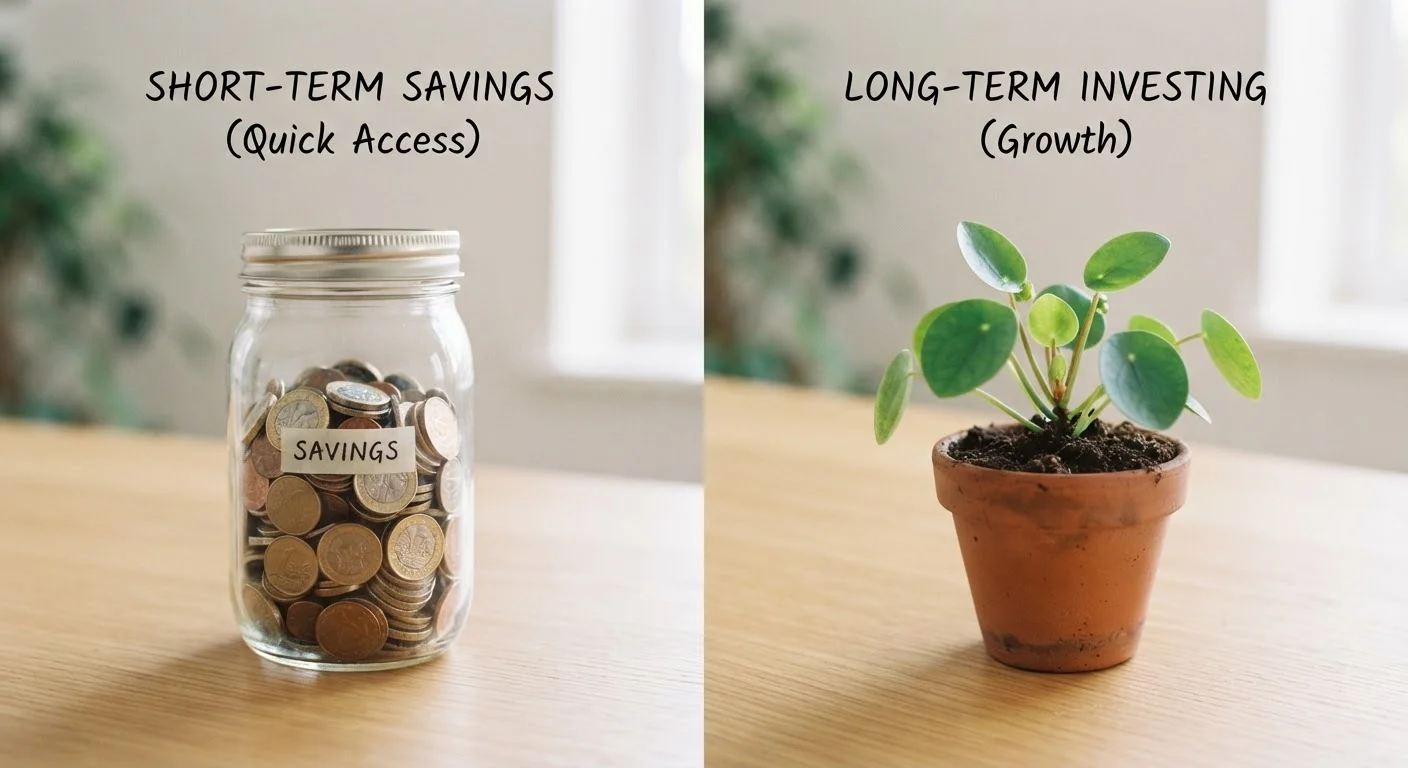
A savings account is a holding place. It keeps your money safe, accessible, and protected from loss. The trade-off is modest returns - high-yield savings accounts may offer more competitive interest rates than traditional accounts, but neither is designed to meaningfully outpace inflation over long periods.
An investment account - whether a brokerage account, a 401(k), or an IRA - is designed to grow money over time by accepting a degree of risk. Returns are not guaranteed, and the value of invested assets can fall as well as rise. What investments offer that savings accounts cannot is the potential for meaningful long-term growth, especially when compound returns have years to accumulate. See why compound interest rewards early starters for a closer look at the math behind that growth.
Comparing the Two Approaches
Understanding the practical differences helps clarify which tool belongs where in your financial life.
| Short-Term Savings | Long-Term Investing | |
|---|---|---|
| Primary purpose | Preserve and access money safely | Grow money over years or decades |
| Typical accounts | Savings, money market, CDs | Brokerage, 401(k), IRA, Roth IRA |
| Risk level | Very low; FDIC-insured up to limits | Variable; value can rise or fall |
| Liquidity | High; funds generally accessible quickly | Lower; early withdrawal may incur penalties |
| Return potential | Modest; tied to prevailing interest rates | Higher over time; not guaranteed |
| Best time horizon | Under 3 years | 5 or more years |
Liquidity - the ease with which you can access your money without penalty - is perhaps the most important variable. Savings are meant to be available. Investments are meant to be left alone long enough to grow. Withdrawing invested assets early, especially from tax-advantaged retirement accounts, often triggers penalties and taxes that erode returns significantly. You can explore those rules further in a plain-language breakdown of common retirement account types.
Building the Bridge: A Practical Sequence
Rather than an either/or decision, the gap between savings and investing is best bridged in a deliberate sequence that reflects your current financial situation.
- Cover immediate obligations first. High-interest debt - particularly credit card balances - typically carries costs that outpace any realistic investment return. Addressing this before directing money into investments is generally sound practice. A framework for splitting cash flow between debt and savings can help if you're managing both simultaneously.
- Establish a liquid emergency fund. Most financial guidance points to three to six months of essential expenses held in an accessible account. This buffer prevents you from having to liquidate investments - potentially at a loss - when unexpected costs arise.
- Begin investing for longer-term goals. Once a foundation of liquid savings is in place, directing additional surplus cash toward investment accounts allows time and compounding to work in your favor. Even modest, consistent contributions made over many years can accumulate substantially - though outcomes are never guaranteed.
If behavioral or structural barriers have made consistent saving difficult in the past, understanding what gets in the way can help you identify and address specific friction points.
Common Misconceptions Worth Addressing
Several widely held beliefs make this gap harder to bridge than it needs to be.
"I need a lot of money to start investing." Many investment accounts can be opened with small initial amounts, and fractional investing options have lowered the practical barrier further. The more consequential variable is time, not starting balance.
"My savings account is growing, so I'm covered." Savings accounts serve a vital purpose, but if inflation is running higher than the interest rate your account pays, the purchasing power of that money is slowly declining. Savings are not a substitute for investing toward goals that are years away. Common savings misconceptions - including the idea that you need to wait for the right moment - are worth reviewing if hesitation is holding you back.
"I'll start investing once things settle down." Financial life rarely reaches a permanent state of calm. A more useful framing is to start with whatever amount is realistic now, and increase contributions as circumstances allow. The tax treatment of the accounts you choose also matters - comparing Roth and Traditional IRA structures is a useful step when you're ready to look at retirement-specific options.
This article is for general informational and educational purposes only. It does not constitute personalized financial, investment, tax, or legal advice. Please consult a qualified financial professional before making decisions about your own financial situation.