

Key Takeaways
Option A
Debt Avalanche
The mathematically optimal, interest-minimizing approach.
Best for: Disciplined savers who want to minimize total interest paid and don't need frequent milestone wins to stay motivated.
Option B
Debt Snowball
The psychologically rewarding, momentum-driven method.
Best for: People who need visible progress and motivational wins to stay committed to a long-term debt payoff plan.
If you carry high-interest credit card debt and are financially disciplined
Debt Avalanche
High interest rates compound quickly. Attacking them first reduces the total amount you repay over time, which can amount to hundreds or thousands of dollars saved.
If you've struggled to stick with a debt payoff plan in the past
Debt Snowball
Eliminating smaller debts quickly gives you concrete wins that reinforce the habit. Behavioral consistency matters as much as mathematical efficiency.
If your debts carry similar interest rates but vary widely in balance size
Debt Snowball
When rates are comparable, the interest cost difference between methods shrinks, making psychological momentum the more meaningful factor.
If your debts are few, large, and carry significantly different interest rates
Debt Avalanche
With fewer accounts, the motivational gap between methods narrows, while the interest savings from targeting high-rate debt remain substantial.
If you're also trying to build savings alongside debt repayment
Debt Avalanche
Reducing interest faster frees up more cash flow over time, giving you more room to direct toward an emergency fund or savings goals.
How Each Strategy Works
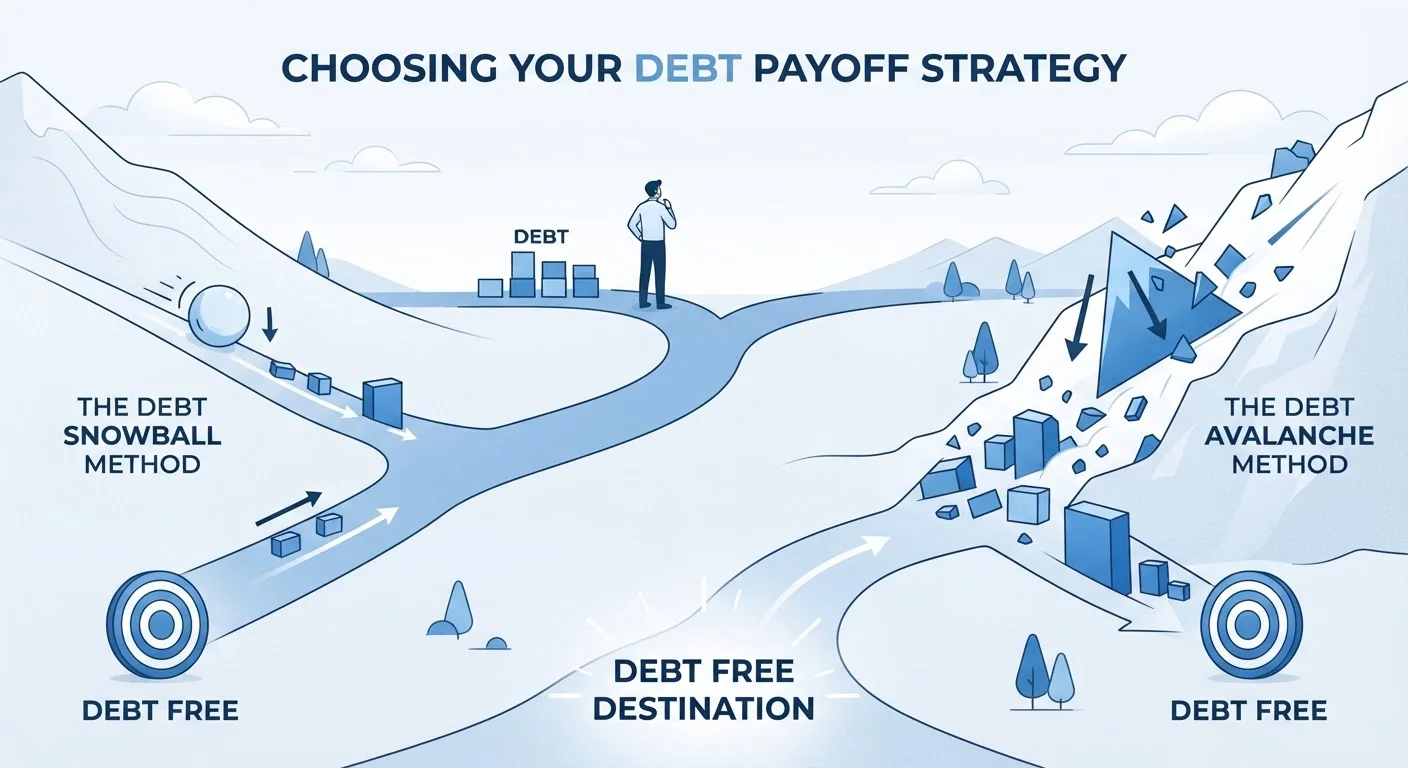
Both the debt avalanche and the debt snowball share the same core mechanic: you make minimum payments on all your debts, then direct any extra money toward one targeted account. The difference lies entirely in which debt you target first.
With the debt avalanche, you rank your debts from highest interest rate to lowest. Every extra dollar goes toward the account charging you the most interest. Once that debt is eliminated, you roll that payment into the next-highest-rate debt, and so on. This approach is the most cost-efficient - it shrinks the total interest you'll pay over the life of your debts.
With the debt snowball, you rank your debts from smallest balance to largest, regardless of interest rate. You attack the smallest debt first, pay it off, then redirect that freed-up payment to the next smallest. Each payoff generates a feeling of forward progress that can keep you engaged with the plan.
Both strategies assume you're committing a fixed extra amount each month - if you're unsure how to carve that out of your budget, budgeting basics can help you find the room. For a broader view of how debt repayment fits alongside savings, see our complete overview of the balancing act.
The Math vs. The Psychology
The avalanche method wins on pure arithmetic. Because it eliminates high-interest debt first, you pay less in total interest and typically become debt-free sooner - assuming you stay the course. The gap between methods can be significant when high-rate credit card debt is involved.
But staying the course is exactly where many people struggle. If your smallest debt has a low interest rate and your highest-rate debt is a large balance, the avalanche can feel slow for months or years before you eliminate a single account. That waiting period is where motivation tends to erode.
| Criterion | Debt Avalanche | Debt Snowball |
|---|---|---|
| Payoff order | Highest interest rate first | Smallest balance first |
| Total interest paid | Lower (mathematically optimal) | Higher (varies by situation) |
| Time to first payoff | Potentially longer | Faster (smallest balance gone first) |
| Motivational structure | Rewards patience and discipline | Rewards early, frequent wins |
| Best interest rate scenario | Wide spread between debt rates | Similar rates across debts |
| Recommended if... | You stay motivated without quick wins | You need visible progress to continue |
Research in behavioral economics has found that people are more likely to successfully pay off debt when they experience early wins. A widely cited study published in the Journal of Marketing Research found that focusing on eliminating individual accounts - rather than reducing aggregate balances - improved follow-through. This is the mechanism behind the snowball's effectiveness: it's not financially optimal, but it can be behaviorally optimal for many people.
The honest answer is that a strategy you abandon early costs more than a slightly less efficient strategy you maintain for years.
Choosing Based on Your Specific Situation
Rather than declaring one method universally superior, it's more useful to match the method to your circumstances. A few questions can help clarify the decision:
- How wide is the interest-rate spread across your debts? If one debt carries 24% APR and another carries 6%, the avalanche's savings are substantial. If all your rates cluster in the 15-18% range, the difference between methods shrinks considerably.
- How many accounts do you have? With two or three debts, the snowball's motivational advantage is less pronounced. With six or seven accounts, the quick wins become more meaningful for sustaining effort.
- What is your track record with financial commitments? Honest self-assessment matters here. If you've repeatedly started and abandoned debt payoff plans, the snowball's structure may be the catalyst you need.
It's also worth noting that neither method requires you to neglect saving entirely. Paying off debt while saving at the same time is feasible with either approach - the key is ensuring minimum payments are covered before splitting extra cash flow between debt and savings goals.
If your debt load is severe, you may also want to explore whether a different structural approach makes sense first. Debt consolidation can sometimes simplify multiple balances into a single payment before you apply either strategy.
Making Your Strategy Stick
Whichever method you choose, consistency is the variable that matters most. A few practical steps help either strategy succeed:
- List every debt with its current balance, minimum payment, and interest rate. This gives you a clear starting point and lets you apply either ranking system immediately.
- Automate your minimum payments so you never miss them while focusing extra resources on your target debt. Automating your finances removes the friction of remembering and reduces the risk of late fees derailing your progress.
- Protect a basic emergency fund first. Going all-in on debt repayment without any cash buffer can force you to take on new debt when unexpected expenses arise. Aggressively paying down debt can backfire when you have no financial cushion.
- Revisit your strategy periodically. Life changes - income, expenses, new debts - can shift which method makes more sense. A hybrid approach, starting with the snowball to eliminate one or two small accounts and then switching to the avalanche, is a legitimate option.
If retirement contributions are also competing for your extra dollars, a framework for debt payoff vs. retirement contributions can help you weigh those priorities without guesswork.
This article is for general informational purposes only and does not constitute personalized financial advice. Consult a licensed financial professional for guidance tailored to your specific situation.