

Key Takeaways
Why Exercise Needs Change With Age
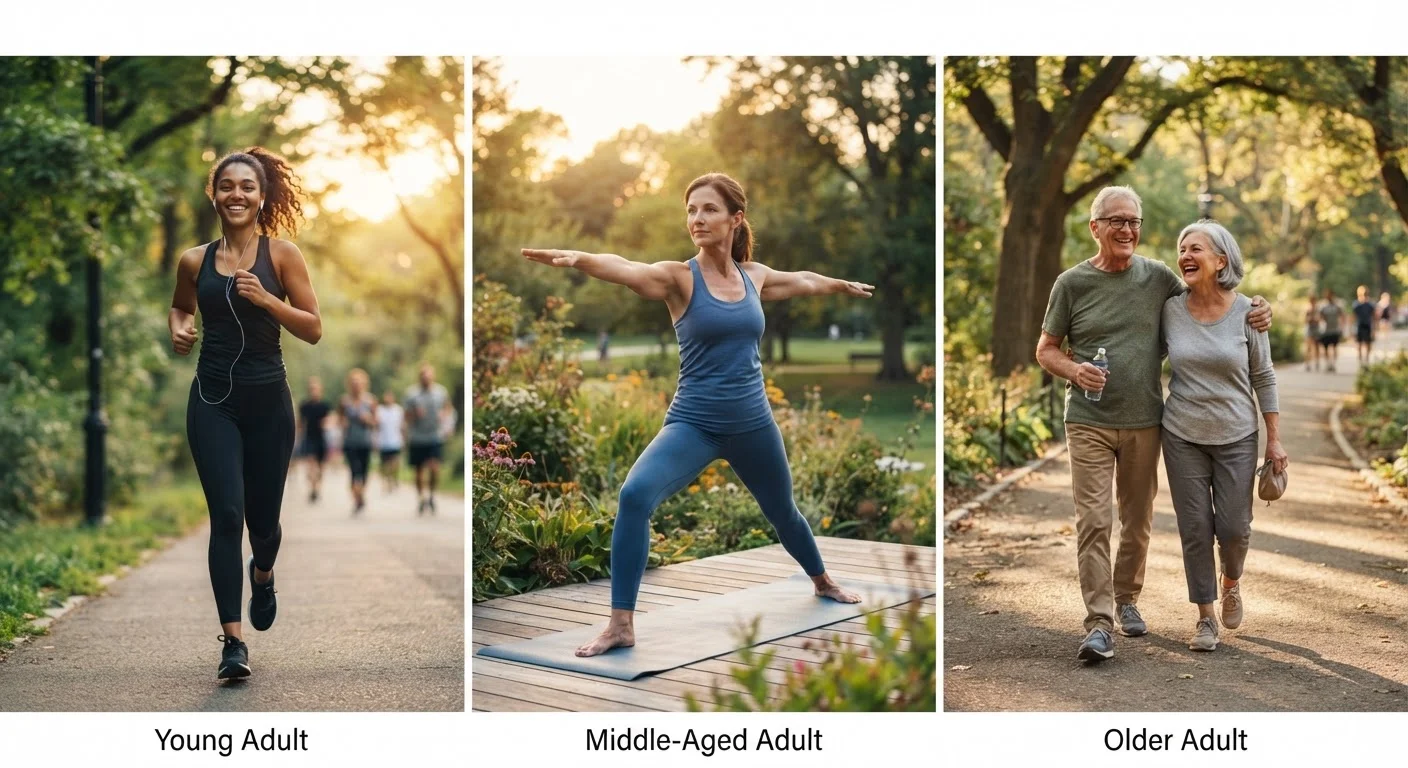
The human body is not a static machine. From your 20s onward, it undergoes measurable physiological changes - shifts in muscle mass, bone density, hormonal balance, cardiovascular efficiency, and recovery capacity - that directly influence what kinds of physical activity are most beneficial and how much your body can tolerate at any given time.
None of this means you become less capable with each decade. Rather, it means the emphasis of a smart fitness approach should evolve. Understanding that shift is the first step to staying active in a way that feels sustainable rather than punishing. For a primer on the vocabulary you'll encounter as you explore fitness at any age, see our plain-language fitness glossary.
This guide walks through the general considerations for each major life decade - not as rigid prescriptions, but as a framework to help you make informed choices. As always, individual health history, fitness level, and medical guidance should shape your specific approach.
Your 20s: Building a Foundation
The 20s are generally a period of peak physical capacity. Muscle-building responds efficiently to training, cardiovascular endurance adapts quickly, and recovery tends to be faster than at any later stage. This makes it an ideal decade to establish habits that will pay dividends for life.
Key priorities in this decade typically include building aerobic fitness through sustained activities like running, cycling, or swimming; developing functional strength through resistance training; and learning how to move well - with good form and body awareness - before adding significant load or intensity.
Prioritize mobility work in your 20s, even if you feel flexible. Dedicate at least 10 minutes after every session to deliberate stretching or joint-range movements.
Movement patterns established early are difficult to reverse later; proactive mobility work reduces injury risk and supports better function across all subsequent decades.
In your 40s, treat your rest days as seriously as your training days - schedule them explicitly rather than letting them happen by accident.
Recovery capacity decreases gradually through midlife, and insufficient rest is one of the most common reasons people experience overuse injuries or burnout that derails consistency.
One underappreciated focus in the 20s is mobility. Many people this age assume flexibility isn't a concern yet, but the movement patterns and joint health you cultivate now set the stage for how your body moves at 45 and beyond. Incorporating regular stretching or yoga alongside other training is a worthwhile investment.
Your 30s and 40s: Staying Consistent Through Life's Demands
For many Americans, the 30s and 40s bring competing priorities - careers, caregiving, family, and reduced sleep - that can squeeze exercise out of the schedule. Yet these are also the decades when maintaining regular activity becomes especially important, because age-related muscle loss (a process called sarcopenia) begins gradually in the 30s and accelerates without resistance training.
Strength training two to three times per week is widely recommended by exercise physiologists as a cornerstone habit for this age group. Cardiovascular fitness remains important for heart health and energy levels. Recovery, however, may take slightly longer than it did in the 20s - meaning that intensity should be balanced with adequate rest.
If your activity level has slipped, our guide on returning to movement after inactivity offers a thoughtful starting point. The goal in this decade is consistency over perfection - shorter, regular workouts outperform sporadic intense sessions.
Your 50s and 60s: Protecting What You've Built
The 50s and 60s are when many people notice more pronounced shifts: joints may feel less forgiving, hormonal changes (including menopause and declining testosterone in men) can affect muscle mass and bone density, and cardiovascular function may require more deliberate attention. These are real changes - but they are not reasons to scale back activity. Often, they are reasons to be more intentional about it.
Resistance training remains critical in this decade for preserving muscle and supporting bone health. Balance work - exercises that challenge your stability - becomes meaningfully important as a fall-prevention strategy. Low-impact cardiovascular activities like walking, swimming, and cycling allow you to maintain heart health while reducing stress on joints.
For context on what federal physical activity guidelines recommend for adults in this range, see our breakdown of what 150 minutes of activity looks like in practice.
Anyone beginning a new exercise program in their 50s or 60s, or managing chronic conditions, should consult a qualified healthcare provider first.
70s and Beyond: Movement for Longevity and Independence
Physical activity in the 70s and beyond is one of the most powerful tools available for maintaining independence, cognitive function, and quality of life. Research consistently shows that older adults who remain active experience better functional outcomes - meaning they can perform daily tasks more easily and maintain mobility longer.
The emphasis at this stage shifts toward functional fitness: exercises that mirror real-life movements like standing from a chair, carrying groceries, or climbing stairs. Balance training takes on heightened importance given that fall-related injuries are a leading cause of reduced independence in older adults. Resistance training, even with lighter loads and modified movements, continues to support muscle maintenance.
Gentle activities - tai chi, water aerobics, walking groups - can provide meaningful physical benefit while also supporting social connection, which is itself linked to better health outcomes. Movement doesn't need to be vigorous to be valuable.
Older adults with existing health conditions or significant mobility limitations should work with a healthcare professional or certified fitness specialist to develop a safe, individualized approach.
Principles That Apply at Every Age
Across all decades, a handful of principles hold steady. Consistency is more important than intensity - regular moderate activity outperforms occasional extreme effort. Progressive challenge matters - the body adapts when given gradually increasing demands, a concept known as progressive overload. And recovery is not optional - sleep, rest days, and stress management directly affect how well the body responds to exercise.
Exercise also intersects with mental wellness in meaningful ways at every life stage. Physical activity is associated with improved mood, reduced anxiety, and better cognitive health. For a broader look at how wellbeing evolves across the lifespan, see our overview of mental wellness across the lifespan.
The most effective fitness approach is one you'll actually sustain. That looks different for everyone - and it changes as you do.
This article is for general informational and educational purposes only and is not a substitute for professional medical advice. Consult a qualified healthcare provider before beginning or significantly changing any exercise program.