

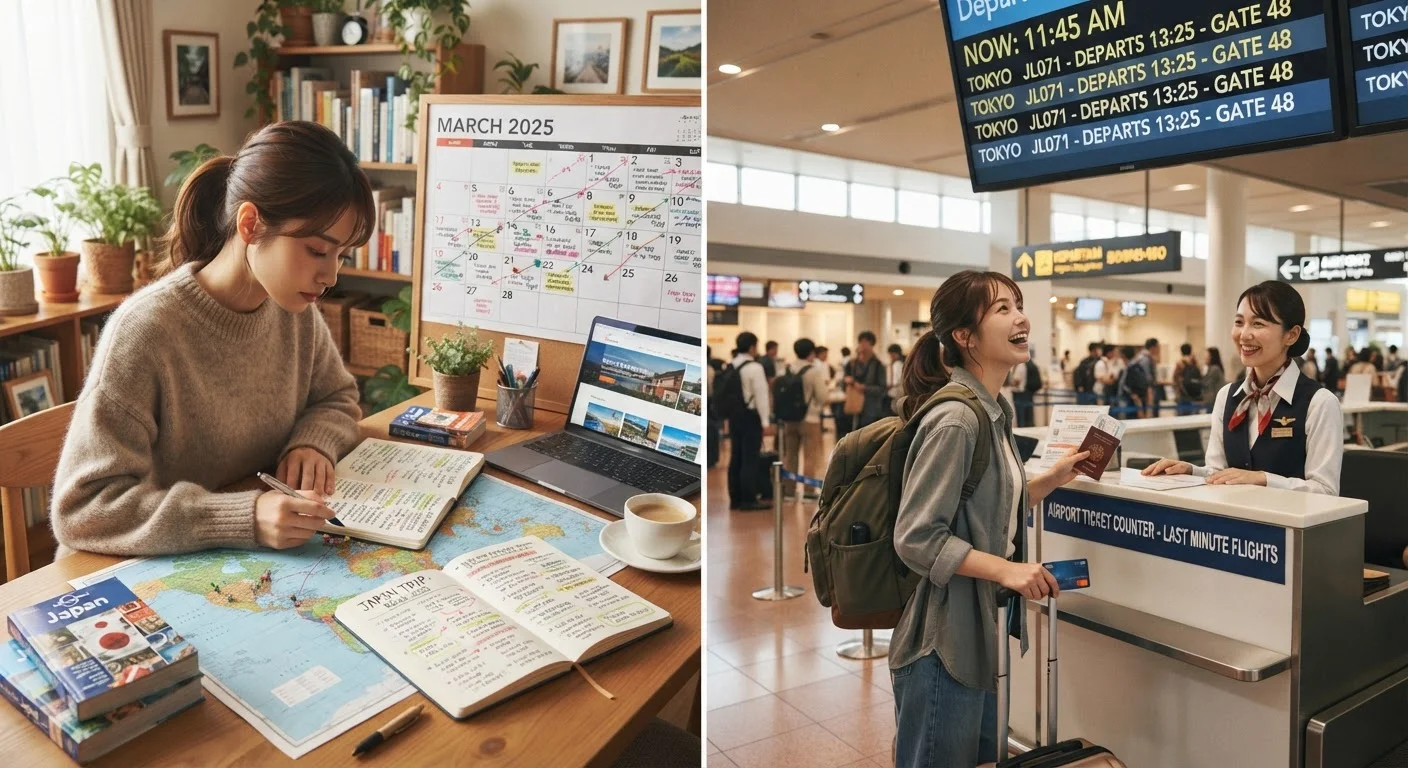
Key Takeaways
Option A
Planning Months Out
The methodical, maximize-your-options approach.
Best for: Travelers with specific destinations, fixed travel windows, groups, or must-have experiences that require advance reservations.
Option B
Booking Last Minute
The flexible, go-with-the-flow alternative.
Best for: Solo or paired travelers with flexible schedules, minimal must-dos, and a tolerance for uncertainty in exchange for potential deals or spontaneity.
If you're traveling with a group of three or more people
Planning Months Out
Coordinating schedules, securing multiple seats on the same flight, and booking accommodations large enough for a group becomes exponentially harder close to the departure date. See group trip planning guidance for more.
If you're a solo traveler with a fully open schedule
Booking Last Minute
One seat, one bed - the logistics are simpler, and you have the flexibility to adapt to wherever deals or availability lead you.
If your trip includes must-have experiences like national park permits or popular tours
Planning Months Out
High-demand activities and sites frequently sell out far in advance. Waiting puts you at real risk of missing the primary reason you wanted to visit.
If budget predictability matters more than the lowest possible price
Planning Months Out
Locking in flights and accommodation early lets you build a realistic budget and avoid the financial uncertainty that last-minute booking can introduce.
If you're comfortable with uncertainty and primarily want a change of scenery
Booking Last Minute
When the destination itself is secondary to the act of traveling, last-minute options can open doors to places you might not have otherwise considered.
What Each Approach Actually Means
"Planning months out" typically means researching and booking flights, accommodation, and key activities anywhere from three to six months before departure - sometimes longer for international or high-demand destinations. "Last-minute booking" generally refers to decisions made within two to four weeks of travel, though the definition shifts by context.
Neither label tells the full story. An early planner can still leave room for spontaneity on the ground, and a last-minute traveler can research efficiently once they've committed to a destination. The real difference lies in what trade-offs each approach forces you to accept - and which of those trade-offs you're prepared to live with. For a closer look at how itinerary structure plays into this, see flexible vs. fixed-schedule travel planning.
The Case for Booking Early
The strongest argument for advance planning is access. Popular flight routes fill up, boutique hotels sell out, and coveted dining reservations disappear - often months before peak season begins. Booking early doesn't just protect your preferences; it expands them. You're choosing from a full menu rather than whatever's left.
Early planning also tends to support more intentional budgeting. When you know your fixed costs - flights, lodging, ground transportation - you can allocate remaining funds to experiences and food without guessing. This is especially relevant for travelers working within a defined budget, as discussed in planning a trip on a tight budget.
International trips benefit most from lead time. Visas, vaccinations, and travel documentation requirements can take weeks to process. Always verify current entry requirements through official government sources well ahead of your planned departure.
| Criterion | Planning Months Out | Booking Last Minute |
|---|---|---|
| Flight selection | Wide choice of routes and times | Limited seats, often higher fares |
| Accommodation options | Full inventory available | Reduced choice, especially peak season |
| Budget predictability | Easier to plan fixed costs early | Costs harder to forecast in advance |
| Flexibility on the ground | Can feel constrained by bookings | More freedom to adapt day-to-day |
| Stress level during planning | Spread over months, generally lower | Compressed into days, can spike |
| Best for groups | Yes - essential for coordination | No - very difficult to align |
| International trips | Strongly recommended | Risky without visa/entry lead time |
| Potential for spontaneity | Lower if over-scheduled | High by nature |
The Case for Going Last Minute
Last-minute travel has a genuine upside: reduced overthinking. Fewer weeks of planning means less time to second-guess every decision, and constraints can actually simplify the process - you work with what's available rather than analyzing every option.
In some travel markets, unsold inventory does get discounted close to departure. This is more reliably true for certain cruise cabins and package trips than for domestic flights, where prices frequently rise as seats fill. The savings narrative around last-minute air travel is often overstated, particularly during holidays and peak seasons. Travelers drawn to cost efficiency may find better results considering shoulder season travel strategies instead.
For domestic trips with flexible accommodation needs - camping, road trips, or stays in less-touristed areas - last-minute planning carries far less risk. The calculus changes dramatically for major cities, popular national parks, and international destinations.
Where Each Approach Breaks Down
Early planners face a different kind of risk: over-commitment. Locking in a rigid schedule months ahead can leave you with a trip that looks great on a spreadsheet but falls apart when reality intervenes - delayed flights, unexpected closures, or simply underestimating how long things take. Why carefully planned itineraries fall apart is worth reading before you finalize any detailed plan.
Last-minute travelers, meanwhile, often underestimate stress. Scrambling for accommodation, accepting whatever seats are available, and navigating an unfamiliar destination without adequate research can turn spontaneity into anxiety quickly. The freedom is real - but so is the cognitive load.
A practical middle ground: book the non-negotiables early (flights, lodging, any timed entry or permits), and leave activities and dining flexible. This approach captures most of the upside from both strategies. For help structuring that balance, building a well-structured travel itinerary offers a useful framework.