

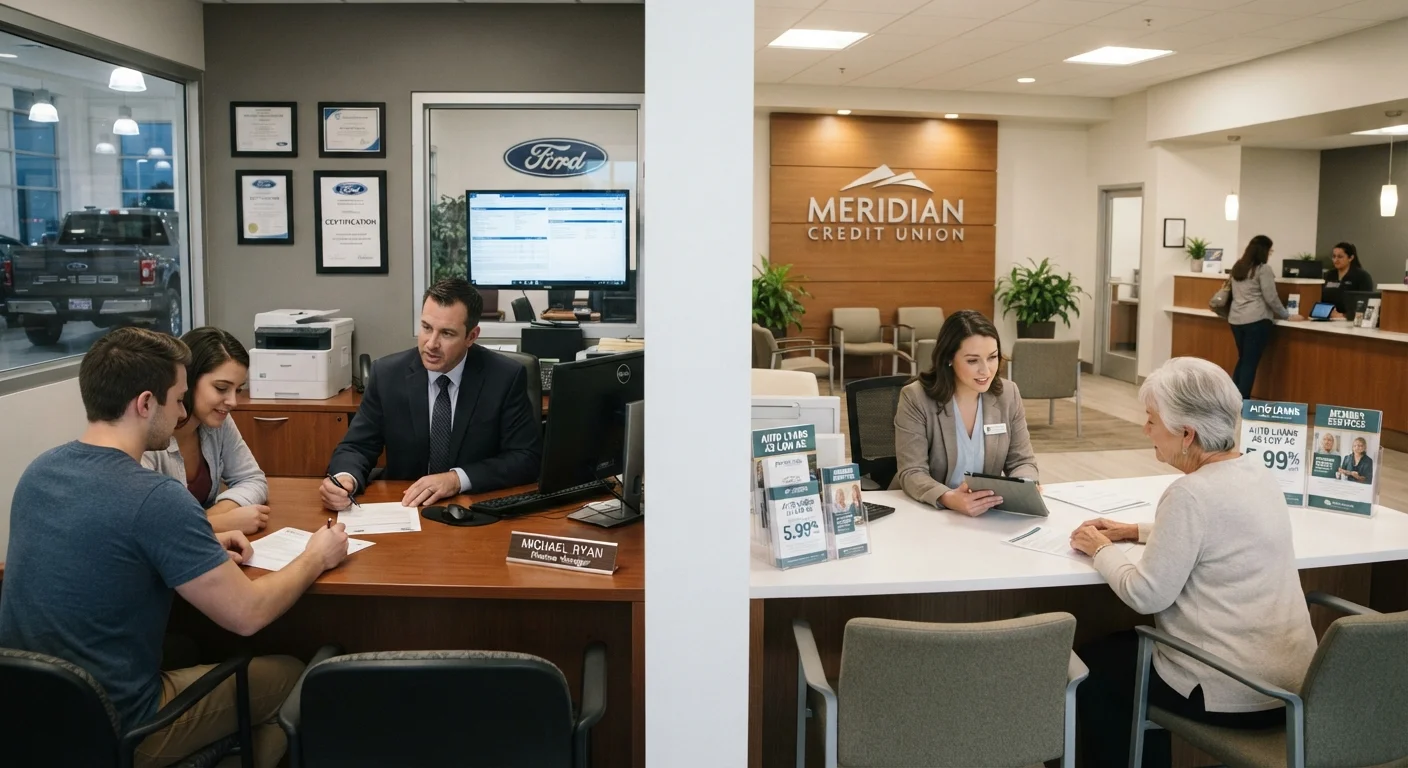
Key Takeaways
Option A
Dealer Financing
The convenient, all-in-one financing option at the point of sale.
Best for: Buyers who want a streamlined purchase experience and may qualify for manufacturer-sponsored promotional rates.
Option B
Bank or Credit Union Financing
The independent, shopper-controlled borrowing route.
Best for: Buyers who want to compare rates in advance, negotiate from a stronger position, and minimize total loan cost.
If you qualify for a 0% or sub-2% promotional APR through the manufacturer
Dealer Financing
Promotional rates sponsored by automakers can be genuinely hard to beat. Read the fine print carefully, as these deals often restrict loan term length and require excellent credit.
If you want the most control over your interest rate and loan terms
Bank or Credit Union Financing
Securing a pre-approval before stepping into a dealership means you know your rate ceiling and can compare any dealer offer against a real alternative.
If you are a credit union member with a solid credit history
Bank or Credit Union Financing
Credit unions are member-owned and typically offer lower rates and fewer fees than commercial lenders, making them a strong first stop for auto financing.
If speed and convenience are your top priority and your credit score is strong
Dealer Financing
Dealers can often finalize financing paperwork the same day, which appeals to buyers who have already done their rate research and have leverage to negotiate.
How Each Financing Route Actually Works
When you finance through a dealership, you are not typically borrowing directly from the dealer. Instead, the dealership acts as an intermediary - submitting your credit application to a network of banks and lenders, selecting an offer, and then presenting it to you. In many cases, the dealer is permitted to add a markup to the lender's approved rate, a practice sometimes called a "dealer reserve." That markup is how the finance office generates additional revenue on the transaction.
When you finance through your own bank or credit union, you apply for a loan directly and receive a pre-approval letter stating the loan amount, interest rate (APR), and term you qualify for. You bring that pre-approval to the dealership and use it either as your primary financing or as a negotiating benchmark against any offer the dealer presents.
Understanding this structure matters because it shifts the dynamic at the dealership. Knowing what each line on a dealer's finance worksheet means helps you spot where costs are being added - including inside the financing terms themselves.
| Criterion | Dealer Financing | Bank or Credit Union Financing |
|---|---|---|
| Where you apply | At the dealership, day of purchase | Directly with lender, before visiting dealer |
| Rate transparency | Rate may include dealer markup | Rate is direct - no intermediary markup |
| Promotional APR availability | Yes, via manufacturer financing arms | Not typically available |
| Negotiating leverage | Lower - terms set during high-pressure close | Higher - pre-approval sets a benchmark |
| Speed of approval | Same day, during dealership visit | Usually 1-3 business days in advance |
| Credit union membership required | No | Yes, for credit union loans |
| Typical rate competitiveness | Varies; depends on dealer and lender mix | Often competitive, especially credit unions |
The Real Cost Differences to Watch For
The APR (annual percentage rate) is the single most important number in any auto loan - it determines how much you pay in interest over the life of the loan, not just what your monthly bill looks like. A difference of even one or two percentage points on a $30,000 loan over 60 months can translate to several hundred dollars in additional interest paid.
Dealer financing is not automatically more expensive, but there are structural incentives that can make it so. The dealer markup on a lender-approved rate is legal in most states, though it is not always disclosed transparently. By contrast, a bank or credit union gives you a direct rate with no intermediary markup built in.
One important exception: manufacturer-sponsored financing promotions (such as 0% APR for a set number of months) are funded by the automaker's financial arm as a sales incentive. These are not marked up by the dealer, and when you qualify, they can be genuinely competitive. The catch is that these offers typically require excellent credit scores and often come with shorter loan terms that raise the monthly payment.
Before agreeing to any loan terms, confirm the APR, the total amount financed, the loan term in months, any prepayment penalties, and whether the rate is fixed for the life of the loan.
Pre-Approval: Why It Changes Your Position at the Dealership
Arriving at a dealership with a pre-approved loan in hand is one of the most practical steps a buyer can take. It accomplishes two things: it establishes a firm rate ceiling, and it separates the financing conversation from the vehicle price negotiation - which is exactly where buyers tend to lose ground.
Dealers are skilled at focusing conversations on monthly payment amounts rather than total cost. If you are negotiating payment rather than price and APR separately, it becomes easier for fees, extended terms, or rate markups to be absorbed into a number that still sounds manageable. A pre-approval forces the conversation into clearer terms.
One persistent myth is that getting pre-approved hurts your credit score. Multiple auto loan inquiries within a short window (typically 14-45 days, depending on the credit scoring model) are usually grouped as a single inquiry, so shopping around has minimal impact.
For more on the broader purchase decision, comparing leasing and buying is a related step worth reviewing before you commit to any loan.
Credit Unions Often Have an Edge on Rates
Credit unions are member-owned, nonprofit financial cooperatives - meaning profits are returned to members rather than shareholders. This structure typically allows them to offer lower interest rates on auto loans than commercial banks. If you are not yet a credit union member, many have accessible membership requirements based on geography, employer, or community affiliation. It is worth checking eligibility before defaulting to dealer financing.