

Key Takeaways
Car Depreciation
Car depreciation is the decline in a vehicle's monetary value over time. Every car loses value from the moment it is purchased, and that loss continues - at different rates - throughout the vehicle's life. For most buyers, depreciation represents the largest single cost of owning a vehicle, often exceeding fuel, insurance, and maintenance combined.
Depreciation is typically measured as the difference between a vehicle's purchase price and its residual value - what it can be sold or traded for at a given point. Lenders and lessors use residual value projections to set loan and lease terms.
What Depreciation Actually Means for a Car Owner
When you drive a new car off the lot, its resale value drops almost immediately. This isn't a flaw in the system - it's simply how consumer markets for durable goods work. A car that was just sold at full retail price now competes with other used vehicles priced lower. Demand shifts, and the value adjusts accordingly.
Over time, wear, mileage, new model releases, and changing consumer preferences all continue to erode value. By the time a typical vehicle is five years old, it may retain only 40-60% of its original purchase price - though this range varies considerably depending on the vehicle.
For buyers, this has a direct financial consequence. The money lost to depreciation doesn't appear on a monthly statement the way a loan payment does, which makes it easy to overlook. But across the full ownership period, depreciation is often the dominant cost - frequently surpassing what a driver spends on fuel or insurance over the same span.
~20%
Average first-year new car value loss
Industry estimates commonly place first-year depreciation for new vehicles in the 15-25% range, depending on make, model, and market demand.
~50%
Value retained after five years (typical)
Many mainstream vehicles retain roughly 40-60% of their original value after five years, though this varies significantly by category and model.
Year 1-3
Period of steepest depreciation
The first three years of a vehicle's life typically account for the largest share of its total lifetime value loss.
The Depreciation Curve: Where Value Loss Is Steepest
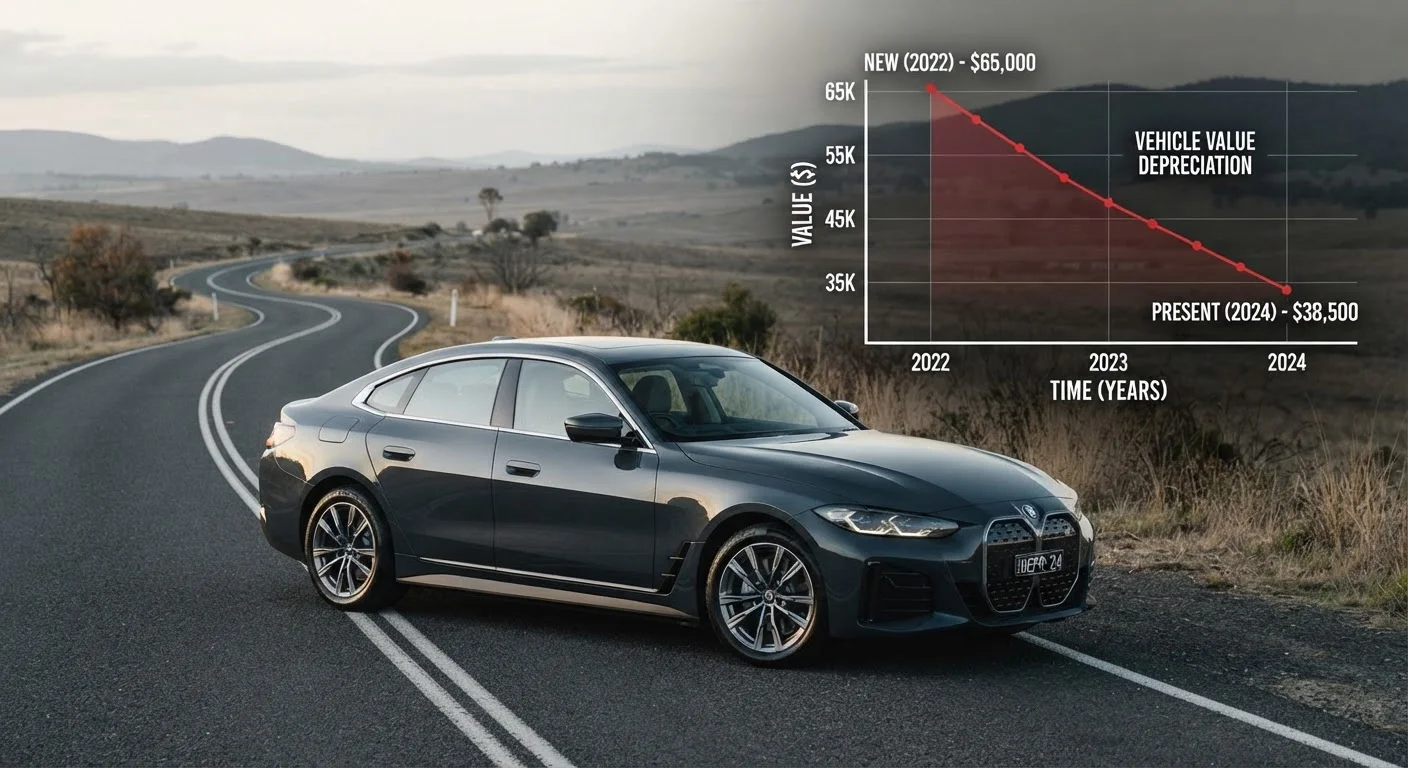
Depreciation does not occur at a flat, steady rate. The decline is sharpest early in a vehicle's life and gradually levels off as the car ages. Most new vehicles experience their biggest single-year drop in year one, with continued significant losses through years two and three. After the five-year mark, the curve tends to flatten, and value loss per year slows substantially.
This pattern has important practical implications. A buyer who purchases a vehicle in its third or fourth year of life avoids the steepest part of the curve entirely. The car is still relatively modern in terms of features and reliability, but a significant portion of its lifetime value loss has already occurred - absorbed by the original owner.
Understanding the trade-offs between new and used vehicles means accounting for exactly this dynamic. A used car purchased at the right point on the depreciation curve can offer substantially better value retention over the ownership period.
What Drives Faster or Slower Depreciation
Not all vehicles depreciate at the same rate. Several factors push a vehicle's value down faster - or help it hold value better than average.
- Vehicle category: Trucks and SUVs have historically retained value well in markets where they are in high demand. Luxury sedans and certain sports cars often depreciate sharply once out of warranty.
- Mileage: Higher mileage accelerates depreciation. Vehicles driven significantly above average annual mileage see steeper value declines.
- Accident and service history: A clean vehicle history report generally supports higher resale value. Accidents, even properly repaired ones, typically reduce what buyers are willing to pay.
- Color and trim: Neutral colors (white, silver, gray, black) tend to appeal to a broader resale audience. Unusual or polarizing colors can narrow the buyer pool and reduce value.
- Reliability reputation: Brands and models with strong long-term reliability reputations consistently outperform others in value retention, because the used-car market prices in perceived risk.
When evaluating a potential purchase, it's worth researching the typical depreciation trajectory of that specific model - not just the segment overall.
How Depreciation Should Shape a Buying Decision
Depreciation should be treated as a real, ongoing cost - not an abstract concept to revisit only at trade-in time. Factoring it into the purchase decision upfront leads to better financial outcomes.
For buyers financing a vehicle, rapid depreciation creates the risk of negative equity - a situation where the loan balance exceeds the car's current market value. This is sometimes called being 'underwater.' If the vehicle is totaled or needs to be sold before the loan is paid off, the gap must be covered out of pocket or rolled into a new loan, compounding the problem.
Leasing and buying handle depreciation very differently. With a lease, the lessee pays for the expected depreciation during the lease term - not the full vehicle value. With a purchase, the buyer owns the depreciation risk outright.
Thinking through total cost of ownership - including projected depreciation, fuel, insurance, and maintenance - gives a more complete picture than focusing on purchase price or monthly payment alone. See our full walkthrough of the car-buying process for guidance on structuring this analysis before signing.