

Key Takeaways
What Is the Monroney Label and Why Does It Exist?
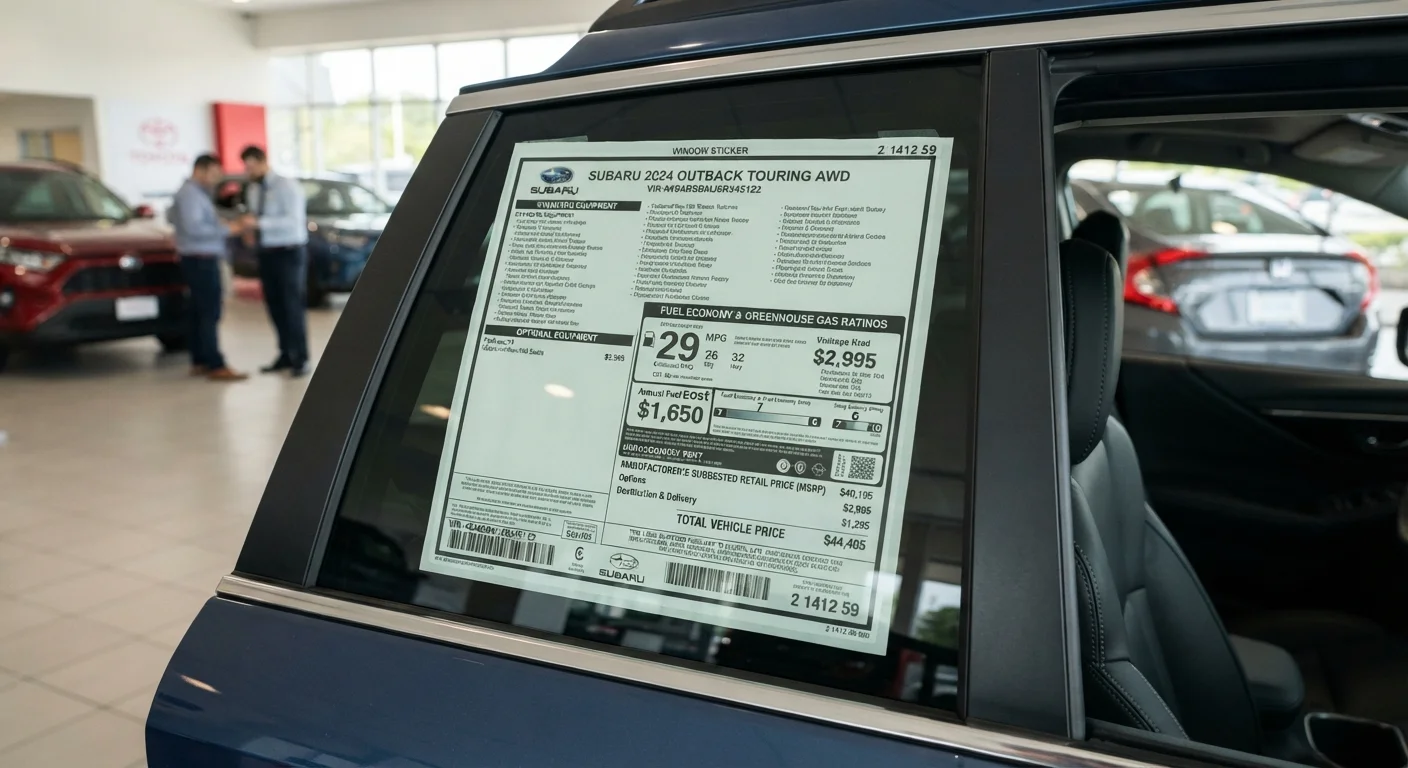
The sticker on the window of every new car sold in the United States is formally called the Monroney label, named after the senator who sponsored the Automobile Information Disclosure Act of 1958. Federal law requires dealers to display it on every new vehicle and prohibits its removal before sale - except by the buyer. Its purpose is straightforward: to give you standardized information so you can compare vehicles on equal terms.
Think of it as a vehicle's nutritional facts panel. Just as food labels follow a consistent format to help consumers compare products, the Monroney label follows a federally specified layout. Understanding its sections before you walk onto a lot gives you a meaningful edge. For a broader view of the full purchase journey, see our complete car-buying walkthrough.
What you will need
Breaking Down Each Section of the Label
The Monroney label is divided into several distinct regions. Here's what each one is actually communicating:
Vehicle Identification and Standard Equipment
The top portion lists the make, model, trim level, and model year. Below that, you'll find a description of standard equipment - features included in the base price of that specific trim. Read this carefully; it tells you what you're actually buying before any options are added.
Optional Equipment and Packages
This section lists every factory-installed option or package added to this specific vehicle, along with the individual price of each. A dealer cannot alter factory-installed options, but this is where you can evaluate whether the package combinations make sense for your needs. Paying for a technology package you'll never use inflates your purchase price permanently.
Manufacturer's Suggested Retail Price (MSRP)
The MSRP is the price the manufacturer recommends the vehicle be sold for, combining the base price and all factory-added options. It is a suggested price - not a fixed one. Dealers may sell above or below MSRP depending on demand, inventory, and negotiation.
Fuel Economy Estimates
The large numbers showing city, highway, and combined miles per gallon (mpg) - or MPGe for electric and plug-in hybrid vehicles - are produced by EPA testing protocols. They allow apples-to-apples comparisons between vehicles, but real-world results vary based on driving style, climate, load, and road conditions. The label also displays an estimated annual fuel cost based on assumed mileage and fuel prices, which can be a useful budgeting benchmark.
Safety Ratings
This section references crash test ratings from the National Highway Traffic Safety Administration (NHTSA) and, where applicable, the Insurance Institute for Highway Safety (IIHS). Ratings are displayed as star counts (NHTSA) or award designations (IIHS). Not all vehicles on the lot will have completed every test at time of sale, so a blank field doesn't necessarily mean poor performance - but it does mean less information for you.
Compare Labels Across Multiple Vehicles
Because the Monroney format is standardized, you can place two labels side by side - literally or in photos - and compare trim levels, option costs, and fuel economy on equal terms. This is one of the most efficient tools available to a car shopper and costs nothing to use.
The Dealer Addendum: Read This Separately
Many dealers attach a second sticker - often called a dealer addendum or market adjustment label - directly beside or over part of the Monroney label. This is not federally regulated and is entirely at the dealer's discretion. It typically includes:
- Dealer-installed accessories (tinted windows, floor mats, paint sealant, nitrogen-filled tires)
- Market adjustments - additional markup above MSRP, often applied to high-demand vehicles
- Dealer fees that aren't part of the manufacturer's pricing
These additions are negotiable in most cases. Dealer-installed accessories are frequently marked up well above retail cost, and some - like paint sealant or fabric protection - offer limited real-world benefit. You are not obligated to pay for accessories you didn't request, though removing them from a delivered vehicle may not always be practical. Know which line items are dealer-added before you discuss price.
The Addendum Is Not Part of the Monroney Label
A dealer addendum is a separately created document with no federal standardization. Items listed there - market adjustments, dealer accessories, protection packages - are added at the dealer's discretion and are generally negotiable. Never assume that the total on an addendum sticker is a fixed, non-negotiable price. Understanding this distinction can directly affect how much you pay.
How to Use the Label During Your Negotiation
Walking in with a clear understanding of the Monroney label changes your position at the negotiating table. Here's how to apply it practically:
Locate and photograph the Monroney label
Before speaking with a salesperson, find the window sticker and take a clear photo of the entire label - including any addendum stickers. This gives you a reference document you can review without time pressure later.
Separate the base price from optional add-ons
Identify the base MSRP for the trim level, then list each factory option and its cost individually. Add them together and verify the total matches the MSRP printed at the bottom of the factory section. This confirms you understand what the manufacturer is charging before any dealer additions.
Review the dealer addendum line by line
For each item listed on the dealer addendum, ask yourself: Was this requested? Is it something I value? Could I purchase or arrange this service independently at lower cost? Mark any line items you intend to challenge or remove from the negotiation.
Compare fuel economy against your actual driving profile
Look at the city versus highway mpg split. If most of your driving is city commuting, weight the city figure more heavily. Use the estimated annual fuel cost as a baseline, but adjust it mentally if your annual mileage differs significantly from the assumed average printed on the label.
Check for missing safety ratings
If the safety section shows incomplete or unavailable ratings, research the vehicle on the NHTSA and IIHS websites before finalizing your decision. These agencies publish ratings independently of the manufacturer, and a complete picture of crash test performance is an important factor in any purchase.
Once you're comfortable reading labels, you'll also find it easier to decode other vehicle information. Our guide on reading a tire sidewall applies the same logic to the markings on your tires.