

Key Takeaways
What You're Actually Looking At
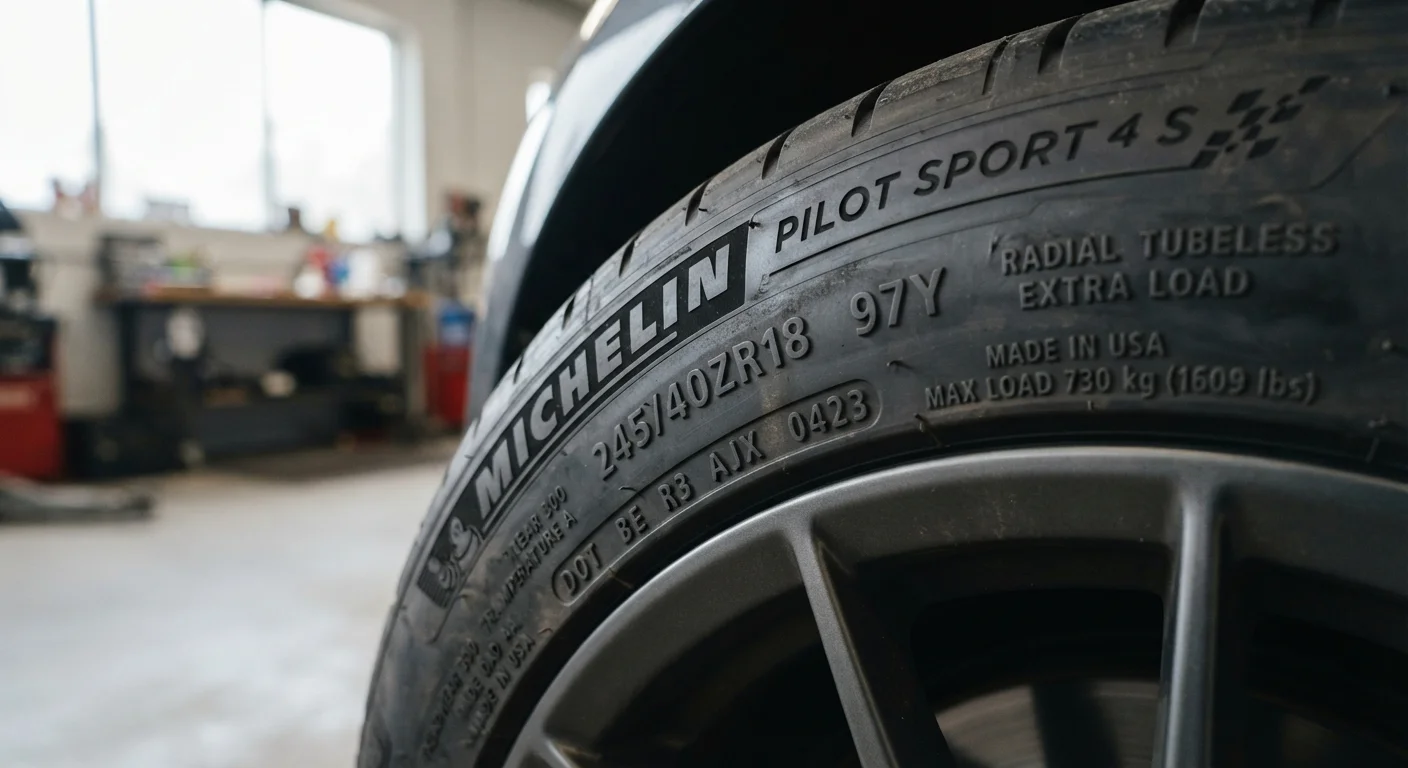
A tire sidewall is essentially a data plate molded into rubber. Every passenger vehicle tire sold in the United States must carry a standardized set of markings - regulated by the Department of Transportation - that communicate critical safety and compatibility information. The challenge is that the shorthand looks like alphabet soup at first glance.
Take a common example: P215/65R16 98H. Each segment of that string has a distinct meaning, and understanding them gives you real power when shopping for replacements, checking inflation, or assessing whether a used vehicle's tires are serviceable. For a similar experience decoding vehicle data, see our guide on reading a car window sticker.
What you will need
Decoding the Size Code Step by Step
Once you know what each segment represents, the size code becomes straightforward to read in sequence.
Identify the service type prefix
The first letter or letters indicate what vehicle category the tire is designed for. Common designations include:
- P - Passenger vehicle (most cars, minivans, crossovers)
- LT - Light Truck (pickups, heavy-duty SUVs)
- T - Temporary spare (compact spare)
If no prefix appears, the tire follows a metric standard common to European vehicles and may have slightly different load ratings than a P-metric equivalent.
Read the section width
The three-digit number following the prefix - 215 in our example - is the tire's section width in millimeters. This is the measurement from sidewall to sidewall at the tire's widest point when properly mounted and inflated.
Find the aspect ratio
After the slash, the two-digit number (65) is the aspect ratio - the tire's sidewall height expressed as a percentage of the section width. A 65 means the sidewall height is 65% of 215 mm. Lower numbers indicate a shorter, sportier sidewall; higher numbers mean a taller sidewall that generally absorbs bumps more comfortably.
Note the construction type
The letter after the aspect ratio describes internal construction. R stands for radial, the dominant construction type for modern passenger tires. You may occasionally see D (diagonal bias) or B (belted bias) on specialty or older tires.
Read the rim diameter
The two-digit number following the construction letter - 16 - is the rim diameter in inches. This must match your wheel size exactly; a tire rated for a 16-inch rim cannot be safely mounted on a 17-inch wheel.
Decode the load index and speed rating
After the rim diameter, a two- or three-digit number followed by a letter represents the load index and speed rating. In our example, 98H means:
- 98 - Load index: Each tire can support up to 1,653 pounds (748 kg) at maximum inflation. Load index tables are standardized and available from tire manufacturers.
- H - Speed rating: The tire is rated for sustained speeds up to 130 mph (210 km/h) under load. Common ratings range from S (112 mph) to Y (186 mph).
The DOT Code and UTQG Ratings
Beyond the size code, two additional marking systems appear on every U.S. tire and carry information many drivers overlook entirely.
DOT Serial Number
The DOT code begins with the letters DOT and ends with a four-digit date code. The last four digits indicate the week and year of manufacture - for example, 2319 means the 23rd week of 2019. Tire age matters because rubber degrades over time regardless of tread depth. Many automakers and tire industry organizations suggest having tires older than six to ten years inspected by a professional, even if they look fine visually.
UTQG Ratings
The UTQG system grades tires across three dimensions: treadwear (a comparative index - higher numbers indicate longer projected tread life under standardized test conditions), traction (graded AA, A, B, or C, measuring wet-pavement stopping distance), and temperature (graded A, B, or C, indicating resistance to heat buildup). These grades allow side-by-side comparison between tire lines, though real-world results vary by driving conditions.
Never Ignore Load Index or Speed Rating
Installing a tire with a lower load index or speed rating than your vehicle requires is a safety hazard. These limits define how much weight a tire can support and the maximum sustained speed it can handle. Always match or exceed the ratings listed in your owner's manual or door jamb sticker, not just the physical size.
After reading the sidewall, a logical next step is checking your maintenance schedule. Tire rotation is one of the most skipped tasks - and uneven wear patterns visible on the sidewall edge can signal that rotation is long overdue.
Common Markings You May Also See
A few additional designations appear on specific tire types and are worth recognizing:
- M+S or M/S - Mud and Snow rating; indicates the tire meets minimum traction requirements for light winter use. Not equivalent to a dedicated winter tire.
- Three-Peak Mountain Snowflake (3PMSF) - A more rigorous winter-traction standard, molded as a mountain outline with a snowflake inside. Tires carrying this symbol have passed standardized snow-traction testing.
- XL or Extra Load - The tire is built to carry a higher maximum load than a standard tire of the same size.
- Run Flat (or RF / ROF) - Reinforced sidewall construction allows limited driving after a puncture. Check your owner's manual for the approved distance and speed.
- Max. Load / Max. Inflation - The maximum load in pounds and kilograms, and the maximum cold inflation pressure in PSI. Note: maximum inflation is not the same as the recommended operating pressure for your vehicle, which is found on the door jamb sticker.
If your dashboard warning light activates after a tire change or pressure check, our guide to dashboard warning lights can help you interpret what you're seeing.