

| Yellow line meaning | Separates traffic moving in opposite directions (MUTCD, Federal Highway Administration) |
| White line meaning | Separates traffic moving in the same direction (MUTCD, Federal Highway Administration) |
| Solid double yellow | No passing permitted in either direction (MUTCD, Federal Highway Administration) |
| Dashed white line | Lane change permitted when safe (MUTCD, Federal Highway Administration) |
| HOV diamond symbol | Lane restricted by minimum vehicle occupancy (MUTCD, Federal Highway Administration) |
| Flashing red signal | Treat as a stop sign - full stop required (MUTCD, Federal Highway Administration) |
The Three Categories of U.S. Road Signs
Every road sign in the United States falls into one of three functional categories: regulatory, warning, or informational. Shape and color are not decorative - they are a coded language standardized by the Federal Highway Administration's MUTCD, which governs traffic control devices nationwide.
MUTCD
The Manual on Uniform Traffic Control Devices, published by the Federal Highway Administration, sets the national standard for all road signs, signals, and pavement markings used on U.S. public roads.
Regulatory sign
A sign that communicates a legal requirement. Drivers must comply with regulatory signs; violations can result in traffic citations.
Stop bar
A solid white line painted across a lane at an intersection indicating the precise point where a vehicle must stop before a stop sign or red light.
Protected turn
A turn permitted by a green arrow signal, during which oncoming traffic is stopped by a red light, allowing the turning driver to proceed without yielding.
HOV lane
A High-Occupancy Vehicle lane restricted to vehicles carrying a minimum number of occupants, designated to reduce congestion and encourage carpooling.
Permissive turn
A turn allowed by traffic law but requiring the driver to yield to oncoming vehicles and pedestrians before completing the maneuver.
Regulatory Signs
Regulatory signs communicate laws and rules that drivers are legally required to obey. They are typically white with red or black text. Common examples include stop signs (octagonal red), yield signs (downward-pointing red triangle), speed limit signs (white rectangle), and no-turn signs (white circle with a red slash). Ignoring a regulatory sign is a traffic violation.
Warning Signs
Warning signs alert drivers to potential hazards or unusual road conditions ahead. They are almost universally yellow with black symbols - or fluorescent yellow-green in school and pedestrian zones. Common examples include curve-ahead signs, merge signs, deer crossing markers, and railroad crossing advance warnings. These signs require drivers to slow down and prepare to adjust.
Guide and Informational Signs
Guide signs help drivers navigate. Green signs indicate highway exits and route distances; blue signs indicate services such as rest areas, hospitals, and fuel; brown signs direct drivers to recreational areas and historic sites. These signs do not impose legal obligations but are essential for route-finding.
For broader safety context, see our complete driver's education resource covering hazard awareness and road rules.
Pavement Markings: What the Lines on the Road Mean
Pavement markings work alongside signs to direct traffic flow. Line color, style (solid vs. dashed), and placement each carry distinct meaning.
| Yellow line meaning | Separates traffic moving in opposite directions (MUTCD, Federal Highway Administration) |
| White line meaning | Separates traffic moving in the same direction (MUTCD, Federal Highway Administration) |
| Solid double yellow | No passing permitted in either direction (MUTCD, Federal Highway Administration) |
| Dashed white line | Lane change permitted when safe (MUTCD, Federal Highway Administration) |
| HOV diamond symbol | Lane restricted by minimum vehicle occupancy (MUTCD, Federal Highway Administration) |
| Flashing red signal | Treat as a stop sign - full stop required (MUTCD, Federal Highway Administration) |
Yellow Lines
Yellow lines separate traffic flowing in opposite directions. A solid double yellow line prohibits passing in either direction. A broken yellow line means passing is permitted when safe. A solid yellow line on your side of the center means you may not pass, even if the opposite line is broken.
White Lines
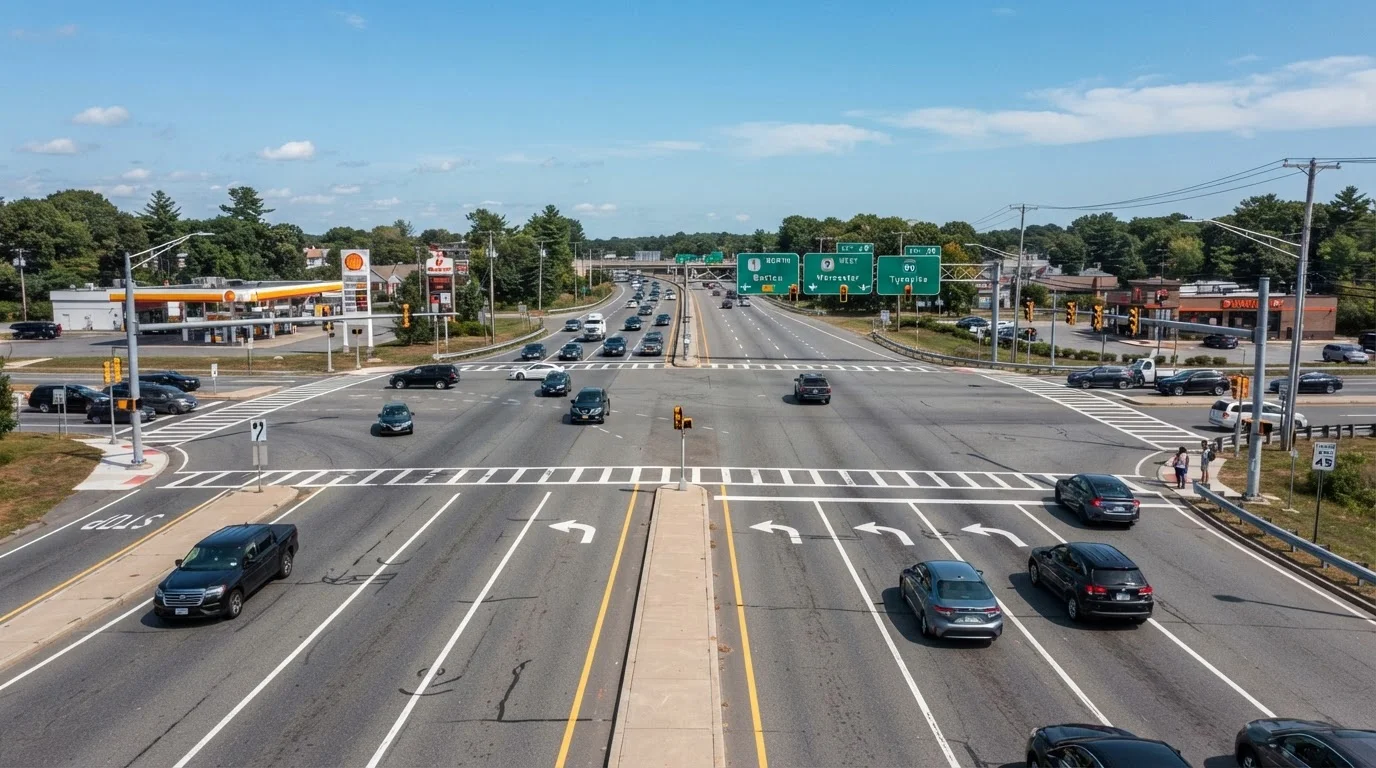
White lines separate traffic moving in the same direction. Dashed white lines mark lane boundaries that drivers may cross to change lanes. Solid white lines - such as those bordering a turn-only lane or edge of roadway - discourage lane changes and define the road's edge. A thick solid white line across lanes at an intersection is a stop bar; you must stop behind it.
Special Pavement Markings
- Arrows: Painted arrows in a lane tell drivers which direction that lane must travel. A lane marked with both a straight arrow and a curved arrow permits going straight or turning.
- HOV diamonds: Diamond symbols designate High-Occupancy Vehicle lanes, which restrict access based on the number of occupants.
- Crosswalks: Parallel white bars across the roadway mark pedestrian crossings - drivers must yield to pedestrians within them.
- Bike lane markings: A bicycle stencil with a solid white border identifies lanes reserved exclusively for cyclists.
Staying aware of pavement markings is one habit that new drivers learn early but that all drivers benefit from reinforcing.
Traffic Signals and Flashing Lights
Standard three-color traffic signals - red, yellow, green - are widely understood, but several signal variations are less familiar and frequently misread.
Flashing Red vs. Flashing Yellow
A flashing red light functions exactly like a stop sign: come to a complete stop, yield to cross-traffic and pedestrians, then proceed when safe. A flashing yellow light is a caution signal - slow down and proceed carefully without a full stop requirement, unless another sign requires it.
Protected and Permissive Turn Signals
A solid green arrow indicates a protected turn: oncoming traffic is stopped, and you may turn without yielding. A flashing yellow arrow indicates a permissive left turn: you may turn, but you must yield to oncoming vehicles and pedestrians. A solid green circle (the standard green) permits turning only after yielding to oncoming traffic - this is the permissive default that most drivers encounter daily.
Pedestrian Signal Heads
The walking figure (white) means pedestrians may cross. The raised hand (orange) with a countdown timer means pedestrians should not start crossing - those already in the crosswalk should complete their crossing. Drivers should treat an active pedestrian signal as confirmation that people may be in or near the crosswalk.
Keeping your vehicle in reliable working order makes it easier to respond correctly to all signal types. Our reference on dashboard warning lights can help you spot vehicle issues before they affect your driving.