

Key Takeaways
Option A
Prepaid Phone Plans
The pay-first, no-commitment approach.
Best for: People who want cost control, flexibility, or don't want a credit check tied to their phone service.
Option B
Postpaid Phone Plans
The traditional billed-monthly model with broader perks.
Best for: People who want device financing options, family plan coordination, or access to premium network tiers.
If you want no credit check and no long-term commitment
Prepaid Phone Plans
Prepaid plans require no credit approval and can typically be cancelled at any time without penalty fees.
If you want to finance a new device through your carrier
Postpaid Phone Plans
Device installment plans are almost exclusively offered on postpaid accounts, where creditworthiness is verified upfront.
If you need multiple lines for a family at a lower per-line cost
Postpaid Phone Plans
Most major carriers offer postpaid family bundles with meaningful per-line discounts as more lines are added.
If you travel internationally and need flexible or short-term coverage
Prepaid Phone Plans
Prepaid plans allow you to switch carriers or buy short-term plans without breaking a contract or paying early termination fees.
If you use a lot of data and want consistent top-tier network priority
Postpaid Phone Plans
Postpaid subscribers typically receive higher network priority during congestion compared to prepaid users on the same carrier.
How Each Billing Model Works
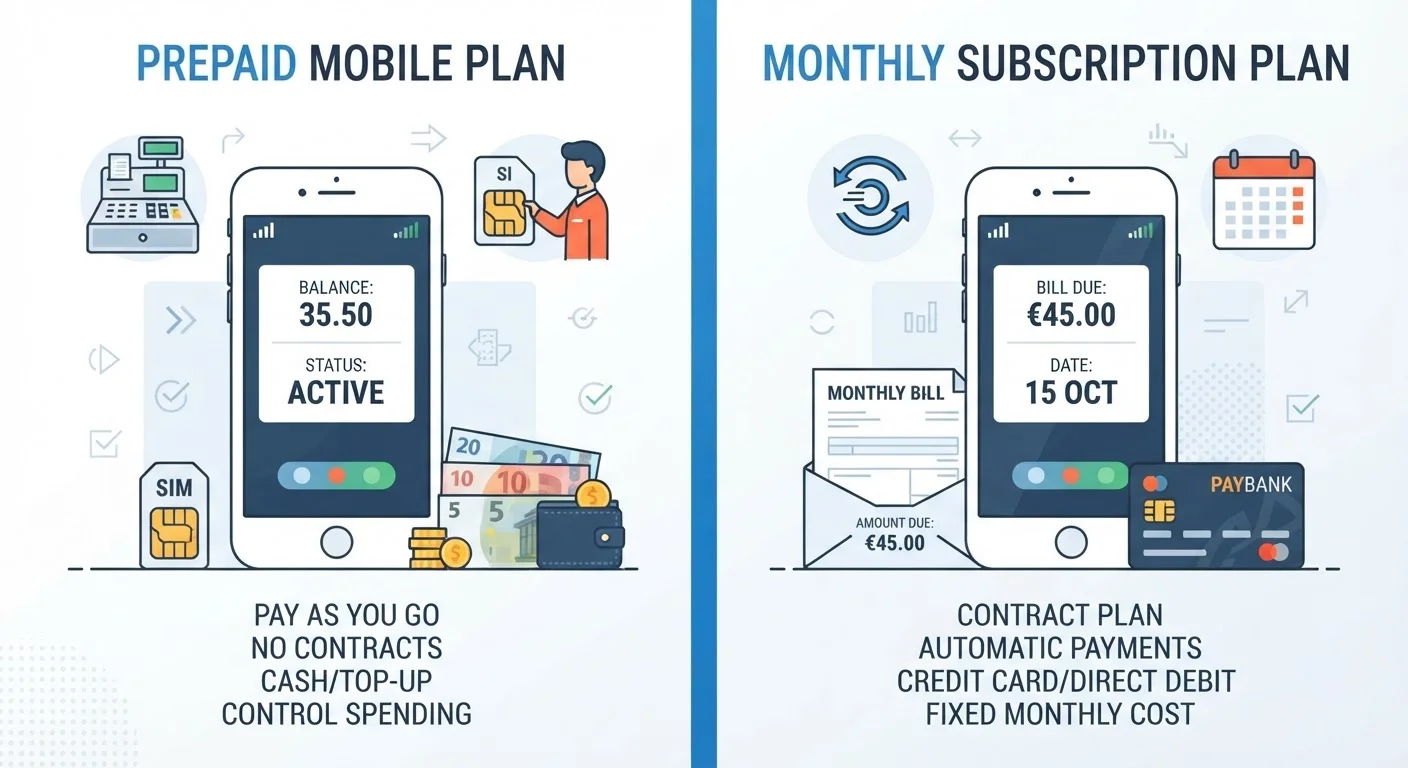
The most fundamental difference between prepaid and postpaid plans is the timing of payment relative to service. With a prepaid plan, you pay for a set amount of service - usually a month of calls, texts, and data - before that service is activated. Once your balance or allotment runs out, service pauses until you add more. There's no invoice, no billing cycle, and no credit check required.
With a postpaid plan, your carrier extends you credit for a month of service and bills you afterward. You use the phone throughout the billing period, then receive a statement. Because the carrier is essentially lending you service before collecting payment, postpaid accounts require a credit check and are tied to an account in your name.
Both types of plan use the same physical cell towers and, increasingly, the same network technologies. The difference is commercial and administrative, not technological - though network priority can differ, as covered below.
| Criterion | Prepaid | Postpaid |
|---|---|---|
| Payment timing | Pay before service begins | Billed after monthly cycle |
| Credit check required | No | Yes |
| Contract or commitment | None | Month-to-month or multi-year |
| Device financing | Rarely available | Commonly available |
| Network priority | Lower during congestion | Higher during congestion |
| Family/multi-line bundles | Limited options | Widely available |
| Per-line cost (single line) | Often lower | Often higher |
| Potential for bill creep | Lower | Higher |
Key Trade-Offs to Understand
Credit and commitment. Prepaid plans are the more accessible option for people with limited credit history, no Social Security number, or a preference for privacy. You're not entering a financial agreement with the carrier beyond the purchase itself. Postpaid plans require a credit check because you're effectively receiving service on credit each month.
Device financing. If you want to spread the cost of a new phone over 24 or 36 monthly installments, that option is almost exclusively available on postpaid plans. Prepaid plans generally require you to bring your own unlocked device or purchase one outright.
Network priority. During times of network congestion, carriers often give postpaid subscribers first access to available bandwidth. Prepaid customers on the same carrier may experience slower speeds when towers are heavily loaded. This distinction is most noticeable in dense urban areas during peak hours.
Perks and bundles. Streaming service subscriptions, international roaming add-ons, and multi-line family discounts are more commonly associated with postpaid accounts. Prepaid plans have improved significantly in recent years but may not offer the same breadth of extras. For more on how multi-line billing is structured, see how shared family phone lines work.
Costs: What You Actually Pay
Prepaid plans are often cheaper on a per-line basis - particularly for a single line - because carriers avoid the overhead of billing infrastructure, credit risk, and customer service tied to account management. However, the advertised price is typically what you pay; there's less room for the incremental fees and add-ons that can quietly raise postpaid bills over time.
Postpaid plans carry more potential for bill creep: device installments, insurance premiums, and automatic upgrades to higher service tiers can push the monthly total well above the base rate. If you've noticed your phone bill rising unexpectedly, understanding which charges are negotiable can help you identify where the increases are coming from.
Taxes and regulatory fees apply to both plan types, though how they're presented differs. Prepaid pricing sometimes includes taxes in the advertised price; postpaid bills often itemize them separately.
Switching Between Plans and What to Check
Moving from postpaid to prepaid - or vice versa - is generally straightforward, but a few practical steps matter. First, verify your phone is unlocked; a device locked to a carrier may not work on another carrier's prepaid plan. Second, check whether your number can be ported, which it typically can under FCC rules regardless of plan type. Third, if you're financing a device on a postpaid plan, the outstanding balance typically becomes due if you cancel the account.
Before committing to any plan, it's worth reviewing the details carefully. What to verify before signing up for a phone plan covers the specific terms, data policies, and fee structures worth scrutinizing. You might also consider how your SIM setup interacts with carrier switching - eSIM vs. physical SIM card explains how digital SIMs can make moving between carriers more flexible.