

Key Takeaways
Smart Thermostat Learning
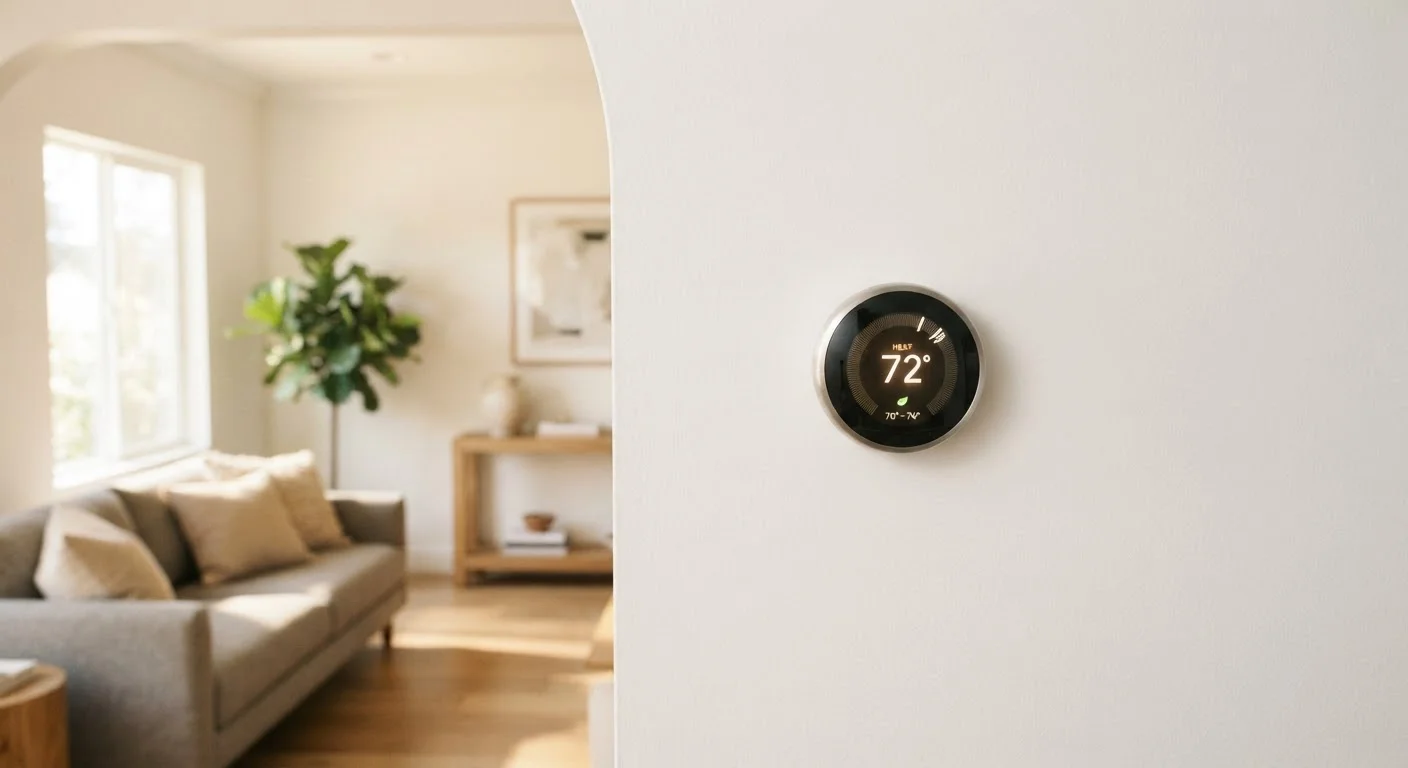
Smart thermostat learning is the process by which a connected thermostat observes your temperature adjustments, detects occupancy patterns, and eventually builds a schedule that mimics your preferences automatically. Instead of you programming fixed times and temperatures, the device does the configuration work on your behalf. Over days or weeks, it refines its model based on real behavior rather than a static program.
Most learning thermostats use a combination of motion sensors, manual override logs, and sometimes geofencing data from a paired smartphone app to infer occupancy and preference - no single data source is definitive on its own.
What 'Learning' Actually Means in a Thermostat
The phrase "learning thermostat" sounds almost human, but the underlying process is more mechanical than it might appear. At its core, a smart thermostat learns by logging two things: what temperature you set and when you set it. Every manual adjustment you make is recorded with a timestamp. Over time, the device looks for recurring patterns - if you consistently lower the heat to 65°F at 10 p.m. and raise it to 70°F at 7 a.m., the thermostat will eventually do this automatically.
This is sometimes called schedule inference. The device isn't reasoning about your comfort the way a person would - it's pattern-matching against your history. The more predictable your routine, the faster and more accurately the thermostat's model converges.
To understand how the thermostat fits into your broader connected home, it helps to know how these devices communicate with other systems. Our explainer on smart home device communication covers the protocols that make integration possible.
The Role of Sensors and Location Data
Manual adjustments are only one input. Smart thermostats also use onboard sensors to detect whether anyone is in the room. A passive infrared (PIR) sensor - the same technology used in motion-activated lights - detects heat signatures from people moving nearby. If no motion is detected for a set period, the thermostat may shift to an "away" temperature to avoid conditioning an empty space.
Many models also integrate with a smartphone app to use geofencing - a virtual geographic boundary. When your phone leaves a defined area (typically your neighborhood), the thermostat registers that you've left home and adjusts accordingly. When you return, it starts bringing the home to your preferred temperature before you arrive.
Check Sensor Placement If Occupancy Detection Seems Off
A PIR sensor positioned in a hallway may not detect someone sitting still in a back bedroom. If your thermostat frequently treats an occupied home as empty, check sensor placement and consider whether the app's location features are enabled and functioning correctly. Moving the thermostat to a more central wall location, if wiring allows, can significantly improve occupancy detection.
Sensor coverage has limits. A PIR sensor positioned in a hallway may not detect someone sitting still in a back bedroom. If your thermostat frequently treats an occupied home as empty, check sensor placement and consider whether the app's location features are enabled and functioning correctly.
How the Learning Period Works in Practice
Most smart thermostats reach a stable learned schedule within one to two weeks, assuming the household follows a reasonably consistent routine. During this period, you should interact with the thermostat as you naturally would - adjusting when you're too warm, too cold, or heading out. Avoiding the device to "let it learn on its own" is counterproductive, since your manual inputs are the primary training signal.
After the initial learning period, the thermostat continues to update its model. A sustained change in behavior - say, working from home after previously commuting - will gradually shift the learned schedule, though this can take several additional days to fully register.
7-14 days
Typical learning period for smart thermostats
Device documentation from multiple manufacturers generally cites one to two weeks as the window for an initial stable schedule to form, assuming consistent daily use.
~30%
Potential reduction in heating and cooling energy use
The U.S. Environmental Protection Agency has cited estimates in this range for well-configured programmable and smart thermostats, though actual results vary widely by household and climate.
If your household has irregular hours or multiple people with different preferences, the learning algorithm may struggle to settle on a consistent schedule. In these cases, switching to a manually programmed schedule is a reasonable alternative that still lets you use the thermostat's other smart features, such as remote control and energy reports.
What the Thermostat Doesn't Know
It's worth being clear about the limitations. A smart thermostat does not understand why you're making an adjustment - it only records that you did. If you turn up the heat because a window was accidentally left open, the thermostat logs that adjustment as a preference signal. Enough unusual overrides can skew the learned schedule in unintended ways.
The device also cannot account for context it has no access to: guests in the home, seasonal illness, a change in clothing habits, or how sunny a particular afternoon is. These factors affect your comfort but are invisible to the thermostat's sensors.
There's also a broader set of misconceptions worth understanding. Our article on common smart home myths addresses several assumptions people make about what connected devices can and can't do.
If you encounter terminology in your thermostat's app - terms like "automation routine," "geofence," or "occupancy mode" - our smart home glossary offers plain-language definitions.
Taking Control of Your Thermostat's Schedule
The learned schedule is not locked in. Every smart thermostat allows you to view, edit, or override what it has inferred. From the companion app or the device's touchscreen, you can see the time blocks the thermostat has established and adjust any of them manually. Think of the learned schedule as a starting draft - one you're free to refine.
Periodic review is worthwhile, especially after seasonal changes or shifts in your household routine. A schedule learned during summer may not serve you well in winter, and vice versa. Some thermostats prompt you to confirm or adjust their learned patterns; others update silently in the background.
If you want to go further and integrate thermostat automation with the rest of your home's routines, our guide on building automation routines covers how to design setups that hold up over time without constant maintenance.