

| Emergency fund benchmark | 3-6 months of essential expenses (Common personal finance guideline; individual needs vary) |
| Sinking fund method | Total cost ÷ months remaining = monthly contribution |
| Best account for emergency funds | Liquid, accessible savings account (e.g., high-yield savings) |
| Long-horizon goals | Often better suited to investment accounts than savings accounts |
Why Lumping All Savings Together Causes Problems
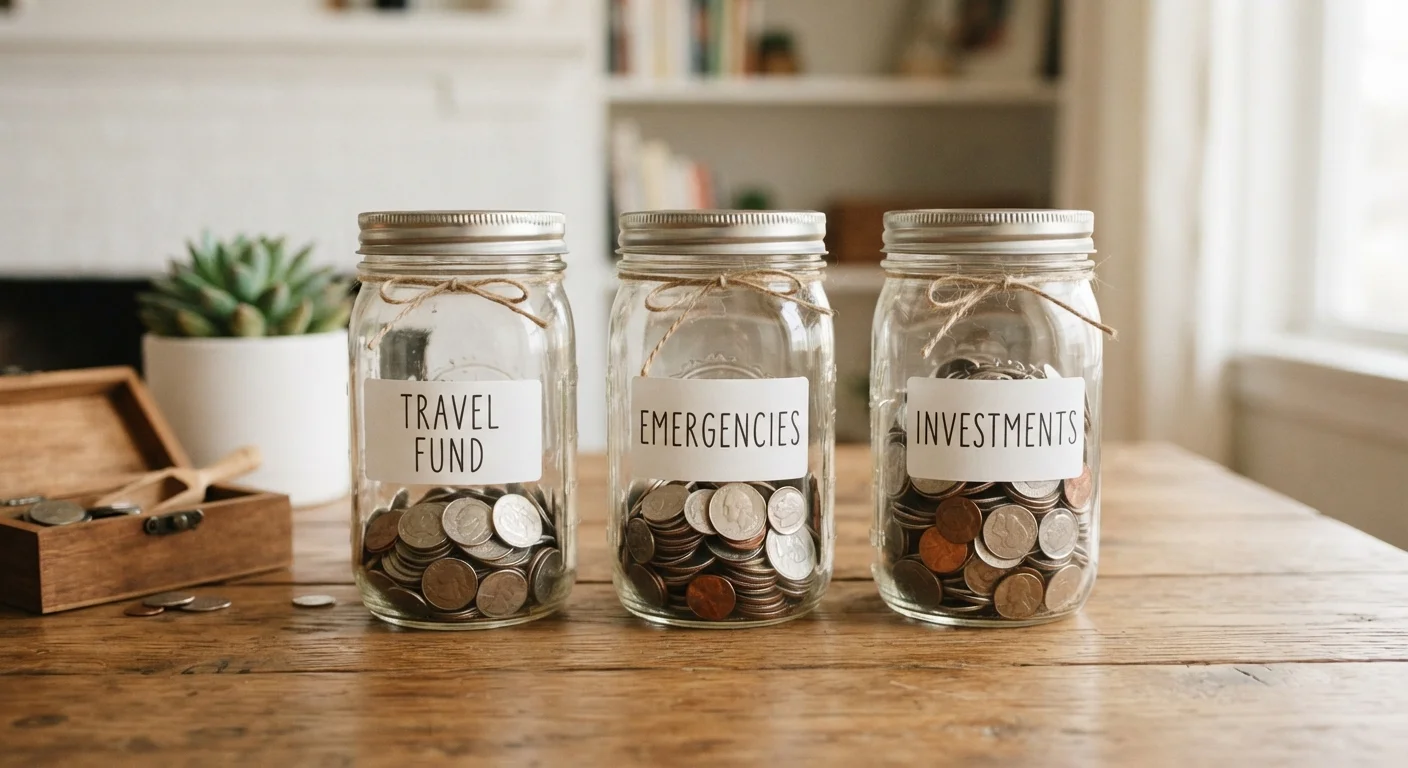
Many people keep one savings account and mentally assign it multiple jobs - cover emergencies, save for a vacation, set aside money for annual car insurance. That approach tends to collapse. When an unexpected bill hits, the vacation fund disappears. When a planned expense arrives, the emergency cushion gets raided.
The fix is straightforward: treat each savings purpose as its own bucket with its own rules. Three types of savings funds do the heavy lifting inside most household budgets - emergency funds, sinking funds, and savings goals. They work differently and serve different functions. Understanding what each one does makes it easier to build and protect all three.
If you've encountered common savings misconceptions, you'll know that the biggest barrier is often confusion about what savings is actually for - not a lack of income.
Emergency Fund
A dedicated cash reserve for unexpected, urgent financial disruptions such as job loss or unplanned medical costs. It should remain untouched for non-emergencies and be kept in a liquid, accessible account.
Sinking Fund
Money set aside in small, regular increments to cover a known future expense. Sinking funds turn large, irregular costs into manageable monthly contributions.
Savings Goal
A targeted savings effort aimed at a specific desired outcome - such as a home down payment or vacation - with a defined amount and timeline.
Liquidity
How quickly and easily a financial asset can be converted to usable cash without penalty. Emergency funds require high liquidity.
Emergency Fund: Your Financial Safety Net
An emergency fund exists for one purpose only: genuine, unexpected financial disruptions. Job loss, a medical bill not covered by insurance, a major car repair, or a sudden household system failure. It is not a backup checking account, and it is not a reserve for predictable costs.
The widely cited benchmark is three to six months of essential living expenses - rent or mortgage, utilities, groceries, minimum debt payments, and transportation. The right target depends on your income stability, household size, and whether you have dependents. Learn how the three-to-six-month standard works and when it should be higher or lower for your situation.
Critically, an emergency fund should be liquid - meaning you can access the money quickly without penalties. A high-yield savings account is a common home for this money. For a detailed look at sizing yours correctly, see the variables that actually determine your emergency fund target.
Key rule: Once the emergency passes, replenish the fund before resuming other savings priorities.
Sinking Fund: Planned Savings for Known Expenses
A sinking fund is money set aside incrementally for a specific, anticipated cost. Unlike an emergency fund, the expense is not a surprise - you know it's coming. What changes is whether you've prepared for it financially.
Common sinking fund categories include annual or semi-annual insurance premiums, car registration fees, holiday gift spending, home maintenance, and back-to-school costs. The math is simple: divide the total amount needed by the number of months until you need it, and set aside that amount each month.
For example, if your car insurance renews in six months and costs $900, setting aside $150 per month means you arrive at renewal date without disrupting your regular budget. That $900 never felt like a crisis because it never caught you off guard.
Sinking funds are a direct solution to one of the most common budget failures - treating predictable irregular expenses as emergencies. Many households find it helpful to maintain several sinking funds simultaneously, each labeled for its purpose. Even small monthly contributions add up to meaningful buffers over time.
Savings Goals: Building Toward Something Specific
A savings goal is forward-looking and tied to a defined outcome - a down payment on a home, a new vehicle, a family vacation, or a career transition fund. It differs from a sinking fund in that it typically represents something you actively want to achieve rather than a recurring cost you're smoothing out.
Savings goals benefit from clear target amounts and timelines. Both inform how much you need to set aside each month. They also benefit from a pay-yourself-first approach, where the savings contribution moves automatically at the start of each pay cycle before discretionary spending begins.
One important distinction: long-horizon goals - retirement, for instance - often belong in investment accounts rather than savings accounts, because the potential for growth over time matters more than short-term liquidity. Understand the boundary between short-term savings and long-term investing to make sure your money is in the right place for its job.
This article provides general financial education and is not personalized financial advice. Consult a qualified financial professional for guidance specific to your situation.