

Key Takeaways
Compound Interest
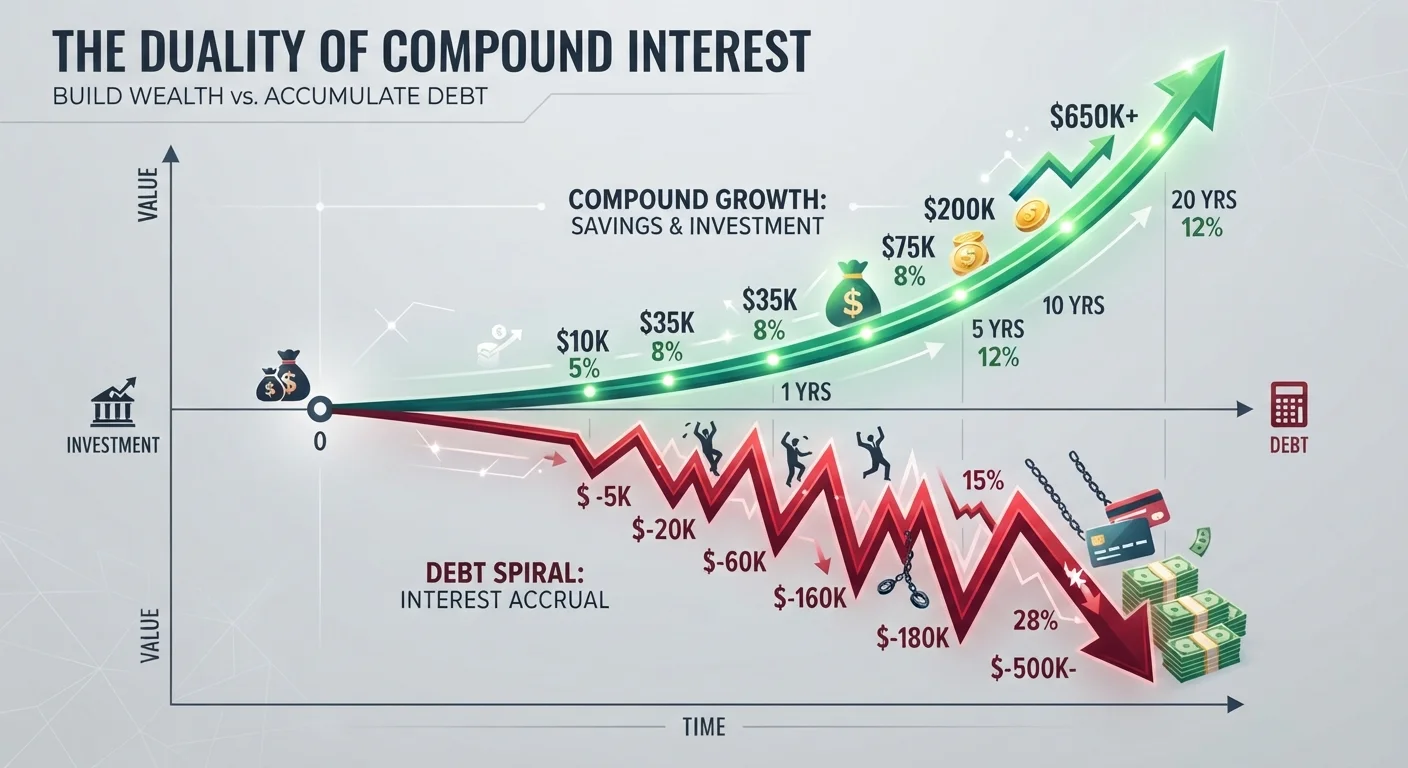
Compound interest is interest calculated not only on the original amount of money (the principal) but also on all previously earned or accrued interest. This creates a snowball effect: your balance grows faster over time because each interest payment itself starts earning interest. The same mechanic applies to debt - unpaid interest gets added to what you owe, and future interest is then calculated on that larger balance.
The standard formula is A = P(1 + r/n)^(nt), where P is the principal, r is the annual interest rate, n is the number of compounding periods per year, and t is time in years. More frequent compounding periods - monthly versus annually - produce slightly higher effective yields or costs.
How Compound Interest Actually Works
At its core, compound interest is interest earning interest. When you deposit money into a savings account, the bank pays you interest on your balance. The next time interest is calculated, it is applied to your original deposit plus everything already earned. This cycle repeats, and the growth curve bends upward - slowly at first, then with increasing speed.
Consider a straightforward example: $5,000 deposited at a 5% annual interest rate, compounded annually. After year one, you earn $250, bringing the balance to $5,250. In year two, the 5% applies to $5,250 - earning $262.50 instead of $250. The difference seems small early on, but after 30 years that original $5,000 grows to roughly $21,600 without a single additional deposit. Simple interest over the same period would yield only $12,500.
The critical variables are the interest rate, how frequently interest compounds, and - most powerfully - time. For a deeper look at why starting early magnifies results so significantly, see why compound interest matters more the earlier you start.
~$21,600
Growth of $5,000 at 5% over 30 years (compounded)
Illustrative calculation based on annual compounding; actual returns vary by account type and rate.
22%+
Average credit card interest rate in the US
Federal Reserve data has shown average credit card rates exceeding 20% APR in recent years, varying by card and creditworthiness.
Rule of 72
Years to double: divide 72 by interest rate
A widely used mental shortcut in personal finance - at 8% annual return, a balance doubles in roughly 9 years.
When Compounding Works Against You: The Debt Spiral
The same mechanics that build wealth can quietly deepen a financial hole. With most forms of debt - particularly credit cards - unpaid interest is added to your balance, and next month's interest is calculated on that larger figure. If you carry a $3,000 credit card balance at 22% APR and make only minimum payments, you could end up paying well over $1,000 in interest alone and take years to pay it off.
What makes this particularly damaging is the asymmetry in rates. Many high-yield savings accounts currently offer returns that fall meaningfully below the interest rates charged on credit card debt. That gap represents a real cost: every dollar sitting in a low-yield account while credit card interest accumulates is effectively losing value in practical terms.
Carrying student loans, auto financing, or personal loans at moderate rates involves the same dynamic, though usually at a slower pace than revolving credit card debt. Understanding this compounding cost is the starting point for choosing a payoff strategy. The debt avalanche vs. debt snowball comparison breaks down how to apply this knowledge to your specific debt mix.
Balancing Savings and Debt Repayment
Knowing how compounding works on both sides of the ledger clarifies a question many Americans wrestle with: should you pay down debt or build savings - or try to do both? The answer depends heavily on interest rates and your financial cushion.
A common framework: prioritize eliminating high-interest debt - generally anything above 7-8% - before aggressively funding long-term savings goals beyond a basic emergency fund. The reason is straightforward math. If your debt compounds at 20% and your savings earn 4%, every dollar that goes toward the debt eliminates a 20% annual cost rather than gaining a 4% annual return. That is a meaningful difference.
However, abandoning savings entirely to chase debt repayment carries its own risk. Without an emergency fund, an unexpected car repair or medical bill may force you back into debt. Paying off debt while saving at the same time offers a practical framework for splitting cash flow between both goals without sacrificing either. And if you're wondering whether an aggressive debt payoff plan could backfire, when aggressively paying down debt backfires explores the risks worth considering.
Use the Rate Comparison Test
Before deciding where to direct extra dollars each month, compare your debt's interest rate against the expected return on your savings or investment account. If your debt rate is higher, paying it down first generally delivers a better financial outcome. When rates are close, splitting contributions between debt and savings may provide both financial and psychological benefits.
This article is for general informational and educational purposes only and does not constitute personalized financial, tax, investment, or legal advice. Consult a qualified financial professional before making decisions specific to your situation.