

Key Takeaways
Why Low-Impact Movement Deserves More Credit
Low-impact exercise often gets undersold. People associate fitness progress with sweat-drenched, high-intensity sessions, but the science tells a more nuanced story. Low-impact movement - broadly defined as exercise that keeps at least one foot on the ground or places minimal force on joints - can build genuine cardiovascular fitness, support muscle development, and improve mobility without the wear-and-tear that harder workouts sometimes bring.
This matters for a wide range of people: those returning to exercise after time away, anyone managing joint discomfort, older adults, and people who simply want movement that feels sustainable day after day. As discussed in why consistency beats intensity, showing up regularly at a manageable effort level tends to outperform occasional all-out efforts over the long run.
The activities below represent a range of low-impact options - different in style, setting, and intensity, but united by their joint-friendly nature. Consider this a starting point for finding what fits your life, not a prescription.
Walking
Walking is the most accessible form of low-impact exercise - no gym membership, no equipment beyond a supportive pair of shoes. It engages the cardiovascular system, supports bone density, and contributes to mental well-being. Research consistently shows that regular walking produces meaningful health benefits even at moderate paces. Walking as exercise is often dismissed as insufficient, but the evidence tells a different story. Brisk walking - where you can speak but feel slightly breathless - is a reliable benchmark for productive effort.
Regular walking produces meaningful health benefits even at a moderate, conversational pace.
Swimming and Water Aerobics
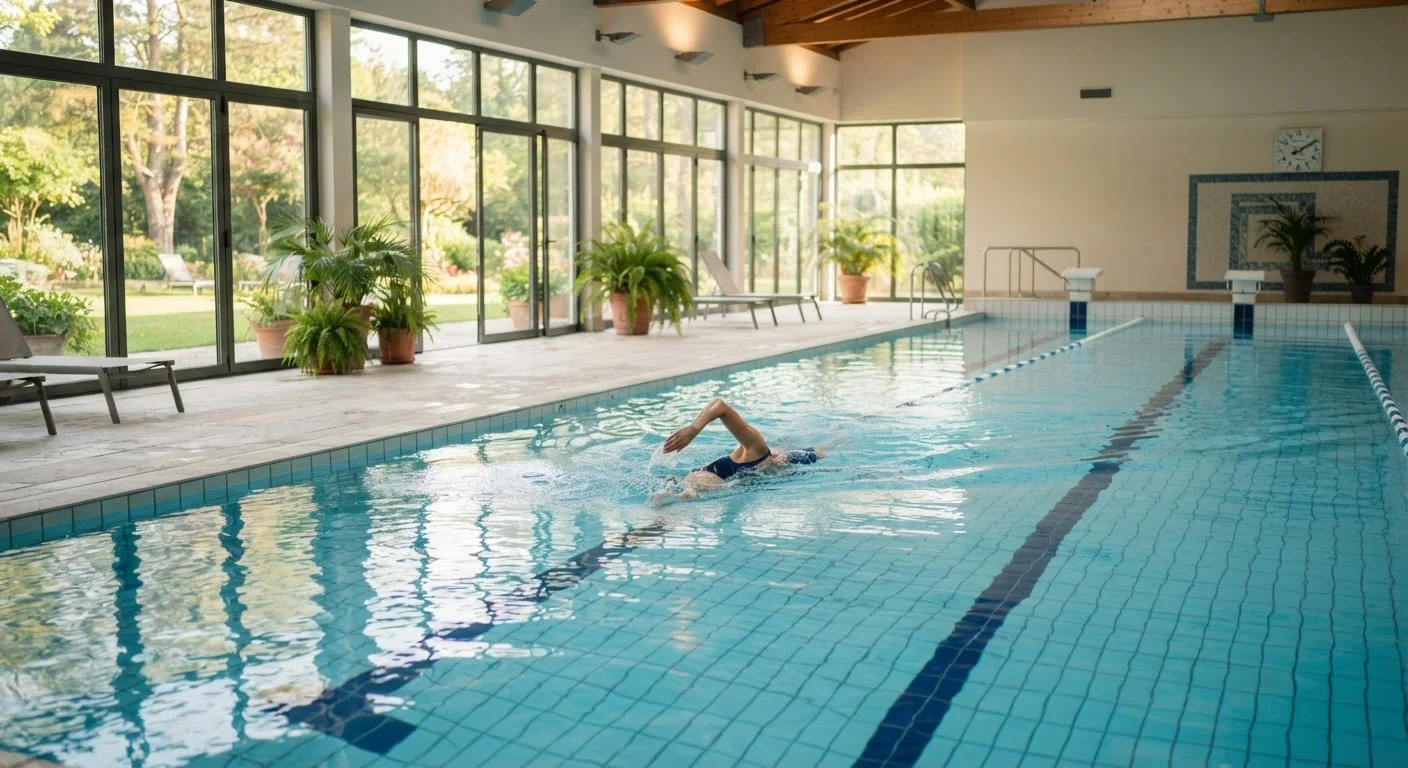
Water-based exercise is uniquely forgiving on joints. Buoyancy reduces the effective weight your body bears, making movement easier on hips, knees, and the spine. Swimming laps engages nearly every major muscle group and provides strong cardiovascular conditioning. Water aerobics classes offer a social, structured option well-suited to older adults or those with arthritis. The resistance of water also provides light muscular challenge without the need for weights.
Water's buoyancy reduces joint load while still delivering full-body muscular and cardiovascular engagement.
Cycling (Stationary or Outdoor)
Cycling keeps your weight supported, removing much of the impact that running places on knees and ankles. Stationary bikes allow for precise intensity control and are useful in any weather; outdoor cycling adds variety and engages stabilizing muscles more actively. Both formats align well with Zone 2 training - maintaining a moderate, sustained heart-rate range that builds aerobic capacity efficiently. Resistance adjustments make cycling scalable for beginners and experienced exercisers alike.
Cycling's supported position removes knee and ankle impact while building strong aerobic fitness.
Yoga
Yoga combines flexibility, balance, and low-load strength work in a single practice. Most styles - including hatha, restorative, and yin - are inherently low-impact. More vigorous styles like vinyasa raise the heart rate moderately while remaining gentle on joints. Beyond the physical, yoga has been studied for its potential benefits on stress, sleep quality, and mindfulness, though individual results vary. Pairing yoga with other exercise types complements strength or cardio work by improving range of motion. Stretching guidance has evolved in recent years, and yoga naturally incorporates many evidence-supported mobility principles.
Yoga builds flexibility and balance while doubling as a mindfulness practice with minimal joint stress.
Elliptical Training
The elliptical machine mimics the motion of running but eliminates the repeated ground impact. Studies have shown that elliptical training produces cardiovascular demands comparable to jogging while placing significantly less force on the lower body. Most machines include handles that engage the upper body, making it a more complete workout. It's a practical option for those who want running-adjacent effort but find actual running uncomfortable or inadvisable due to joint issues.
Elliptical training mimics running's cardiovascular demands while cutting the impact load significantly.
Tai Chi
Tai chi is a slow, deliberate movement practice rooted in Chinese martial arts tradition. Its slow, flowing sequences improve balance, coordination, and flexibility with virtually no joint impact. Research has found it particularly beneficial for older adults, with evidence suggesting it can help reduce fall risk - a significant concern as people age. Sessions can be done indoors or outdoors, alone or in a group, and typically require no equipment. It is worth consulting a healthcare provider if you have specific balance disorders before beginning.
Tai chi's slow, flowing movements have been shown to help reduce fall risk in older adults.
Resistance Band Training
Resistance bands offer a low-impact way to build muscular strength and endurance. Unlike heavy free weights, bands provide accommodating resistance - the load increases through a range of motion rather than hitting joints with abrupt force. They're lightweight, portable, and adaptable to dozens of exercises targeting different muscle groups. For those curious about bodyweight-style training, bodyweight exercise's possibilities and limits provides useful context on what resistance-based training can and can't accomplish without equipment.
Resistance bands deliver strength-building stimulus without the abrupt joint forces that heavy weights can create.
Finding What Works for You
The best low-impact exercise is the one you'll actually do. Each option on this list has its own learning curve, equipment needs, and social dimension - factors worth weighing alongside physical benefits. If you've been mostly sedentary and aren't sure where to begin, getting active after a long sedentary stretch offers a thoughtful framework for easing back in safely.
Mix and Match for Best Results
Combining two or three low-impact activities tends to produce more well-rounded fitness than relying on a single one. For example, cycling builds aerobic capacity while yoga addresses flexibility and tai chi sharpens balance. Variety also reduces overuse strain on any one set of joints and keeps your routine engaging over time. Even brief sessions add up - see movement snacks for ideas on working activity into a packed schedule.
Low-impact doesn't mean low-effort. Many of these activities can be progressively intensified - cycling faster, increasing resistance, holding yoga poses longer - so they remain challenging as your fitness improves. For a deeper look at how exercise priorities shift across life stages, see how exercise needs shift as you age.
This article is for general informational and educational purposes only and is not a substitute for professional medical advice. Speak with a qualified healthcare provider before starting any new exercise program, particularly if you have existing health conditions, injuries, or concerns.