

Key Takeaways
Our Verdict
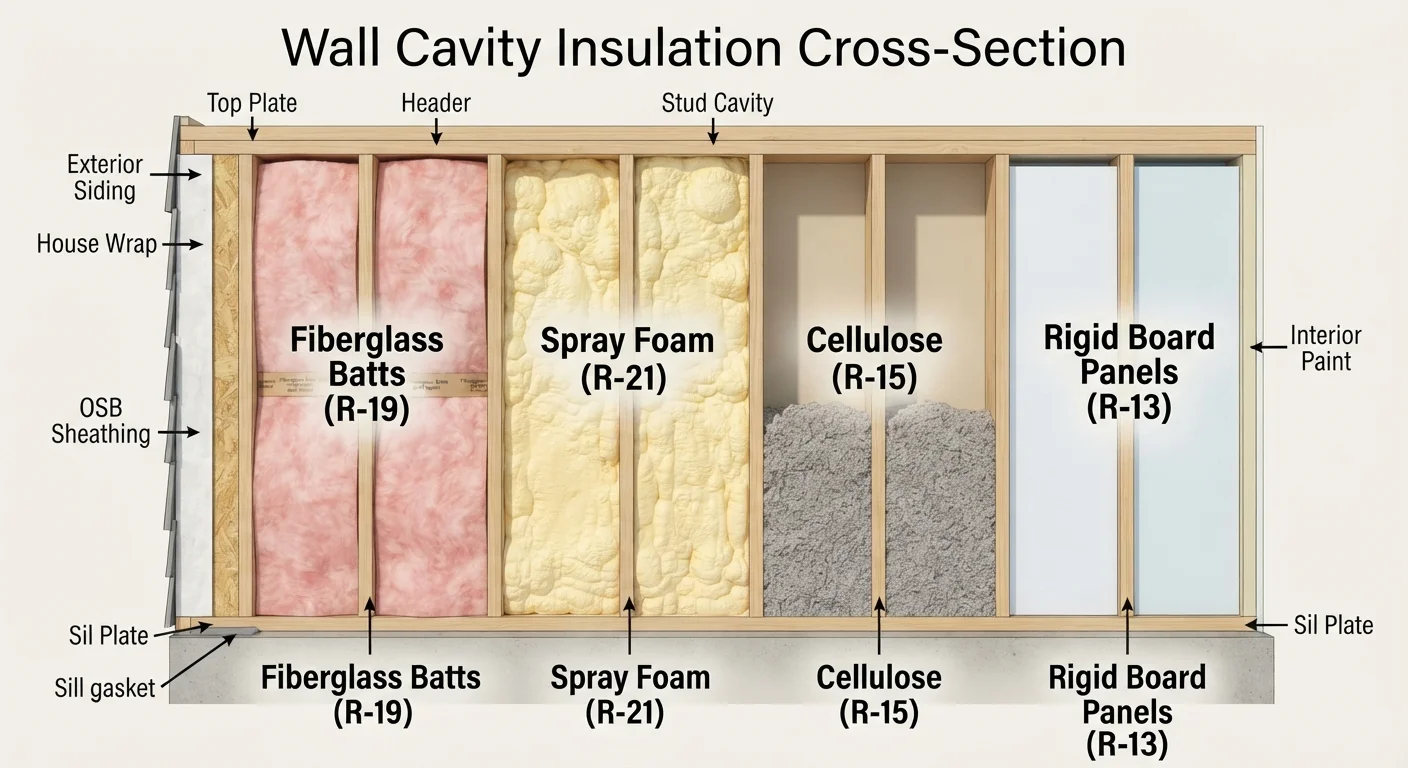
No single insulation type wins across every scenario. Fiberglass is a reliable, low-cost workhorse for most standard framed cavities. Spray foam is unmatched for airtightness in complex or hard-to-reach spaces. Cellulose is the environmentally conscious choice with solid thermal performance. Rigid board shines wherever space is at a premium or moisture is a concern.
| Best for | Recommended |
|---|---|
| Budget-conscious homeowners insulating standard framed walls or attics | Fiberglass batts |
| Crawl spaces, rim joists, and areas requiring a complete air barrier | Spray foam |
| Attic retrofits where eco-friendly materials and dense coverage matter | Cellulose |
| Basement walls, exterior sheathing, or tight spaces with limited depth | Rigid board |
Understanding R-Value Before You Compare
Before choosing an insulation type, it helps to understand R-value - the measure of thermal resistance per inch of material. A higher R-value means better insulation per unit of thickness. The U.S. Department of Energy publishes recommended R-values by climate zone, which vary from around R-30 in warm southern climates to R-60 in cold northern attics. Knowing your local requirement sets the baseline for every decision that follows.
R-value alone isn't the whole picture. Air leakage can undermine an insulation's thermal performance dramatically - a well-sealed, lower R-value installation often outperforms a higher R-value material riddled with gaps. This is why installation quality matters as much as material choice.
Fiberglass: The Familiar Standard
Fiberglass insulation comes in two main forms: batts (pre-cut blankets) and blown-in loose fill. Batts are one of the most DIY-friendly insulation products available - they fit between standard 16-inch and 24-inch stud spacing without special equipment. Blown-in fiberglass requires a blower machine, which many home improvement stores rent.
Fiberglass batts typically deliver R-2.9 to R-3.8 per inch. Performance depends heavily on proper installation - compressed or improperly fitted batts lose a significant portion of their rated R-value. Fiberglass does not resist moisture on its own and should not be used in areas with known water intrusion without an appropriate vapor barrier.
It's worth noting that fiberglass fibers can irritate the skin, eyes, and respiratory tract during handling. Always wear long sleeves, gloves, eye protection, and an N95 respirator when installing it.
Spray Foam: Maximum Air Sealing, Professional Complexity
Spray polyurethane foam (SPF) comes in two types: open-cell and closed-cell. Open-cell foam is lighter and less expensive, achieving roughly R-3.5 to R-3.7 per inch. Closed-cell foam is denser, delivers R-6 to R-7 per inch, and acts as a vapor barrier - making it particularly well-suited for areas like crawl spaces, basement rim joists, and roof decks.
Spray foam's defining advantage is its ability to expand into cracks, gaps, and irregular surfaces, creating a continuous air barrier that batts and loose fill cannot match. This makes it especially valuable in older homes with non-standard framing. For guidance on foundation-specific insulation challenges, see our crawl space vs. basement maintenance comparison.
| Fiberglass Batts | Spray Foam (Closed-Cell) | Cellulose | Rigid Board (Polyiso) | |
|---|---|---|---|---|
| R-value per inch | R-2.9 to R-3.8 | R-6 to R-7 | R-3.2 to R-3.8 | R-6 to R-6.5 |
| Air sealing capability | Low | Very high | Moderate | High (taped seams) |
| Moisture resistance | Low - needs vapor barrier | Very high | Low to moderate | High (XPS/polyiso) |
| DIY friendliness | High | Low (professional advised) | Moderate | Moderate |
| Typical cost | Low | High | Low to moderate | Moderate to high |
| Best application | Wall cavities, attics | Crawl spaces, rim joists | Attic loose-fill, retrofits | Basement walls, exterior sheathing |
| Environmental impact | Moderate | Higher (chemical process) | Low (recycled content) | Moderate |
Two-component spray foam kits are available for small DIY applications, but whole-wall and attic applications typically require a trained contractor with professional equipment. Improper mixing ratios or application temperatures can result in poorly cured foam that off-gasses harmful chemicals - this is not a project to rush.
Cellulose: Recycled Material, Solid Performance
Cellulose is made primarily from recycled paper fiber treated with borate compounds for fire and pest resistance. It's available as loose-fill blown-in material and, less commonly, as dense-pack cellulose for enclosed wall cavities. Blown-in cellulose achieves roughly R-3.2 to R-3.8 per inch and is one of the most environmentally responsible insulation choices available.
Dense-pack cellulose is particularly effective in retrofit applications - contractors drill small holes in existing wall sheathing or drywall and inject the material under pressure, filling the cavity with minimal disruption. This makes it a strong option for older homes without opening walls for full renovations.
One consideration: cellulose can absorb moisture over time, which may reduce its R-value and promote mold growth if a moisture source is not addressed first. It performs best in well-ventilated attics and dry wall assemblies.
Cellulose Works Well for Retrofit Projects
If you're adding insulation to existing walls without gutting the drywall, dense-pack cellulose injected through small access holes is one of the least disruptive methods available. A qualified insulation contractor can assess wall cavity depth and fill coverage to ensure proper density - under-packed cellulose can settle over time, reducing effective R-value.
Rigid Board: Compact and Moisture-Resistant
Rigid foam insulation panels come in three main types: expanded polystyrene (EPS), extruded polystyrene (XPS), and polyisocyanurate (polyiso). R-values range from about R-3.8 per inch for EPS to R-6.5 per inch for polyiso, making rigid board one of the most thermally efficient options by thickness.
Rigid board is widely used on exterior wall sheathing, basement walls, under slab-on-grade floors, and in areas where space is limited. XPS in particular has low moisture absorption, making it a practical choice in below-grade applications. Because rigid board leaves no air gaps when properly installed with taped seams, it also contributes meaningfully to air sealing.
Most rigid foam panels must be covered with a fire-rated material (such as drywall) when installed in occupied interior spaces - check your local building code before leaving panels exposed. Licensed professionals are generally recommended for exterior continuous insulation systems that affect weather barriers or structural sheathing.
Choosing the Right Insulation for Your Project
The right insulation depends on where you're installing it, your climate zone, available depth, moisture conditions, and whether you're doing the work yourself or hiring a contractor. Attics with open joist bays favor blown-in cellulose or fiberglass. Standard framed wall cavities suit fiberglass batts or dense-pack cellulose. Rim joists and crawl spaces often benefit most from closed-cell spray foam. Exterior assemblies and basement walls frequently call for rigid board.
Budget matters too: fiberglass batts and blown-in cellulose are typically the most affordable materials, while closed-cell spray foam carries the highest installed cost per square foot. That cost difference can be justified when air sealing is the primary goal, but may be unnecessary for a straightforward attic top-up.
Whatever material you choose, check whether your project requires a building permit or inspection. In many jurisdictions, adding insulation to attic floors does not require a permit, but insulating basement walls or changing the thermal envelope of the building may trigger code compliance requirements. When in doubt, contact your local building department before starting work.