

Key Takeaways
Option A
Solid Hardwood Flooring
The timeless, refinishable classic for dry living spaces.
Best for: Main-level rooms in stable climates where long-term refinishing value is a priority.
Option B
Engineered Wood Flooring
The versatile, moisture-tolerant option for more of your home.
Best for: Basements, kitchens, and humid regions where solid wood would warp or buckle.
If you want a floor you can sand and refinish every decade
Solid Hardwood Flooring
Solid hardwood is typically 3/4 inch thick, allowing it to be sanded and refinished four to six times - extending the floor's life well past 50 years.
If you're installing in a basement or below-grade space
Engineered Wood Flooring
Solid hardwood is not recommended below grade due to moisture; engineered wood's plywood core handles humidity swings without warping.
If you live in a region with high humidity or temperature swings
Engineered Wood Flooring
The cross-ply plywood construction resists expansion and contraction far better than a solid plank, reducing gapping and cupping over time.
If long-term resale value and authenticity matter most
Solid Hardwood Flooring
Real estate buyers often recognize and value solid hardwood; its refinishability means it can look new again before a home sale.
If you want a floating floor installation over radiant heat
Engineered Wood Flooring
Most solid hardwood manufacturers do not approve installation over radiant heating systems; engineered wood is generally compatible when installed per manufacturer guidelines.
What's Actually Inside Each Plank
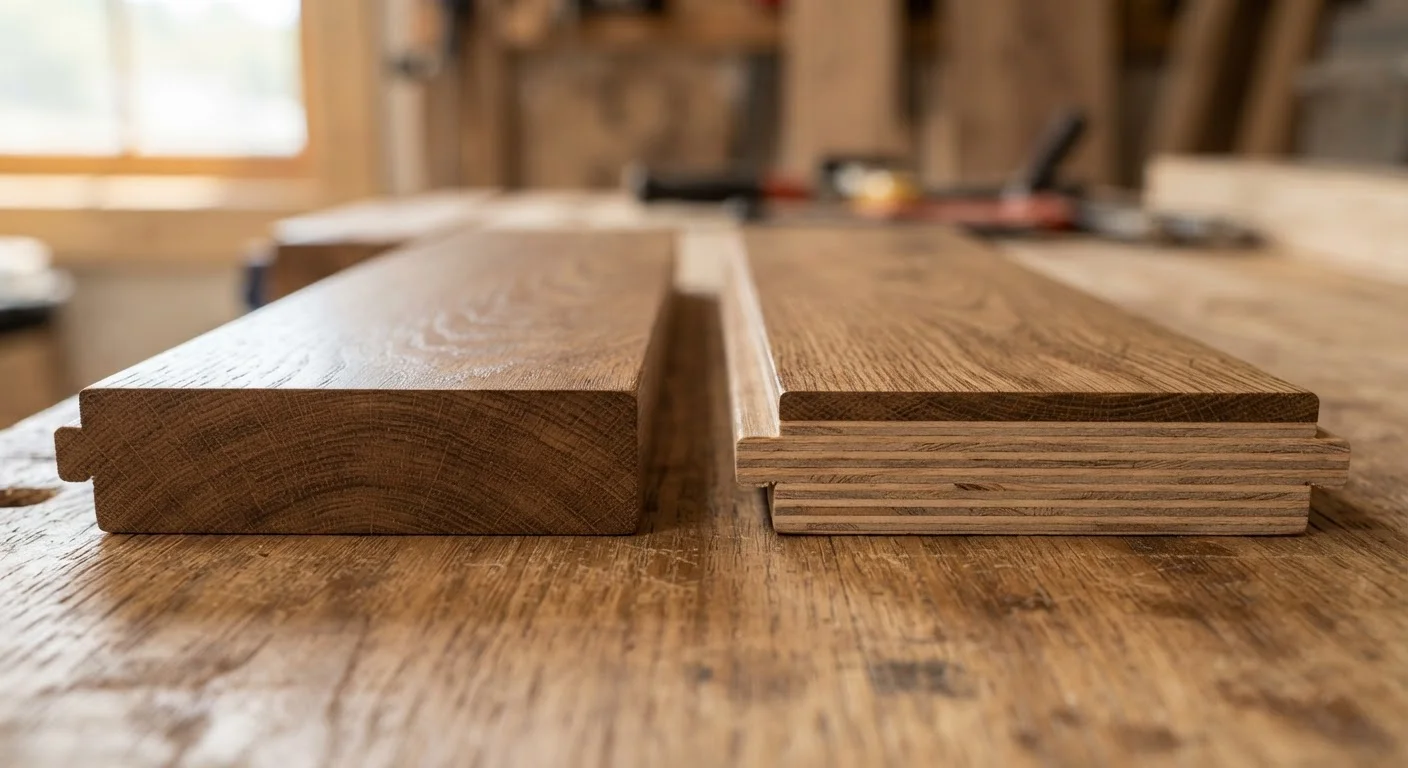
The core difference between these two flooring types isn't visible once they're installed - it's structural. Solid hardwood is exactly what the name suggests: a single, uniform piece of milled wood, typically 3/4 inch thick. Species like oak, maple, hickory, and walnut are common. Because the plank is one material throughout, it responds to moisture and temperature as a single unit - expanding when humid, contracting when dry.
Engineered wood, by contrast, is a layered product. A top veneer of real hardwood (ranging from 1/16 to 1/8 inch thick depending on grade) is bonded over multiple plywood or high-density fiberboard (HDF) layers arranged in alternating grain directions. This cross-ply construction is the key engineering advantage - opposing grain directions cancel out each layer's tendency to expand or contract, producing a plank that stays far more dimensionally stable than a solid piece of the same species.
Neither construction is inherently superior. The right choice depends almost entirely on where you're installing and how you want to maintain the floor over time.
Moisture, Stability, and Where Each Floor Can Go
Moisture tolerance is the single most practical factor separating these two materials. Solid hardwood should only be installed on or above grade - meaning main floors and upper levels - never in basements or directly over concrete slabs where ground moisture can wick upward. Even in above-grade rooms, wide solid planks in humid climates can cup (edges rise) or gap (center sinks) with seasonal humidity shifts.
Engineered wood handles moisture-adjacent environments significantly better. Its plywood core resists the swelling and shrinking that causes solid wood to move. It can be installed below grade, directly over concrete (with appropriate moisture barriers), and in rooms like kitchens and mudrooms that see occasional water exposure. Note that moisture-tolerant does not mean waterproof - standing water will damage engineered wood just as it damages solid.
| Criterion | Solid Hardwood | Engineered Wood |
|---|---|---|
| Construction | Single piece of milled wood | Hardwood veneer over plywood core |
| Typical thickness | 3/4 inch | 3/8 to 9/16 inch |
| Below-grade installation | Not recommended | Generally suitable |
| Moisture tolerance | Low - warps and cups | Moderate - resists movement |
| Refinishable | Yes - 4 to 6 times | Limited - veneer-dependent |
| Installation methods | Nail/staple-down only | Nail, glue, or floating |
| Over radiant heat | Typically not approved | Often compatible |
| Expected lifespan | 50-100 years with care | 25-50 years typical |
Climate matters too. Homeowners in the humid Southeast or the dry Mountain West will see more dramatic seasonal movement in solid floors than those in mild, stable climates. If your home runs without climate control for extended periods, engineered wood is the lower-risk choice.
Installation Methods and Subfloor Requirements
Solid hardwood is almost always nail- or staple-down, requiring a wood subfloor (typically 3/4-inch plywood) for the fasteners to grip. This limits where it can go and means installation is more involved - almost always a job for an experienced installer or flooring contractor.
Engineered wood offers more flexibility. It can be:
- Nail- or staple-down - same as solid, over plywood subfloors
- Glue-down - bonded directly to concrete, common in basements
- Floating - planks click together and rest over an underlayment without fasteners, making it a more accessible DIY option
Floating installation is particularly useful over radiant heating systems, where most solid hardwood warranties are void. Always check the specific manufacturer guidelines before installing any wood product over radiant heat.
Subfloor flatness matters for both types - high or low spots greater than 3/16 inch over 10 feet should be corrected before installation to avoid hollow-sounding spots and premature wear at joints.
Refinishing, Longevity, and Maintenance
This is where solid hardwood holds a clear structural advantage. A 3/4-inch solid plank can typically be sanded and refinished four to six times over its life, effectively resetting visible wear, scratches, and stains. With proper care, a solid hardwood floor can last 75 years or more.
Engineered wood's refinishability depends almost entirely on the veneer thickness. Thicker-veneer products (around 1/8 inch) may tolerate one or two light sandings. Thinner-veneer products should not be sanded at all - sanding through the veneer exposes the plywood core and ruins the floor. If refinishing longevity is a priority, check the veneer thickness specification before purchasing, and ask the supplier directly how many times the product can be refinished.
A Note on Veneer Thickness Claims
Marketing language around engineered wood can be imprecise. Terms like 'thick veneer' or 'refinishable' vary between manufacturers. Before purchasing, ask for the exact veneer thickness in millimeters and request written documentation of the refinishing warranty. A reputable supplier should be able to provide both without hesitation.
Day-to-day maintenance is essentially identical for both types: sweep regularly, wipe spills promptly, use felt pads under furniture, and avoid wet mopping. Both floors benefit from maintaining indoor humidity between roughly 35% and 55% year-round - a basic whole-home humidifier or dehumidifier can help in climates that swing far outside that range.
For other structural decisions that affect your renovation planning, see our guide on load-bearing vs. non-load-bearing walls to understand which changes are safe to make on your own.