

Key Takeaways
Option A
Fixed-Rate Mortgage
The predictable, long-term stability choice.
Best for: Buyers who plan to stay in their home long-term and want consistent monthly payments regardless of market shifts.
Option B
Adjustable-Rate Mortgage (ARM)
The flexible, lower-entry-cost alternative.
Best for: Buyers who expect to move or refinance within a few years and want to take advantage of a lower initial interest rate.
If you plan to stay in the home for 10 or more years
Fixed-Rate Mortgage
Long-term owners benefit most from payment stability. Rate fluctuations over a decade or more could make an ARM significantly more expensive.
If you expect to sell or refinance within 5-7 years
Adjustable-Rate Mortgage (ARM)
You may exit the loan before the rate adjusts, meaning you capture the lower introductory rate without exposure to future increases.
If your income is variable or your budget is tight
Fixed-Rate Mortgage
Knowing exactly what you owe each month makes budgeting more reliable and reduces the risk of payment shock.
If you're buying in a high-rate environment and expect rates to fall
Adjustable-Rate Mortgage (ARM)
An ARM may let you benefit from rate decreases at reset time - though refinancing into a fixed loan later is also worth evaluating.
How Each Mortgage Structure Works
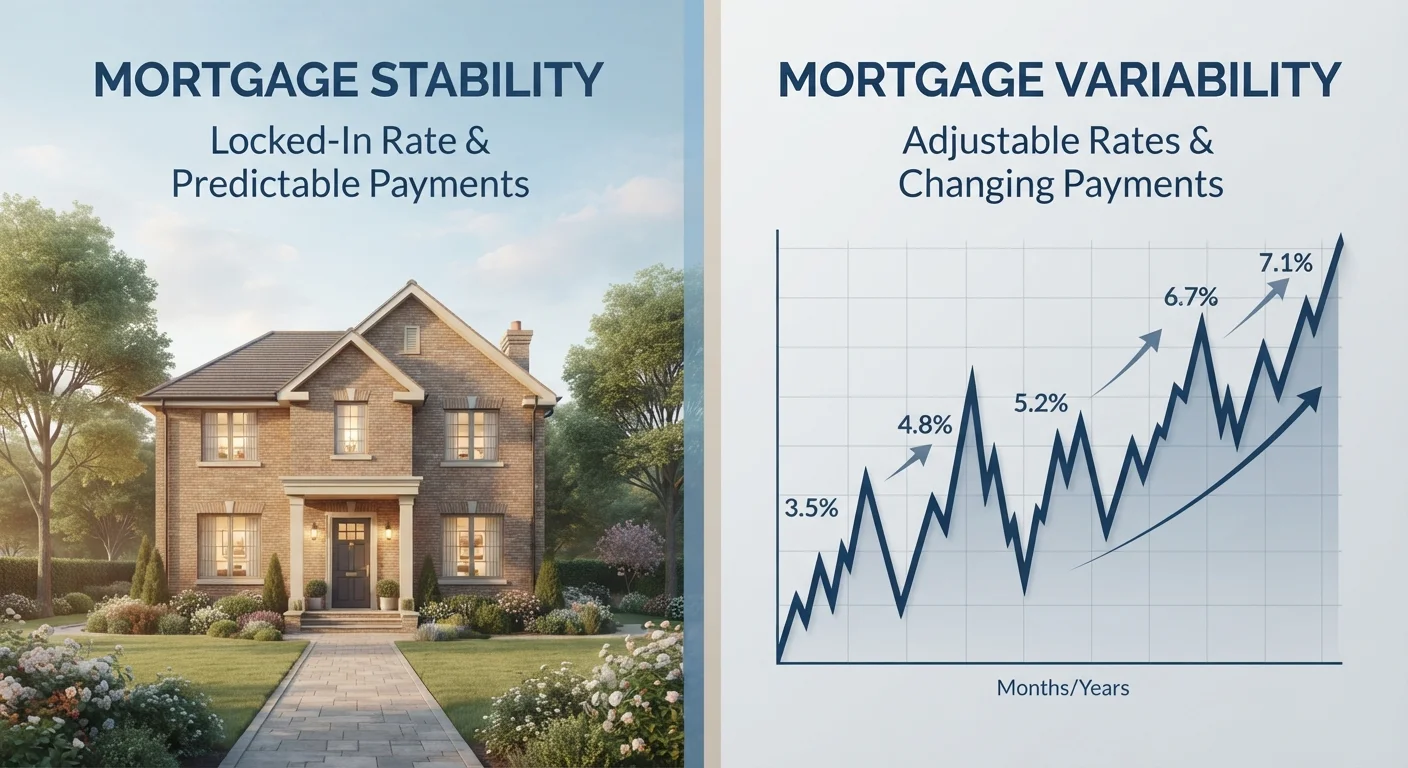
A fixed-rate mortgage sets your interest rate at closing and keeps it there for the entire loan term - most commonly 15 or 30 years. Your principal and interest payment never changes, even if market rates climb or fall. What you see at signing is what you pay at year twenty-nine.
An adjustable-rate mortgage (ARM) works differently. It begins with a fixed introductory period - often 5, 7, or 10 years - during which the rate is typically lower than comparable fixed-rate loans. After that window closes, the rate adjusts periodically (usually once per year) based on a benchmark index, such as the Secured Overnight Financing Rate (SOFR), plus a fixed margin set by the lender. Common ARM labels like "5/1" or "7/1" indicate the length of the initial fixed period and how often it adjusts afterward.
ARMs include rate caps that limit how much the interest rate can increase at each adjustment and over the life of the loan - a meaningful protection, though not a guarantee against significantly higher payments. Understanding how these caps work is essential before committing to an ARM. For context on how broader housing market forces interact with mortgage pricing, see our piece on why home prices and mortgage rates don't always move together.
| Criterion | Fixed-Rate Mortgage | Adjustable-Rate Mortgage (ARM) |
|---|---|---|
| Interest Rate | Locked in for full loan term | Fixed initially, then adjusts periodically |
| Initial Monthly Payment | Typically higher | Typically lower |
| Payment Predictability | Completely stable | Variable after intro period |
| Rate Risk | None after closing | Rises if market rates increase |
| Best Horizon | Long-term (10+ years) | Shorter-term (under 7 years) |
| Complexity | Straightforward | Requires understanding caps and indexes |
| Refinancing Need | Optional | Often part of the strategy |
The Core Trade-Off: Certainty vs. Cost
The central tension between these two mortgage types comes down to what you're willing to pay for certainty. Fixed-rate loans price in predictability - borrowers effectively pay a premium to guarantee their rate won't rise. ARMs shift some of that interest-rate risk back to the borrower in exchange for a lower starting cost.
When fixed rates are relatively high compared to historical norms, the introductory rate on an ARM can be meaningfully lower - sometimes by a full percentage point or more. On a $400,000 mortgage, a one-point rate difference translates to roughly $200-$250 less per month at the outset. That gap matters - but only if you're not exposed to large rate resets later.
5/1
Most common ARM structure in the US
A 5/1 ARM has a fixed rate for five years, then adjusts annually - the most widely offered adjustable structure according to mortgage industry data.
2-5%
Typical refinancing closing cost range
Homeowners who plan to refinance before an ARM adjusts should budget for closing costs, which commonly run 2-5% of the loan balance.
30 years
Most common fixed mortgage term
The 30-year fixed-rate mortgage remains the dominant loan type for US homebuyers, prized for its payment stability over a long ownership horizon.
Conversely, when fixed rates are already low, the savings offered by an ARM narrow considerably, and the added complexity and risk may not be worth it. This is why the rate environment at the time you borrow matters as much as the loan structure itself.
For buyers still weighing whether to purchase at all, our overview of renting versus buying trade-offs may be a useful companion read.
How to Apply This to Your Situation
Start with one honest question: How long do you realistically expect to stay in this home? If the answer is fewer than seven years, an ARM's fixed introductory period may expire after you've already sold or refinanced - meaning you'd capture the lower rate without facing the adjustment risk. If you're planting roots for the foreseeable future, a fixed-rate loan's stability tends to serve long-term owners better.
Next, consider your income stability. Fixed payments simplify budgeting and protect against financial stress if rates spike. If your household income fluctuates or has little margin, the payment certainty of a fixed-rate mortgage is often worth the slightly higher initial rate.
Also factor in refinancing. Some ARM borrowers plan to refinance before the rate adjusts. That strategy can work, but it depends on rates being favorable and your financial profile qualifying at that future point - neither of which is guaranteed. Refinancing also carries closing costs, typically 2-5% of the loan amount, which erode any savings achieved.
This decision also connects to how you're structuring your overall finances. Our saving and debt guidance can help you think through the broader picture before committing to either structure. If you've already settled the rent-vs-buy question, the framework for thinking it through may offer additional context as you move deeper into the buying process.
This article provides general educational information about mortgage loan structures and is not personalized financial or legal advice. Consult a licensed mortgage professional or financial advisor before making decisions about your specific situation.