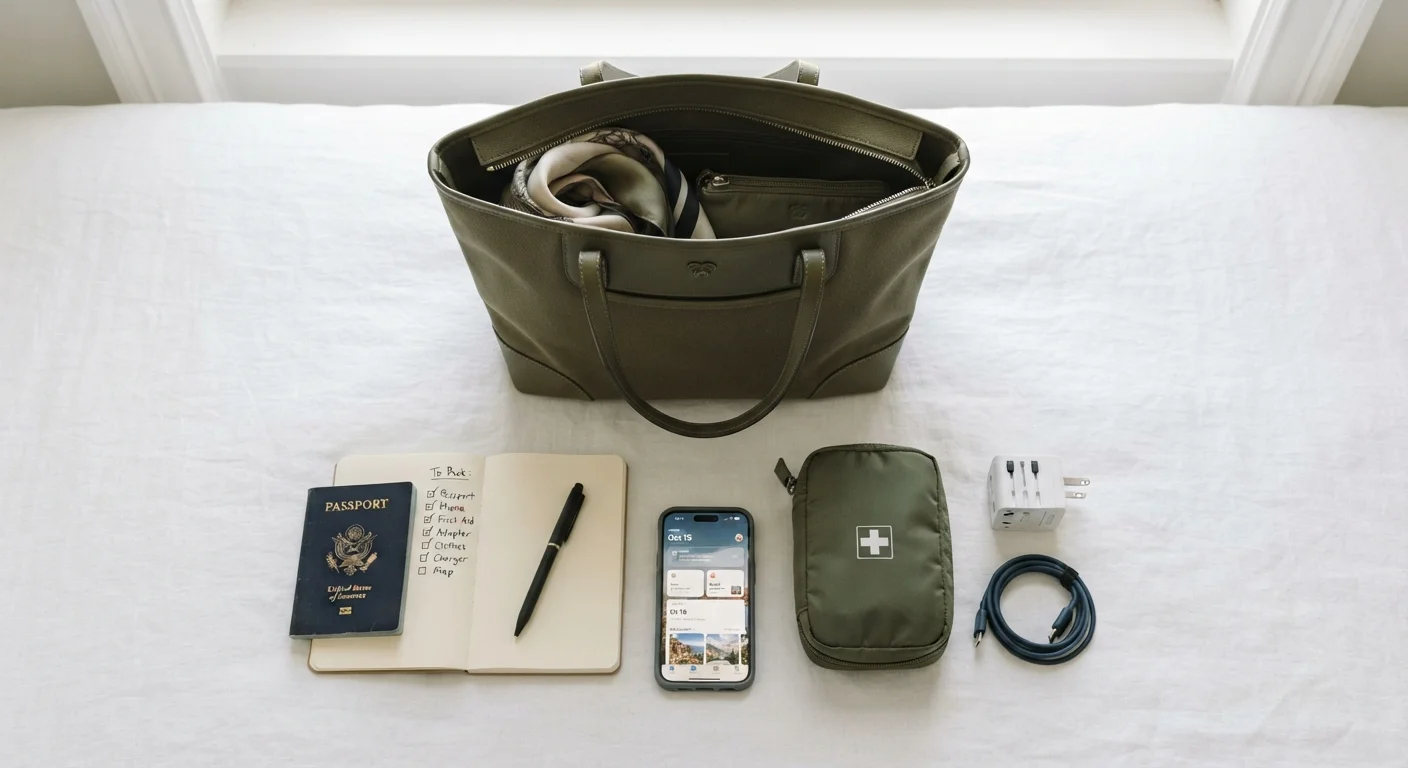
Carry both physical and digital copies of all critical travel documents before departure.
Share your full itinerary and emergency contacts with someone you trust at home.
Verify health insurance coverage and medication rules for your destination in advance.
Secure your devices and avoid public Wi-Fi for sensitive transactions while traveling.
Confirm your financial accounts are travel-ready and that you have accessible backup funds.
30–60 min
Summary
24 items · 30-60 minutes
Why a Pre-Trip Safety Checklist Matters
Most travel mishaps aren't random - they result from gaps in preparation that seemed minor at home but snowballed on the road. A missed document, an unreachable emergency contact, or a phone stolen without a backup plan can turn an inconvenience into a genuine crisis.
This checklist is designed to close those gaps before you leave. It covers the five pillars of travel safety readiness: documents, emergency communications, health, digital security, and financial preparedness. Whether you're heading overseas for a month or driving three states away for a weekend, the same fundamentals apply.
For a broader foundation on staying safe from the moment you start planning, see Travel Safety From the Ground Up, which walks through core safety concepts every traveler should understand. You can also pair this checklist with the full Pre-Trip Preparation Checklist for a complete pre-departure review.
Documents & ID
Confirm your passport is valid for at least six months beyond your return date and make two photocopies - leave one at home and carry one separately from the original.Must
Store digital copies of your passport, driver's license, visa, travel insurance policy, and vaccination records in a secure, encrypted cloud location.Must
Verify visa and entry requirements directly through official government sources for every country you're entering, including transit stops.Must
Register your trip with the U.S. State Department's Smart Traveler Enrollment Program (STEP) if traveling internationally, so embassies can reach you in emergencies.Should
Emergency Communications
Write down the local emergency number, the nearest U.S. embassy or consulate address and phone number, and your accommodation's address for every destination.Must
Leave a complete, day-by-day itinerary - including hotel names, flight numbers, and local contact details - with at least one trusted person at home.Must
Agree on a check-in schedule with your emergency contact so they know when to act if they don't hear from you.Should
Save key contacts (home contact, insurance hotline, embassy) in both your phone and on a written card stored separately from your phone.Should
Health & Medical Prep
Confirm that your health insurance covers international travel or that your travel insurance policy includes adequate medical and evacuation coverage - read the policy details carefully.Must
Carry a supply of all prescription medications that covers your full trip plus several extra days, kept in original labeled containers.Must
Check whether your medications are legal in your destination country, as some common prescriptions are controlled or prohibited abroad.Must
Consult a travel health clinic or your physician about recommended or required vaccinations and preventive medications for your destination well in advance.Should
Pack a compact first aid kit that includes adhesive bandages, antiseptic wipes, pain reliever, antidiarrheal medication, and any personal medical items.Should
Digital Security
Enable full-device encryption and strong passcodes or biometric locks on every device you're bringing.Must
Install and activate a reputable VPN before departure so you can use it immediately on any public or hotel Wi-Fi network.Should
Back up all devices - photos, contacts, and key files - to a secure cloud account or external drive before leaving.Must
Enable remote-wipe capabilities on your smartphone and laptop in case of theft or loss.Should
Avoid accessing banking or sensitive accounts over public Wi-Fi; use mobile data or a VPN instead.Should
Financial Readiness
Notify your bank and credit card issuers of your travel dates and destinations to prevent transactions from being flagged and blocked.Must
Carry at least two payment methods - such as a credit card and a debit card from different networks - stored in separate locations.Must
Keep a small amount of local currency or US dollars accessible for emergencies where cards aren't accepted.Should
Know the international customer service number for each card you're carrying - printed on the card back or stored securely offline.Nice to have
How to Use This Checklist
Work through each group at least 48-72 hours before your departure, not the night before. That buffer gives you time to act on anything you find - like renewing an expiring passport, filing a travel notice with your bank, or visiting a travel health clinic.
Document and financial items should be revisited closest to departure. Digital security steps can be done a week out. Health prep, especially vaccinations, may require weeks of lead time - check official CDC and State Department guidance for your destination early.
Don't Leave Vaccination Timing to the Last Minute
Some travel vaccines require multiple doses spread over several weeks before they become fully effective. If you're traveling to a region with yellow fever, typhoid, or other vaccination requirements, start the process at least four to six weeks before departure. Check the CDC Travelers' Health website and your destination country's entry requirements for current guidance.
For detailed guidance on entry documents, visas, and what Americans frequently overlook, consult Documents, Visas, and Entry Requirements. For financial readiness specifically, the Pre-Trip Financial Checklist covers bank notifications, currency, and spending limits in detail.
Travel & Vacations Editorial Team is the collective byline for our editorial team and contributor network. Articles published under this byline or an editorial pen name are researched, written, and reviewed according to our editorial standards for clarity, consistency, and independence before publication.
Disclaimer: The content on this site is provided for informational purposes only and should not be considered a substitute for professional advice. While we strive to provide accurate and up-to-date information, we make no guarantees regarding its completeness or accuracy. Always consult a qualified professional for advice specific to your circumstances before making any decisions.