

Key Takeaways
Tailgating (Following Too Closely)
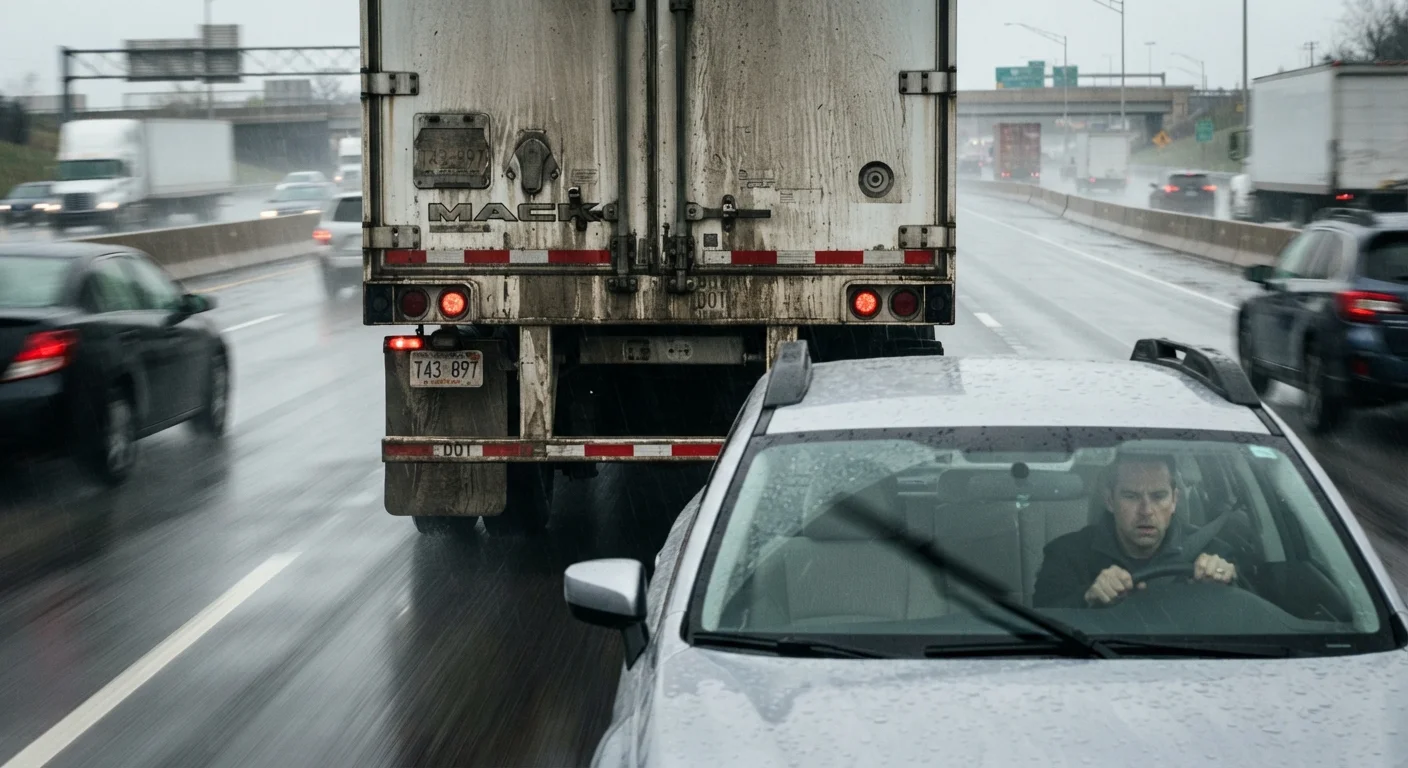
Tailgating means driving so close behind another vehicle that you would not have enough distance to stop safely if that vehicle braked suddenly. It is one of the most common contributing factors in rear-end collisions on American roads. The term applies at any speed - from slow city traffic to highway driving - wherever the gap between vehicles is smaller than what stopping physics require.
Traffic safety researchers often measure following distance in terms of 'time gap' - the number of seconds between when the front vehicle passes a fixed point and when the following vehicle reaches the same point. A gap under two seconds is widely considered unsafe at highway speeds.
The Physics Problem Every Tailgater Ignores
When a driver follows too closely, they are not merely bending a rule - they are overriding basic physics. Stopping a vehicle involves three distinct phases: perception (seeing the hazard), reaction (deciding to brake), and braking (the vehicle slowing to a stop). Each phase takes time, and time translates directly into distance traveled.
Research from the National Highway Traffic Safety Administration (NHTSA) consistently shows that the average driver takes approximately 1.5 seconds just to perceive and react to a hazard before braking even begins. At 60 mph, that reaction delay alone covers roughly 132 feet - nearly half the length of a standard city block. Add actual braking distance on top, and the total stopping requirement often exceeds what a tailgating driver has available.
This is why the physics of tailgating are so unforgiving: the gap that seems reasonable at a standstill disappears in fractions of a second once vehicles are in motion.
~29%
Share of U.S. crashes involving rear-end collisions
According to NHTSA data, rear-end crashes consistently represent one of the largest single crash categories on American roads.
1.5 sec
Average driver perception-reaction time
Traffic safety research indicates most drivers require approximately 1.5 seconds from perceiving a hazard to beginning brake application.
132 ft
Distance traveled during reaction time at 60 mph
At 60 mph, a vehicle covers roughly 88 feet per second - meaning reaction delay alone consumes about 132 feet before braking begins.
Why Drivers Underestimate the Risk
Tailgating is uniquely underestimated because it does not feel dangerous in the moment. Unlike running a red light or drifting into another lane, following closely tends to feel routine - especially in heavy traffic where bumper-to-bumper conditions are normalized.
Speed perception also works against drivers. At highway speeds, the brain struggles to accurately gauge how fast the gap between vehicles is closing when the car ahead brakes. What feels like a comfortable buffer at 70 mph is, in objective terms, a fraction of a second away from contact.
There is also a false confidence problem. Many drivers believe their own reflexes are faster than average, or that modern vehicles' braking systems will compensate for a short gap. Anti-lock braking systems (ABS) and electronic stability control are genuine safety advances, but they do not override the laws of physics - they simply optimize braking within whatever distance is available. If that distance is already too short, no technology closes the gap.
For a broader look at how assumptions behind the wheel contribute to crashes, see how misreading other drivers' intentions causes collisions.
How Following Distance Should Actually Be Calculated
The widely taught three-second rule provides a practical baseline: choose a fixed landmark, and ensure at least three full seconds pass between the vehicle ahead crossing it and your own vehicle reaching the same point. This method automatically adjusts for speed - at higher speeds, three seconds represents a larger physical distance, which is exactly what greater speed demands.
However, three seconds is a minimum for ideal conditions. Traffic safety professionals recommend expanding that gap in the following situations:
- Rain or wet roads: Stopping distances increase substantially on wet pavement. Four to five seconds is a more appropriate buffer.
- Night driving: Reduced visibility means hazards appear later. Night driving habits that reduce risk include increasing following distance to compensate.
- Towing or hauling: Added weight significantly extends stopping distance. Drivers towing trailers should treat their vehicle's braking as fundamentally different from unloaded driving.
- Following large trucks: Large vehicles take longer to stop and also block your forward sightlines, reducing your hazard perception time further.
Speed and following distance are closely linked - understanding posted limits in context matters too. Our article on speed limits versus safe speed explains when the legal ceiling is not the same as the safe ceiling.
The Broader Safety Picture
Tailgating does not occur in isolation. It frequently combines with other risk factors - distraction, drowsiness, or aggressive driving - to dramatically raise crash probability. A driver who is both following closely and momentarily distracted has essentially eliminated their stopping margin entirely.
Common distracted driving myths reveal how even brief inattention is far more dangerous than most drivers appreciate. The compounding effect of distraction plus tailgating is a scenario traffic safety researchers flag as especially high-risk.
For newer drivers still building situational awareness, these risks are amplified. Road safety for new drivers covers how habits around following distance and hazard perception develop - and why they take deliberate practice to establish.
The bottom line: maintaining adequate following distance is one of the simplest, most consistently effective things any driver can do. It costs nothing, requires no equipment, and has a direct, measurable impact on the time available to avoid a crash.
This article is intended for general driver education purposes. Always follow the traffic laws of your state and consult official driving resources or a licensed instructor for personalized guidance.