

Key Takeaways
Option A
Posted Speed Limit
The legal ceiling - defined by regulation, not real-time conditions.
Best for: Establishing a uniform, enforceable maximum speed on a given road under ideal circumstances.
Option B
Safe Speed
The condition-adjusted standard - defined by context, not a sign.
Best for: Protecting drivers, passengers, and others on the road when real-world conditions fall short of ideal.
If conditions are clear, dry, and traffic is light
Posted Speed Limit
Under ideal circumstances, the posted limit represents a reasonable and legal ceiling that traffic engineers designed for that road type.
If rain, fog, ice, or snow is present
Safe Speed
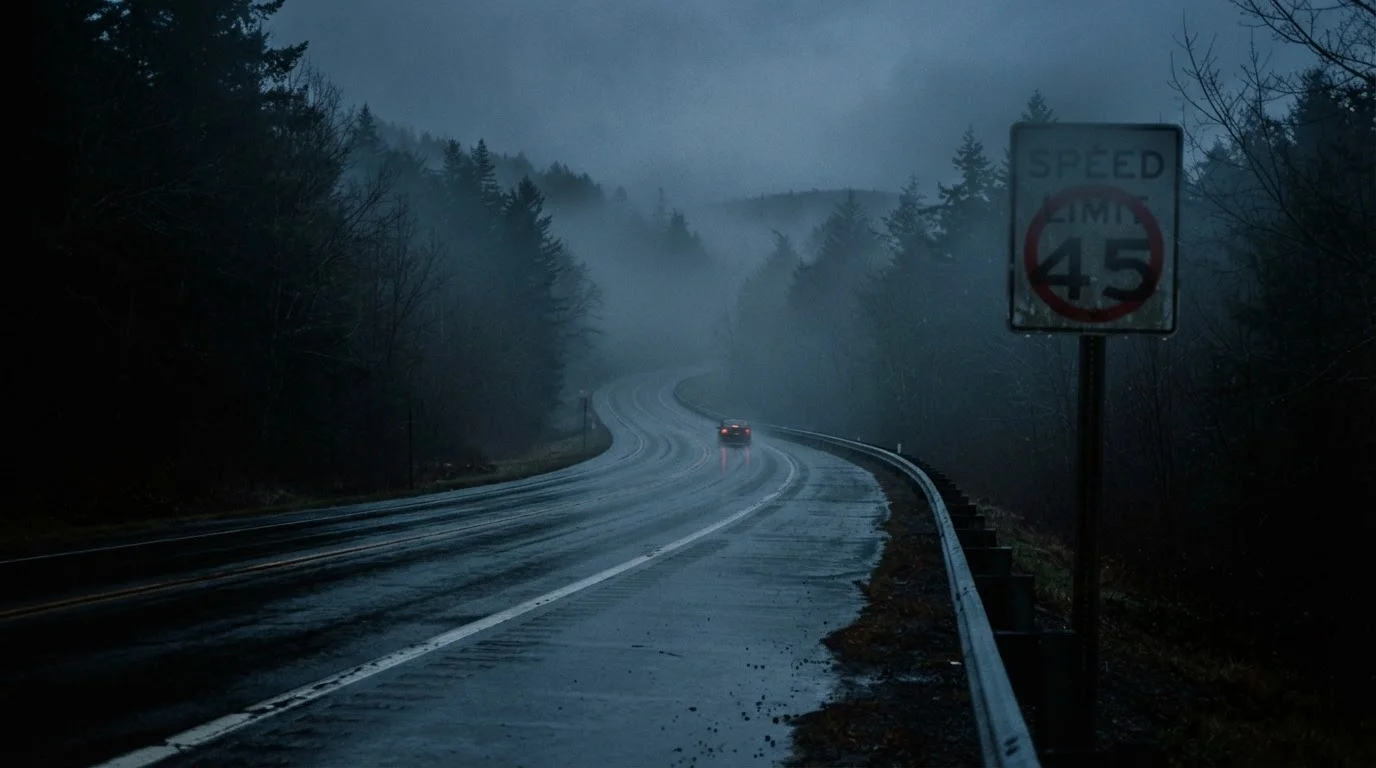
Wet or frozen roads dramatically extend stopping distances; driving below the posted limit is both legally expected and physically necessary.
If visibility is reduced by darkness, glare, or weather
Safe Speed
Your speed should never exceed your ability to stop within the distance you can clearly see ahead - a standard the posted limit doesn't account for.
If navigating heavy traffic, school zones, or pedestrian areas
Safe Speed
High pedestrian density and unpredictable traffic behavior require margin that the posted limit alone does not provide.
If driving an unfamiliar road with curves, hills, or poor markings
Safe Speed
Unknown road geometry and limited lane guidance demand reduced speed to maintain control and response time.
What Speed Limits Actually Represent
Speed limits are set through an engineering process that typically considers road geometry, lane width, pedestrian activity, crash history, and the speed at which most drivers naturally travel under good conditions. The widely used standard in the U.S. involves studies of what's called the 85th percentile speed - the pace at or below which 85% of freely moving drivers travel on a given road. Engineers then set limits at or near that figure for typical conditions.
That word - typical - carries enormous weight. A posted limit of 55 mph on a rural highway assumes adequate visibility, dry pavement, and light traffic. It does not account for the patch of black ice that forms on a shaded overpass at 28°F, the deer that steps into your headlights, or the thick fog rolling in off a river. The sign cannot update itself. You have to.
Understanding this distinction is foundational to responsible driving. The posted number is a legal ceiling, not a situational guarantee. As our guide to stopping distance explains, speed and road surface interact in ways most drivers underestimate - and the posted limit reflects none of those variables in real time.
How Conditions Override the Posted Number
Most U.S. states include a basic speed law (sometimes called the prima facie speed law) in their traffic codes. The principle is consistent: a driver must travel at a speed that is reasonable and prudent given the actual conditions on the road, regardless of what the posted sign says. In practical terms, this means you can receive a citation for driving at or even below the speed limit if conditions made that speed unsafe.
The conditions that most commonly demand a reduction in speed include:
- Precipitation: Rain, snow, and ice reduce tire grip significantly. Wet roads can increase stopping distances by 50% or more; ice can multiply them several times over.
- Reduced visibility: Fog, heavy rain, glare, or darkness narrow the distance within which you can perceive and react to hazards. Safe driving requires that you can stop within what you can see.
- Traffic density: Heavy or erratic traffic shrinks the margin for error. Following distance and reaction time both become more critical - see our overview of why tailgating is more dangerous than most drivers realize.
- Road geometry: Sharp curves, steep grades, and blind crests require lower speeds than straights, even at the same posted limit.
- Construction zones and school zones: Temporary hazards and vulnerable road users demand heightened caution beyond what static signage can fully communicate.
| Criterion | Posted Speed Limit | Safe Speed |
|---|---|---|
| Set by | Traffic engineers and regulators | Driver judgment based on conditions |
| Based on | Ideal road and weather conditions | Real-time visibility, surface, and traffic |
| Legal status | Enforceable maximum | Required under basic speed laws |
| Updates in real time | No - fixed until sign is changed | Yes - must adapt constantly |
| Accounts for weather | No | Yes - central factor |
| Accounts for visibility | No | Yes - stop-within-sight rule applies |
| Accounts for traffic density | Partially (design basis only) | Yes - must adjust for live conditions |
| Can you be cited for ignoring it | Yes - if you exceed it | Yes - if conditions required lower speed |
The Judgment Gap: Why Compliance Isn't Enough
One of the most common misunderstandings in driver behavior is equating legal compliance with safety. Driving at exactly the speed limit feels like the responsible choice - and often it is. But the judgment gap opens when conditions diverge from what the limit was designed for.
New and inexperienced drivers are particularly susceptible to this mindset. Because sign-reading is one of the first skills taught, it can anchor thinking in a way that crowds out situational awareness. Our article on road safety for new drivers explores how experienced drivers develop a more fluid, condition-sensitive relationship with speed over time.
The risks also differ sharply by environment. A 45 mph road in a dense urban neighborhood presents fundamentally different hazards than a rural 45 mph two-lane - as discussed in our comparison of rural roads vs. urban streets. The posted number may be identical; the safe speed may not be.
There is also the matter of other drivers. Speed decisions don't happen in isolation. Misreading traffic flow, assuming another vehicle will yield, or misjudging a gap are all factors that can make a technically legal speed lethal. Our piece on assumptions that cause crashes addresses this dynamic directly.
~33%
Of fatal crashes linked to speeding
The NHTSA consistently reports that speeding - including speed inappropriate for conditions - is a factor in roughly one-third of U.S. traffic fatalities annually.
50%+
Increase in stopping distance on wet roads
Transportation safety research indicates that wet pavement can increase braking distances by more than 50% compared to dry conditions at the same speed.
85th percentile
Speed used to set many posted limits
Many U.S. jurisdictions use the 85th percentile speed from traffic studies as a baseline for posted limit determination under ideal conditions.
This article is for general educational purposes about road safety and is not a substitute for your state's traffic laws or professional driver training. Always verify local regulations with your state's DMV or transportation authority.