

Key Takeaways
Our Verdict
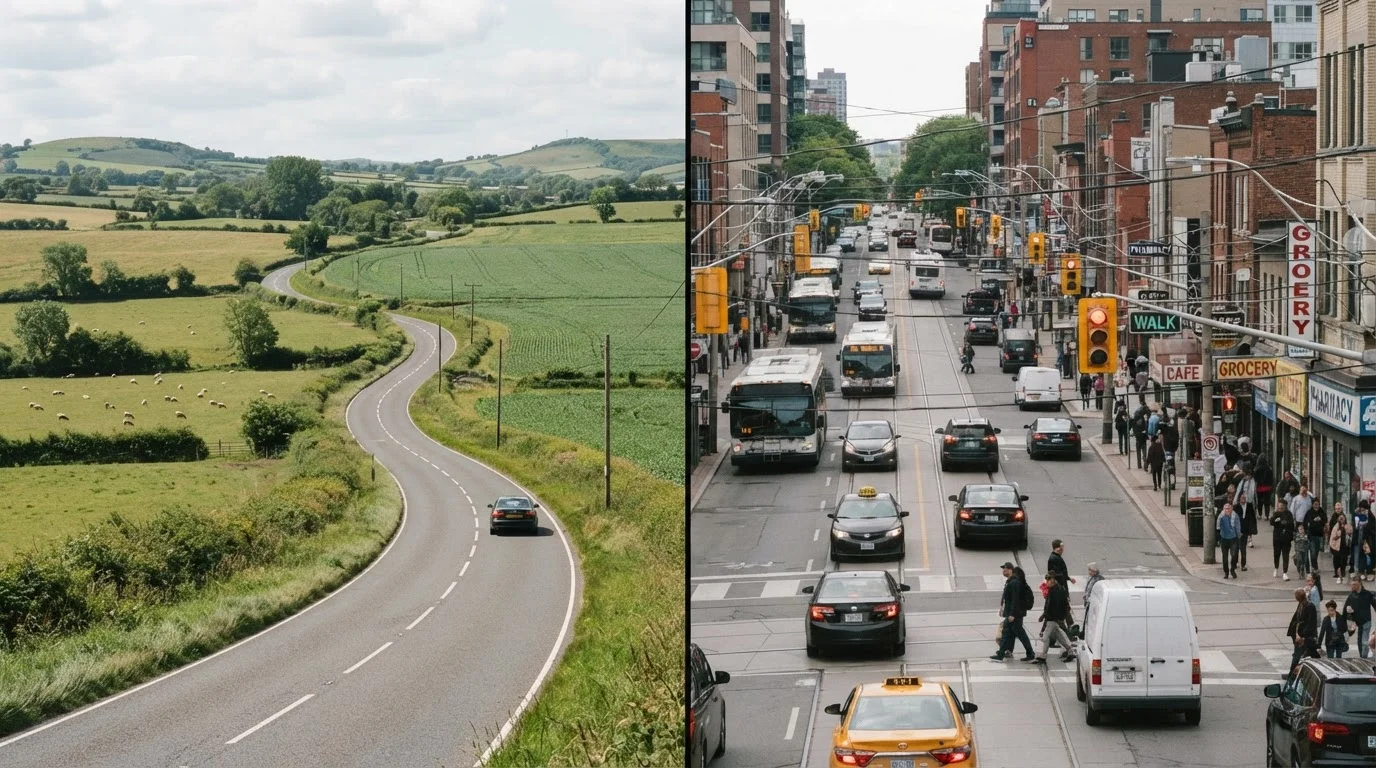
Rural and urban roads present fundamentally different risk profiles. Rural environments are associated with higher fatality rates due to speed, limited lighting, and delayed emergency response. Urban environments generate more frequent crashes overall, driven by congestion, pedestrians, cyclists, and complex intersections. Safe driving in either setting depends on recognizing which specific hazards are most likely and adjusting behavior accordingly.
| Best for | Recommended |
|---|---|
| Drivers navigating rural highways and back roads | Rural-focused awareness: manage speed, combat fatigue, and plan for delayed emergency response |
| Drivers in dense city traffic | Urban-focused awareness: monitor pedestrians, intersections, cyclists, and frequent stops |
| Drivers who regularly travel between both environments | Adaptive driving: consciously shift mindset and habits when transitioning between road types |
The Numbers Behind the Risk
A common assumption is that city driving - dense, congested, unpredictable - must be the most dangerous. The data tells a more complicated story. According to the National Highway Traffic Safety Administration (NHTSA), rural roads consistently account for a majority of traffic fatalities in the U.S., often representing more than half of all fatal crashes despite carrying a fraction of total vehicle miles traveled.
Urban roads, by contrast, produce a far higher volume of crashes overall, but most are lower-severity collisions - fender-benders, sideswipes, and low-speed impacts. The key distinction is crash severity versus crash frequency. Rural crashes are more likely to kill; urban crashes are more likely to occur.
~50%+
Rural share of U.S. traffic fatalities
NHTSA data consistently shows rural roads account for more than half of traffic fatalities despite lower traffic volume compared to urban areas.
2-4x
Longer rural EMS response times
Emergency medical response in rural areas can take two to four times longer than urban response, increasing fatality risk for serious crash injuries.
Understanding why these patterns exist is the first step toward driving more safely in both settings.
What Makes Rural Roads More Deadly
Several structural factors converge to make rural crashes more lethal:
- Higher speeds: Rural roads often have posted limits of 55-70 mph, and without the natural friction of traffic, drivers frequently exceed them. At higher speeds, crash forces increase dramatically, and reaction distances grow. See our guide on safe speed vs. posted limits for how conditions should shape your actual pace.
- Limited lighting: Most rural roads have no street lighting, making nighttime driving significantly more hazardous. Reduced visibility reduces reaction time for animals, debris, or unexpected curves. Our article on night driving habits covers evidence-based practices for exactly these conditions.
- Delayed emergency response: When a serious crash occurs in a remote area, EMS response times can be two to four times longer than in urban settings. Survivable injuries can become fatal without timely medical intervention.
- Road design: Rural roads often lack medians, guardrails, rumble strips, and paved shoulders - features that reduce run-off-road crashes and head-on collisions.
- Driver fatigue: Long, monotonous stretches of straight road contribute to highway hypnosis - a state of reduced alertness that impairs reaction time without the driver always recognizing it.
The Urban Driving Challenge: Complexity Over Speed
Urban driving hazards stem less from speed and more from density and unpredictability. City streets concentrate vehicles, cyclists, pedestrians, delivery trucks, and public transit into limited space - often managed by traffic signals and signage that not every road user follows consistently.
Intersections are a particular danger zone. Research consistently shows that a large share of urban crashes occur at or near intersections, where crossing paths, turning conflicts, and signal violations create collision opportunities. Our breakdown of why intersections are where crashes most often happen explains the specific dynamics at work.
Other urban-specific risks include:
- Pedestrian and cyclist exposure: Urban environments have far more vulnerable road users. Pedestrian fatalities are heavily concentrated in city settings, particularly at crosswalks and mid-block crossings.
- Frequent stop-and-go: Rear-end collisions are among the most common urban crash types, driven by sudden stops, distracted driving, and tailgating in congested conditions.
- Dooring and lane-change conflicts: Parked vehicles, narrow lanes, and cyclists create hazards that rarely appear in rural driving.
| Risk Factor | Rural Roads | Urban Streets | |
|---|---|---|---|
| Crash frequency | Lower overall crash volume | Higher overall crash volume | |
| Crash severity / fatality rate | Significantly higher fatality rate | Lower fatality rate per crash | |
| Typical speed | 55-70 mph or higher | 25-45 mph in most areas | |
| Primary hazards | Speed, wildlife, poor lighting, fatigue | Pedestrians, cyclists, intersections, congestion | |
| Road infrastructure | Often lacks medians, guardrails, lighting | Signals, crosswalks, marked lanes common | |
| Emergency response time | Significantly delayed in remote areas | Generally faster due to proximity | |
| Most common crash type | Run-off-road, head-on, animal strikes | Rear-end, sideswipe, pedestrian conflicts |
Adapting Your Habits When Environments Change
Many drivers spend time in both environments - commuting in the city, then traveling rural highways on weekends or holidays. The transition between these settings requires a deliberate mental shift, not just a change in posted speed.
When moving from urban to rural driving, recalibrate for:
- Increased following distance to account for higher speeds and fewer escape routes
- Active scan for animals, farm equipment, and unmarked intersections
- Fatigue management on long stretches - plan rest stops before you feel tired
When moving from rural to urban driving, recalibrate for:
- Expanded awareness of pedestrians, cyclists, and parked-car doors
- Earlier braking and lower following speeds in stop-and-go conditions
- Heightened intersection attention, particularly for signal violations and turning vehicles
New drivers navigating either environment for the first time face a steep learning curve - our road safety guide for new drivers covers the situational awareness skills that take time to develop. Weather also reshapes risk in both settings; our guide on driving in rain, fog, and snow outlines how each condition changes the equation.
The core principle in both environments is the same: match your awareness and speed to the actual risks present, not just the posted limit or familiar routine. Both rural roads and city streets reward the driver who stays engaged.