

Key Takeaways
Intersection Crash Risk
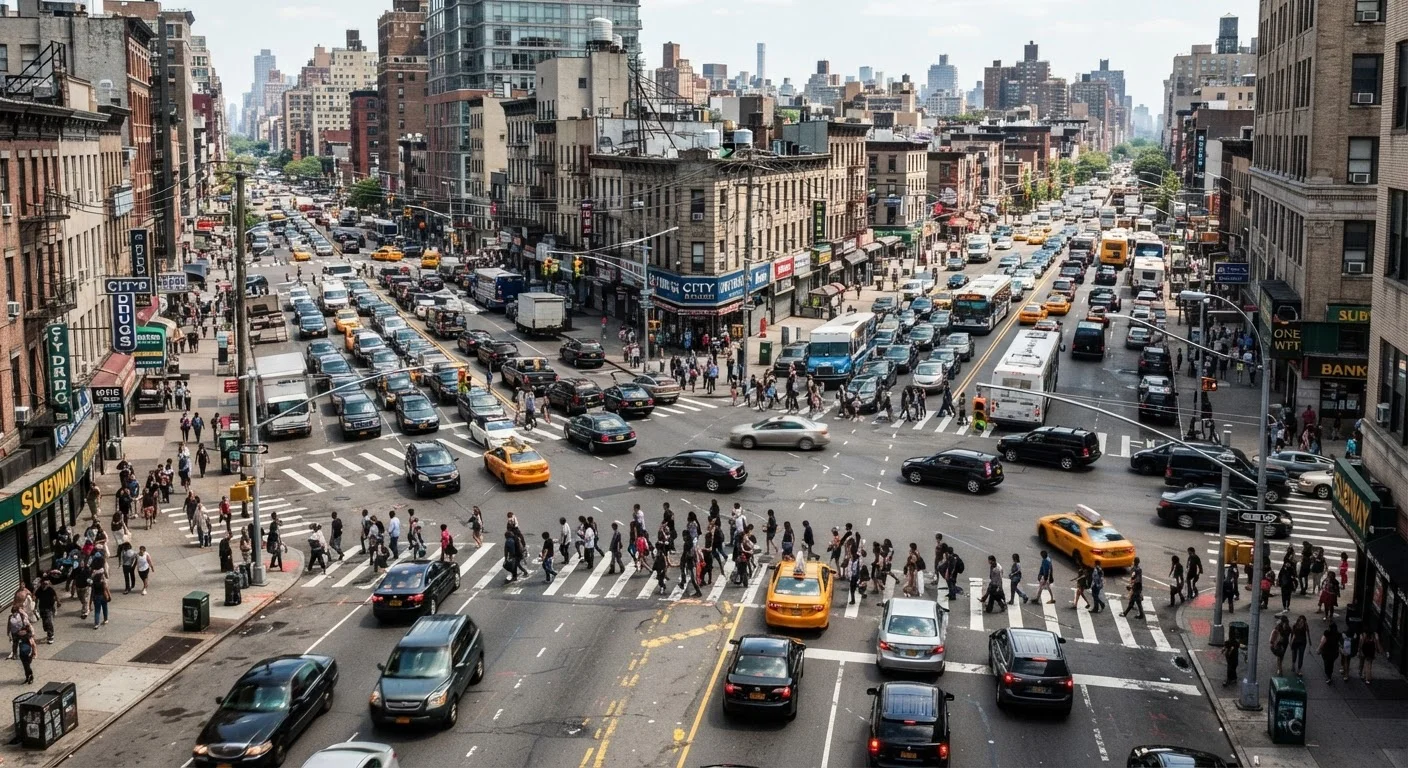
An intersection is any point where two or more roadways cross or meet, requiring drivers to navigate conflicting vehicle paths, turning movements, and pedestrian activity simultaneously. Because so many movements converge in a small space, intersections account for a disproportionately large share of all traffic crashes. The risk stems not from any single factor but from the combination of speed, driver decision-making, road design, and visibility - all colliding at once.
Traffic engineers use the term 'conflict points' to describe the locations within an intersection where vehicle paths can legally cross or merge. A standard four-way intersection has up to 32 vehicle-to-vehicle conflict points, excluding pedestrian crossings.
Why Intersections Concentrate Crash Risk
Every intersection is an engineered compromise. Multiple roads, with vehicles traveling at different speeds and in different directions, must share the same physical space. Traffic signals, stop signs, and yield markings attempt to sequence these movements - but they rely entirely on every driver following the rules at exactly the right moment.
When that coordination breaks down, the consequences are swift. Unlike a rear-end crash on a straight road, an intersection collision often occurs at a right angle or during a crossing movement, channeling the full force of both vehicles into a side structure with less crash protection. The geometry alone makes these crashes more likely to cause serious injury.
The Federal Highway Administration identifies intersections as the location of approximately 40 percent of all U.S. traffic crashes. Understanding why that figure is so high is the first step toward driving through them more safely. For a broader look at how different road environments create different risks, see our article on how driving risk differs by environment.
~40%
Of all U.S. crashes involve intersections
According to the Federal Highway Administration, intersections account for roughly 40 percent of all reported traffic crashes nationwide.
Hundreds/year
Annual fatalities from red-light running
The Insurance Institute for Highway Safety reports that red-light running causes hundreds of deaths and tens of thousands of injuries in the U.S. each year.
32
Vehicle conflict points in a 4-way intersection
Traffic engineers identify up to 32 vehicle-to-vehicle conflict points at a standard four-way intersection, not counting pedestrian crossings.
Significantly lower
Fatal crash rates at roundabouts vs. signals
IIHS research consistently shows roundabouts produce substantially fewer fatal crashes than traditional signalized intersections of comparable volume.
The Specific Movements That Cause Crashes
Not all intersection movements carry equal risk. Traffic engineers categorize intersection conflicts by type, and several consistently produce the highest injury rates.
Left Turns Across Oncoming Traffic
A driver turning left must judge the speed and gap of oncoming vehicles while monitoring the opposing lane, checking for pedestrians, and watching for cyclists - often under pressure from vehicles queued behind. Misjudging oncoming speed by even a fraction of a second can place the turning vehicle directly in the path of a faster-approaching car. This movement is disproportionately represented in serious-injury crash data.
Red-Light Running
Entering an intersection on a red signal creates a high-speed angle collision scenario. The Insurance Institute for Highway Safety consistently identifies red-light running as a source of hundreds of U.S. fatalities per year. Critically, the driver with the green signal has no warning before the impact - the collision happens before any evasive action is possible.
Failure to Yield at Uncontrolled Intersections
Not every intersection has a signal or stop sign. At uncontrolled crossings, drivers must negotiate right-of-way using judgment alone. Assumptions about who will yield - a common cognitive shortcut - are a major crash contributor here. Our article on misreading other drivers' intentions explains why prediction and anticipation are not the same thing.
Environmental and Design Factors Drivers Often Overlook
Driver behavior is only part of the equation. Intersection design, sight-line obstructions, and signal timing all independently affect crash likelihood.
Sight-line obstructions - parked vehicles, overgrown vegetation, utility poles, or poorly placed signage - can hide a cross-street vehicle until it is too close to avoid. Drivers should actively scan for these blind zones on approach rather than assuming a clear view.
Signal timing and yellow-light duration influence whether drivers attempt to clear the intersection or stop. Poorly calibrated timing can increase red-light violations even among attentive drivers.
High-volume pedestrian crossings add another layer of conflict. Pedestrians entering the crosswalk on a walk signal can be in the path of a legally turning vehicle whose driver is focused on vehicle gaps rather than the crosswalk.
Roundabouts: A Design Response to Intersection Risk
Roundabouts replace right-angle conflict points with merging movements at lower speeds, which is why research consistently links them to fewer fatal crashes. However, they introduce their own yielding requirements that unfamiliar drivers sometimes misapply. If you encounter a roundabout, yield to circulating traffic already inside the roundabout, and signal before exiting.
Roundabouts address several of these structural problems by eliminating right-angle conflict points and forcing vehicle speeds down through geometry. Research from the Insurance Institute for Highway Safety shows roundabouts substantially reduce fatal crashes compared to traditional intersections - though driver familiarity and correct yielding behavior remain essential to their effectiveness.
Attentive Driving Habits That Reduce Intersection Risk
No driving habit eliminates risk entirely, but several practices consistently reduce a driver's exposure at intersections.
- Slow on approach, not just at the stop line. Reducing speed earlier gives you more time to scan cross-traffic and react to unexpected movements.
- Treat a green light as permission to proceed, not a guarantee of safety. Briefly scanning cross-traffic before entering - even on a green - can catch a red-light runner before a collision occurs.
- Cover the brake on stale greens. If a light has been green for a while, it is more likely to change. Hovering your foot near the brake rather than the accelerator shortens reaction time.
- Never assume another driver will yield. Right-of-way rules describe what should happen; they do not guarantee what will happen. This is especially critical at uncontrolled intersections.
- Eliminate in-cab distractions. The few seconds a driver spends glancing at a phone are precisely the interval in which another vehicle can enter a conflict path.
These habits complement broader safe-driving disciplines. Excessive following distance on a straight road matters less than a clear-eyed approach to every intersection ahead - but tailgating at higher speeds remains a serious independent risk that compounds when traffic slows near busy crossings.
For a comprehensive overview of road safety fundamentals, the complete driver's education resource covers everything from basic rules to advanced hazard awareness.