

Key Takeaways
Our Verdict
No single internet type is universally best - the right choice depends heavily on what infrastructure is available at your address. Fiber is the strongest performer where it exists; cable is a reliable fallback for most suburban and urban households; DSL suits light users in areas with limited options; and satellite fills the gap for those beyond the reach of all other technologies.
| Best for | Recommended |
|---|---|
| High-demand households streaming, gaming, or working from home | Fiber |
| Suburban and urban users wanting broad availability and solid performance | Cable |
| Light users in areas where fiber and cable aren't available | DSL |
| Rural and remote users with no wired broadband options | Satellite |
How Each Technology Delivers Your Internet
Understanding how each connection type physically works helps explain the speed, reliability, and availability differences you'll encounter when shopping for a plan.
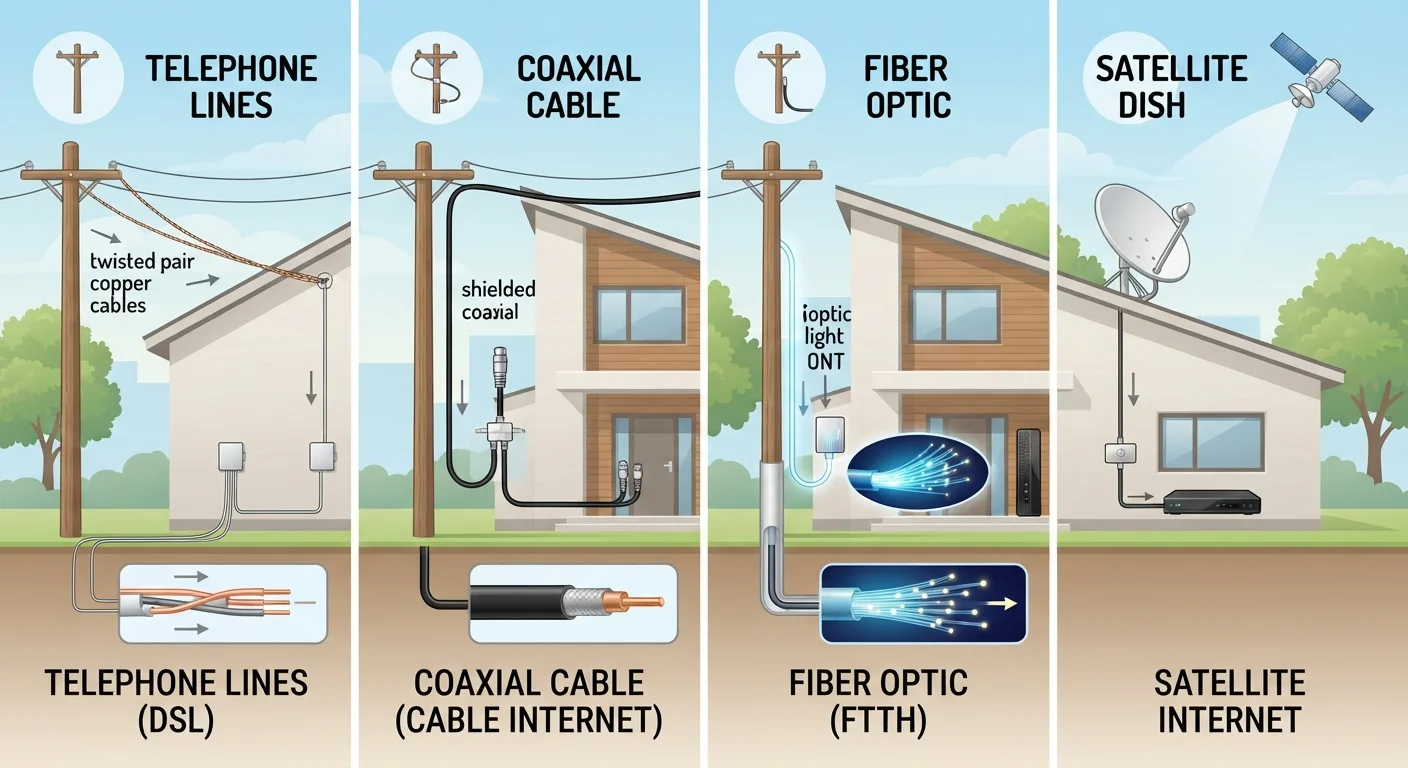
DSL (Digital Subscriber Line) transmits data over the copper telephone wires already installed in most homes. It's a mature technology with broad availability, but your maximum speed is directly limited by how far you live from your provider's equipment. The farther away, the weaker the signal.
Cable internet uses coaxial cable - the same type that delivers cable TV - to carry data. Coaxial cable has significantly more bandwidth capacity than copper phone lines, enabling much higher speeds. However, because neighbors share a network node, speeds can slow during peak evening hours in densely populated areas.
Fiber optic internet transmits data as pulses of light through glass or plastic strands. Light signals degrade far less over distance than electrical signals, which is why fiber delivers consistently high speeds regardless of how far you are from a provider hub. Fiber is increasingly available in cities and suburbs, though rural deployment remains limited.
Satellite internet beams signals between a dish at your home and an orbiting satellite. Traditional geostationary satellites sit roughly 22,000 miles above Earth, creating unavoidable delays (called latency) of 500-700 milliseconds. Newer low-Earth orbit (LEO) satellite systems orbit much closer, dramatically reducing latency - though service quality can still be affected by weather and sky obstructions.
Speed, Latency, and Reliability Compared
Raw download speed is only part of the story. Latency (the delay before data begins moving) and consistency under load matter just as much for video calls, gaming, and streaming.
| DSL | Cable | Fiber | Satellite | |
|---|---|---|---|---|
| Typical download speeds | 1-100 Mbps | 25-1,000+ Mbps | 100-5,000+ Mbps | 25-300 Mbps |
| Typical upload speeds | 1-20 Mbps | 5-50 Mbps | Equal to download | 3-20 Mbps |
| Latency | 25-70 ms | 15-35 ms | 5-20 ms | 20-600 ms |
| Rural availability | High | Moderate | Low | Very high |
| Speed consistency | Moderate | Variable (peak hours) | Very consistent | Variable (weather) |
| Infrastructure used | Copper phone lines | Coaxial cable | Fiber optic strands | Orbital satellites |
Fiber's symmetrical speeds - meaning upload matches download - are particularly valuable for remote workers uploading large files or participating in video conferences. Cable plans often have asymmetrical speeds with uploads significantly slower than downloads, which can become a bottleneck in multi-person households.
DSL speeds vary widely by provider and distance. Basic plans may offer only 1-25 Mbps down, though some newer DSL variants (like VDSL) can approach cable speeds in ideal conditions. For households with only one or two light users, this is often sufficient.
Satellite latency - even with LEO systems - makes real-time applications like competitive online gaming less practical. Streaming video and general web browsing, however, are workable on modern satellite services for most users.
Availability: Where Each Type Actually Reaches
Your location is often the single biggest factor in which internet type you can realistically choose. Before evaluating plans, check which technologies are physically available at your address - ISP coverage maps are a useful starting point, though verifying directly with providers is more reliable.
- DSL reaches the widest geographic footprint because copper phone lines already run to nearly every home in the U.S.
- Cable follows the cable TV infrastructure footprint - comprehensive in suburbs and cities, but sparse in rural areas.
- Fiber is expanding steadily but remains concentrated in urban and growing suburban markets. Many rural communities are still years away from fiber availability.
- Satellite is available virtually anywhere with a clear view of the sky, making it the only broadband option for millions of rural Americans.
If you're evaluating connectivity for a smart home setup with multiple connected devices, see our Smart Home Tech hub for guidance on how your connection type affects device performance. For a broader look at alternative technologies like fixed wireless - which uses radio towers rather than physical lines - compare fixed wireless and cable to see if it's available in your area.
Check Availability Before Comparing Plans
ISP websites allow you to enter your address to see which services are genuinely offered at your location. Government broadband maps (such as those maintained by the FCC) can provide a secondary reference. Knowing exactly which technologies reach your home narrows your decision considerably before you start evaluating speed tiers and pricing.
Cost Considerations and Typical Plan Structures
Pricing varies widely by region, provider, and plan tier, so treat any figures here as general context rather than a shopping guide. That said, some patterns hold across most markets.
DSL plans are often among the more affordable options, reflecting both the older infrastructure and the lower speeds offered. Some providers bundle DSL with phone service, which can affect perceived value depending on whether you need a landline.
Cable plans span a wide price range depending on speed tier. Entry-level cable plans compete with mid-range DSL on price, while gigabit cable plans sit at a premium. Promotional pricing is common - rates often increase after an introductory period, so reviewing the full contract term matters.
Fiber plans have become increasingly competitive as deployment has expanded. In markets with multiple fiber providers, pricing can be comparable to cable. Equipment costs and installation fees vary; some providers include a modem or gateway, while others charge monthly rental fees.
Satellite internet, particularly LEO services, generally carries a higher monthly cost than ground-based alternatives, along with upfront equipment costs that can be substantial. For users with no other broadband option, this cost is often unavoidable. For a deeper look at when satellite makes financial and practical sense, read our satellite internet overview.
For a comprehensive look at how infrastructure choices connect to your monthly bill, see our complete home internet guide.