

Key Takeaways
Option A
Compost
The long-game soil builder.
Best for: Gardeners who want to improve soil structure, biology, and long-term fertility over multiple seasons.
Option B
Fertilizer
The targeted nutrient delivery system.
Best for: Gardeners who need to correct specific nutrient deficiencies or give plants a precise, fast-acting boost.
If your soil is compacted, sandy, or drains poorly
Compost
Compost physically restructures soil, improving drainage in clay and moisture retention in sand - no fertilizer can do that.
If your plants show signs of a specific nutrient deficiency
Fertilizer
Fertilizer delivers concentrated, targeted nutrients quickly, making it the right tool when plants need an identified correction fast.
If you're starting a new garden bed from scratch
Compost
Establishing good soil biology and structure from the outset pays dividends for years and reduces future fertilizer dependence.
If you want a lower-maintenance, sustainable routine
Compost
Regular compost additions reduce the need for ongoing fertilizer applications by continuously improving soil's natural nutrient cycling.
If you're growing heavy-feeding crops like corn or tomatoes mid-season
Fertilizer
Heavy feeders often demand more nutrients than compost can release quickly enough during peak growth periods.
What Compost and Fertilizer Actually Are
Both compost and fertilizer are used to help plants grow, but they are fundamentally different products that work in different ways. Mixing them up - or treating them as interchangeable - is one of the most common mistakes home gardeners make.
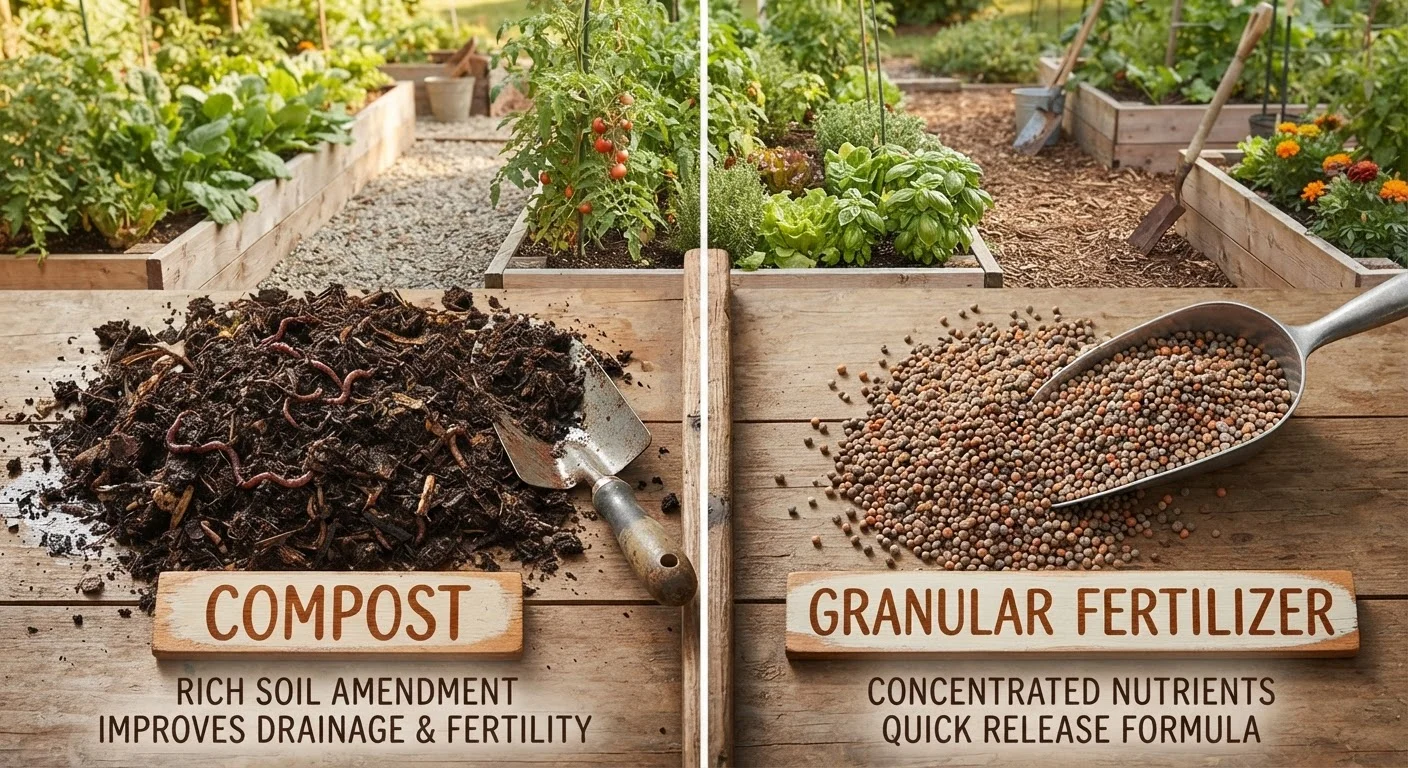
Compost is decomposed organic matter: food scraps, leaves, grass clippings, and similar materials broken down by microorganisms into a dark, crumbly substance. It improves the physical and biological conditions of your soil rather than simply adding nutrients to it.
Fertilizer - whether synthetic or organic - is a concentrated source of specific plant nutrients, most commonly nitrogen (N), phosphorus (P), and potassium (K). These are expressed as an N-P-K ratio on product labels. Fertilizer bypasses soil biology and delivers nutrients more directly to plant roots.
Think of compost as improving the kitchen, while fertilizer stocking the pantry. A better kitchen makes everything work more efficiently long-term - but if the pantry is bare, the kitchen alone won't feed anyone.
How Each One Affects Your Soil
Compost's most important contribution isn't nutrients - it's soil structure. When worked into clay soil, compost separates tightly packed particles and improves drainage. In sandy soil, it binds particles and helps retain moisture. It also feeds earthworms and beneficial microbes that play a critical role in breaking down organic matter into plant-available nutrients naturally. Healthy soil biology means your soil becomes more self-sustaining over time.
Fertilizer doesn't improve soil structure at all. Synthetic fertilizers in particular are salts, and over-application can actually suppress the microbial activity that healthy soil depends on. Organic fertilizers - derived from sources like blood meal, bone meal, or kelp - are gentler on soil biology but still don't replicate the structural improvements compost provides.
For gardeners interested in how nutrients become available to plants in the first place, it's worth understanding how soil pH affects nutrient availability - even the best fertilizer won't help if your pH is working against you.
| Criterion | Compost | Fertilizer |
|---|---|---|
| Primary purpose | Improve soil structure and biology | Deliver specific plant nutrients |
| Speed of effect | Slow, season-scale improvement | Fast, often within days to weeks |
| Nutrient content | Low, broad-spectrum, slow-release | High, targeted N-P-K ratios |
| Soil structure impact | Significant improvement over time | None |
| Risk of over-application | Very low in normal quantities | Moderate to high (nutrient burn, runoff) |
| Supports soil biology | Yes - feeds beneficial microbes | Synthetic: can suppress; organic: minimal |
| Best use case | Long-term soil health and new beds | Correcting deficiencies, heavy feeders |
When to Use Each - and When to Use Both
The most practical answer for most home gardeners is: use both, strategically. Compost is best applied as a regular soil amendment - worked into beds each spring or fall, or used as a top dressing around established plants. It won't cause nutrient burn and is nearly impossible to over-apply in reasonable quantities.
Fertilizer is most useful when you've identified a specific deficiency - ideally through a soil test - or when you're supporting heavy-feeding plants during active growth periods. A soil test takes the guesswork out of both decisions and prevents you from adding nutrients your soil doesn't need.
~1-2%
Typical nitrogen content of finished compost
The USDA notes compost typically contains far lower nutrient concentrations than fertilizer, making it a slow-release amendment rather than a quick-fix nutrient source.
30-50%
Potential reduction in fertilizer needs
Research from cooperative extension programs suggests that consistent compost use over several years can significantly reduce - though not always eliminate - supplemental fertilizer requirements.
If you're building a new garden bed, start with compost to establish good soil structure, then supplement with fertilizer only if testing indicates a deficiency. For established beds that have received compost regularly over several years, you may find fertilizer needs decrease significantly as soil biology improves. The core practices behind thriving lawns follow the same logic - good soil first, targeted inputs second.
Mulching on top of beds complements both strategies by reducing moisture loss and moderating soil temperature. A season-by-season mulching approach works hand-in-hand with regular compost additions to keep beds productive with less effort over time.