

Key Takeaways
Highway On-Ramp Merging
Highway on-ramp merging is the process of accelerating from a surface road onto a high-speed freeway and joining the flow of traffic already traveling at highway speeds. The on-ramp is the short, curved lane that connects local roads to the main highway. Successfully merging means reaching an appropriate speed, identifying a safe gap in traffic, and smoothly entering the travel lane without forcing other drivers to brake suddenly.
Traffic engineers design on-ramps with a specific acceleration lane length based on target merge speeds; when that length is insufficient - due to design constraints or heavy traffic - the risk of conflict increases significantly.
Why On-Ramp Merging Demands More Than Basic Driving
For experienced drivers, merging onto a highway can feel routine. But from a skill standpoint, it's one of the most cognitively demanding moments in everyday driving. In a matter of seconds, you must accelerate to match traffic, scan mirrors, check a blind spot, signal, judge a gap, and steer - all simultaneously, at speeds that leave little room for hesitation.
That complexity is why on-ramp merging is a common point of difficulty for newer drivers and a frequent source of near-misses even for those with years behind the wheel. Understanding exactly what's happening - and why each step matters - is the foundation for doing it well. See our guide for new drivers for a broader look at the situational skills that take time to develop.
Start Scanning Before You Hit the Ramp
Begin assessing highway traffic while you're still on the curved entrance portion of the on-ramp - not when you reach the acceleration lane. Early scanning gives you more time to select your target gap and adjust your acceleration accordingly. Waiting until the last stretch of the ramp to look for a gap puts you behind the decision curve.
The Anatomy of an On-Ramp: What the Road Is Designed to Do
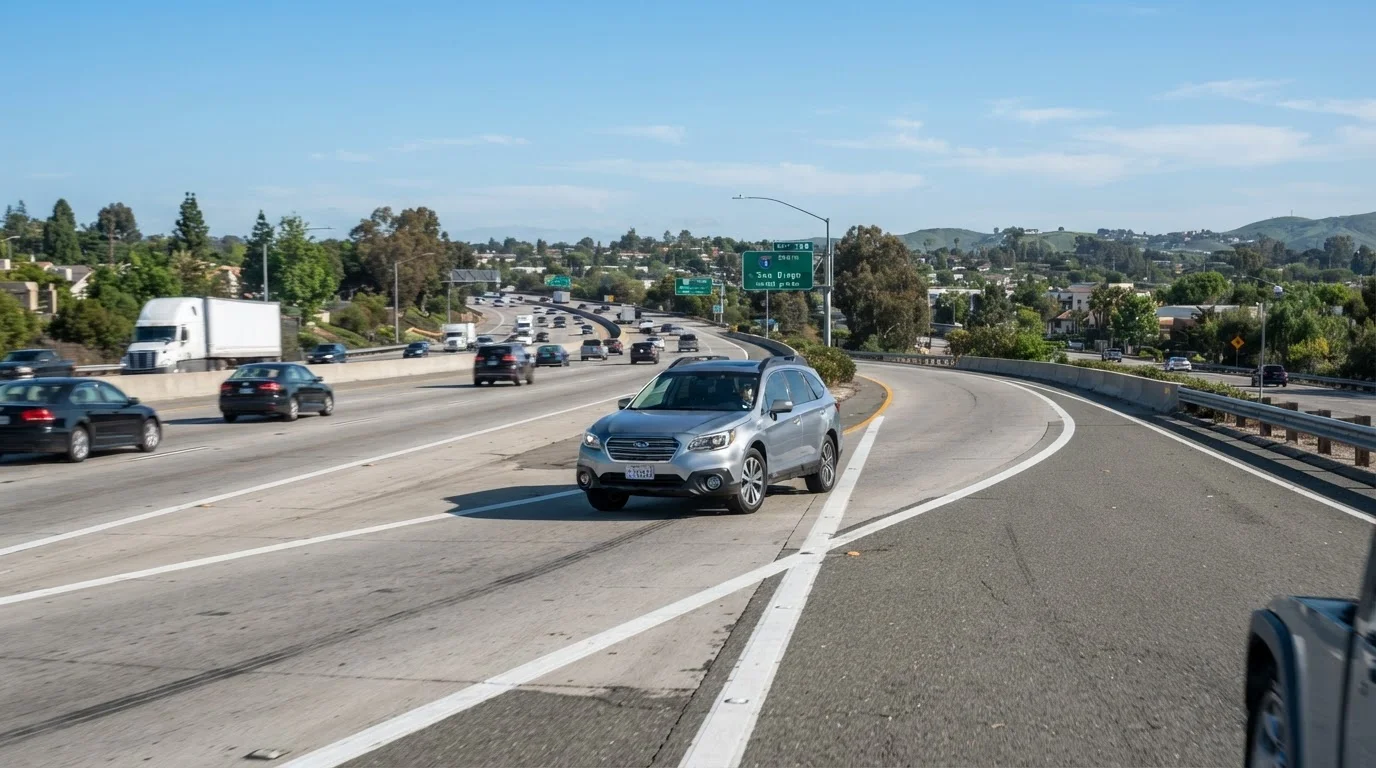
Every highway on-ramp has two main sections: the entrance ramp, which is the curved road that transitions you from the surface street, and the acceleration lane, which is the straight, parallel lane where you build speed before merging into the main travel lanes.
The acceleration lane is not a suggestion - it's an engineering accommodation designed specifically to give you space and time to reach highway speed safely. Many drivers make the mistake of treating it as a waiting area, slowing or hesitating at the point where it begins to narrow. The correct approach is the opposite: use the full length of the acceleration lane to reach a speed that matches the flow of traffic.
On some older or constrained interchanges, the acceleration lane may be shorter than ideal. This is more common on urban freeways where space is limited. When you encounter a short ramp, you need to begin identifying your target gap in traffic earlier - ideally while still on the curved entrance portion. The differences between urban and rural driving environments affect on-ramp design and merging difficulty in ways many drivers don't anticipate.
Speed, Gaps, and the Merging Decision
The central challenge of merging is creating a match between your speed and the speed of highway traffic, while simultaneously selecting an appropriate gap. A gap is the space between two vehicles already traveling on the highway. Not every gap is large enough to merge into safely.
A useful mental model: the gap needs to be large enough that you can enter without requiring any driver already on the highway to brake or swerve. At 65 mph, vehicles are covering about 95 feet per second. That context matters when estimating whether a gap is genuinely sufficient or just looks adequate.
~70%
Of merge conflicts involve speed differential
Traffic safety research consistently identifies speed mismatch between merging and highway vehicles as a primary factor in on-ramp conflicts and collisions.
95 ft/sec
Distance covered per second at 65 mph
At a typical U.S. highway speed of 65 mph, vehicles travel approximately 95 feet every second, underscoring how quickly gap sizes change during merging.
3-4 seconds
Minimum safe following gap recommended
A gap of at least three to four seconds of following distance is a widely cited baseline for safe merging in normal conditions, per traffic safety guidance.
Speed matching is equally important. Entering the highway significantly below traffic speed forces vehicles behind you to react with hard braking - a chain-reaction risk. Entering too fast can push you into a gap that closes faster than expected. The goal is to arrive at the merge point at approximately the same speed as surrounding traffic, already committed to a specific gap.
Be careful not to assume other drivers will move over or slow down for you. As covered in our article on how assumptions cause crashes, predicting what other drivers will do is not the same as safe anticipation.
The Role of Signals, Mirrors, and Blind Spots
Signaling before you merge serves two purposes: it's legally required in most states, and it communicates your intent to drivers who may be adjusting their own position in response to your entry. Activate your turn signal as you enter the acceleration lane - not at the last second before you cross the line.
Mirror checks and blind-spot glances work together. Your side mirrors eliminate much of the guesswork about what's in the adjacent lane, but they don't capture everything. The blind spot - the zone just behind and to the side of your vehicle that mirrors don't reach - must be checked with a quick shoulder glance. This should be a brief, practiced motion; taking your eyes off the road ahead for more than a moment at highway speeds is itself a hazard.
Proper sequencing: signal, check mirrors, glance at blind spot, confirm your gap is still clear, and then complete the lane change with a smooth steering input. Rushing any step, or skipping the blind-spot check, is one of the most common causes of merge-related collisions. For context on how crashes happen across different road environments, our breakdown of intersection crash factors highlights how driver behavior - not just road design - drives risk.
Conditions That Change the Merging Calculus
Standard merging technique assumes reasonably clear visibility and moderate traffic. Several conditions shift the difficulty significantly:
- Heavy traffic: Gaps shrink and driver behavior becomes less predictable. Patience is essential - wait for a gap rather than forcing one.
- Poor weather: Wet or icy roads extend stopping distances for every vehicle involved, meaning gaps that feel adequate in dry conditions may not be.
- Night driving: Reduced visibility makes it harder to judge vehicle speed and gap size accurately. Extra caution is warranted.
- Large vehicles: Trucks and buses take longer to slow down and have larger blind spots. Avoid merging directly in front of a large vehicle unless the gap is substantial.
- Construction zones: Lane configurations and speed limits may change abruptly near or on the ramp itself.
In all these situations, the principles remain the same - speed matching, gap selection, signaling, mirror and blind-spot checks - but each step requires more margin for error. Our complete driver's education resource addresses how to adapt safe driving habits across a wide range of road conditions.
This article is for general educational purposes and does not constitute legal or professional driving instruction. Always follow the traffic laws applicable in your state and consult a licensed driving instructor for personalized guidance.