

Key Takeaways
What Companion Planting Actually Means
Companion planting is the practice of deliberately growing certain plants near each other to produce mutual benefits - whether that's improved pest control, better pollination, more efficient use of space, or enriched soil. The idea is ancient, and the enthusiasm around it in gardening culture is real. But the word "companion" covers a wide range of claims, and not all of them hold up equally under scrutiny.
At its most basic, companion planting draws on observable ecology: plants interact with each other chemically, structurally, and through the organisms they attract or repel. Some of these interactions are well-studied. Others have been passed down through gardening tradition with little verification. Understanding the difference helps you invest your garden space wisely.
It's also worth noting that garden conditions vary enormously - soil type, climate zone, local pest pressure, and even planting density all affect whether any pairing performs as described. What works reliably in one region or study may not translate directly to your backyard. For a broader look at claims that don't always hold up, see our article on common garden myths.
Pairings With Credible Research Behind Them
A smaller set of companion planting combinations has been studied in controlled or replicated field conditions. Here are the most evidence-supported ones:
The Three Sisters: Corn, Beans, and Squash
This Indigenous American polyculture system is among the most thoroughly documented in agricultural research. Corn provides vertical structure for beans to climb. Beans fix atmospheric nitrogen into the soil through a symbiotic relationship with Rhizobium bacteria, which benefits subsequent crops. Squash spreads along the ground, shading out weeds and retaining soil moisture. Studies published in peer-reviewed agronomy journals have found measurable yield advantages when these three are grown together versus in monoculture, particularly in low-input systems.
Marigolds and Root Nematodes
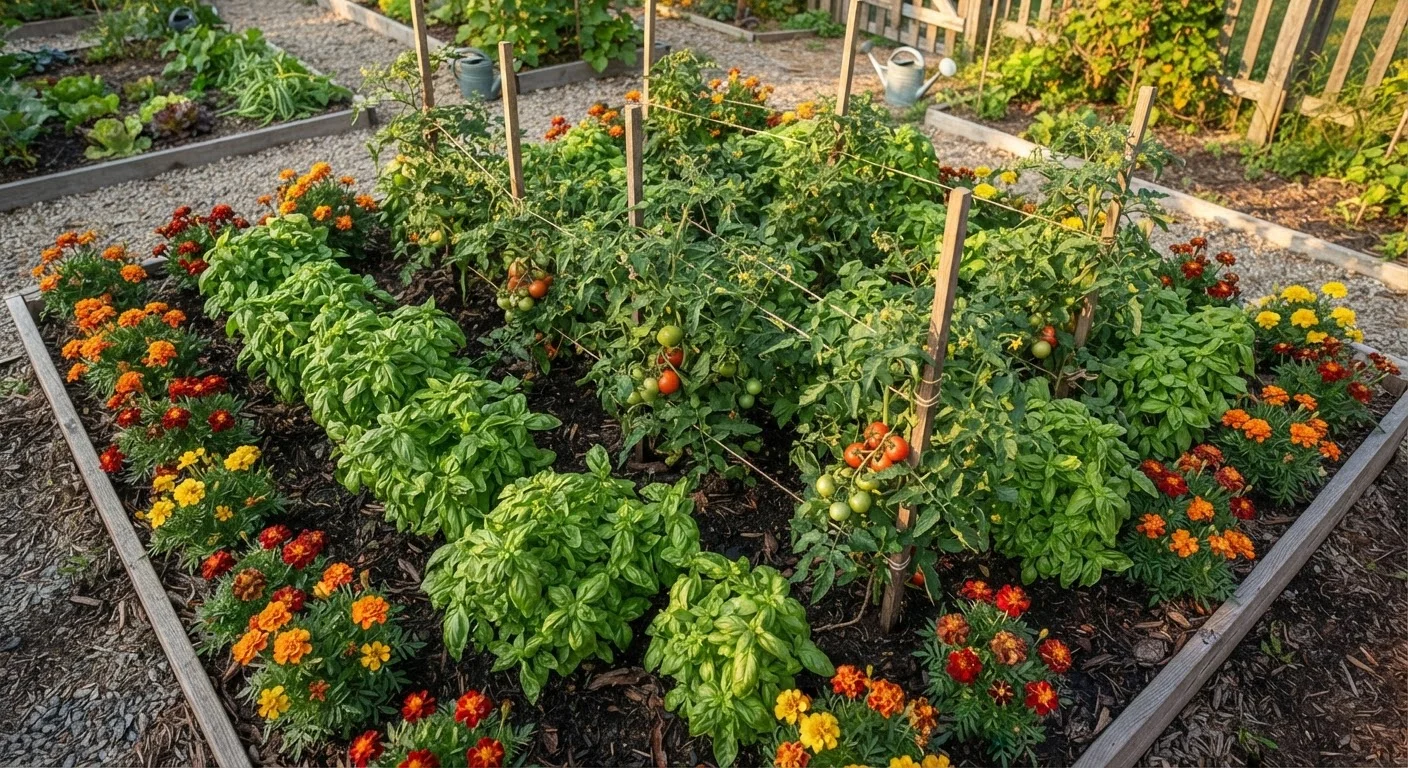
French marigolds (Tagetes patula) produce thiophene compounds in their roots that are toxic to several species of root-knot nematodes - microscopic soil pests that damage vegetable crops. Research has confirmed this effect, though the results depend on species selection, density, and whether marigolds are grown as a cover crop (grown for a full season, then tilled in) rather than just interplanted casually. A few scattered marigolds around tomatoes may do less than a dedicated rotation block.
Legumes as Nitrogen Fixers
Planting legumes - beans, peas, clover - near heavy nitrogen feeders like brassicas or corn is supported by well-established soil science. Legumes don't just add nitrogen while growing; the real benefit comes when their roots and organic matter decompose. This is the principle behind cover cropping, which has strong agronomic backing. See our guide on compost versus fertilizer for how nitrogen inputs fit into a broader soil strategy.
When using marigolds for nematode suppression, plant them densely as a full-season cover crop in the affected bed, then till them in before planting vegetables the following year. Scattered border plants rarely produce enough root exudate to make a difference.
Research on marigold nematode suppression consistently shows that density and incorporation - not casual interplanting - are what drive measurable results in the soil.
Track your companion planting experiments with a simple garden journal: note the pairing, planting date, spacing, and any pest or yield observations at season's end. Two seasons of your own data is more relevant to your garden than most generalized charts.
Garden conditions - soil type, microclimate, local pest species - vary enough that individual observation over time outperforms blanket recommendations drawn from different regions or controlled settings.
Popular Pairings That Are Mostly Folklore
Several companion planting recommendations appear everywhere in gardening books and blogs, yet have thin or contradictory evidence behind them.
Tomatoes and Basil
This is probably the most repeated pairing in home gardening. The claim is that basil improves tomato flavor and repels pests. Controlled studies have not consistently confirmed either effect. Basil does attract some beneficial pollinators, but so do many other flowering plants. The two grow well together in terms of space and timing, but there's no strong evidence that basil meaningfully protects tomatoes or enhances their taste.
Carrots and Onions
The lore here is that carrot fly is confused by onion scent, and vice versa. Some studies have found minor effects, but results are inconsistent across settings. Physical barriers and row covers are far more reliable at controlling carrot fly than intercropping.
Roses and Garlic
Garlic planted near roses is said to deter aphids. The mechanism - that garlic's sulfur compounds repel insects - is plausible, but field evidence supporting a practical benefit in home gardens is limited. Strong aphid pressure typically requires more targeted intervention.
How to Apply Companion Planting Practically
Given the mixed evidence, the most sensible approach treats companion planting as one useful tool among many - not a substitute for sound soil management, adequate water, or pest monitoring.
- Start with supported pairings. Build around combinations with documented benefits: Three Sisters for vegetable gardens, marigolds as a rotation crop for nematode-prone beds, legumes as soil-builders before heavy feeders.
- Treat unverified pairings as low-risk experiments. There's usually no harm in planting basil near tomatoes - just don't rely on it as pest control. Observe and note what you see each season.
- Account for spacing. Many companion planting arrangements fail in home gardens because plants are placed too close and compete for light, water, and nutrients instead of helping each other.
- Consider bloom timing. If you're interplanting to attract beneficial insects, choose plants that flower when your vegetables are most vulnerable to pests. Continuous bloom diversity is more effective than a single companion.
Maintaining healthy soil through mulching is foundational to making any planting strategy work. Our season-by-season mulching guide explains how to keep beds in good condition year-round.
Building a Garden System That Works
Companion planting is most effective when it's embedded in a thoughtful overall approach rather than applied as a collection of isolated pairings. Think in terms of plant communities and garden layers - what's fixing nitrogen, what's attracting pollinators, what's covering bare soil - rather than searching for a magic pair.
Native flowering plants, for instance, often outperform exotic companions at attracting the beneficial insects that naturally keep pest populations in check. Our article on native plants and landscaping explores why regionally adapted plants tend to be more effective supports for garden health overall.
Document what you plant, where, and what you observe. Over two or three seasons, your own garden data becomes one of the most reliable guides you have - more relevant to your conditions than any generalized pairing chart. Companion planting, practiced with appropriate skepticism and careful observation, can genuinely improve a garden. It just works best when the gardener knows which claims are grounded and which ones to test rather than take on faith.